
German cuisine is known for its hearty, comforting, and flavorful dishes.
These 31 authentic German recipes take you on a culinary journey through Germany, offering traditional dishes that showcase the rich history and regional diversity of its food.
Start with iconic mains like wiener schnitzel, a crispy breaded veal or pork cutlet, sauerbraten, and a marinated pot roast served with tangy gravy.
Pair these with classic sides such as spaetzle, German egg noodles, or rotkohl, a sweet and sour red cabbage.
German baking traditions shine in desserts like apfelstrudel, a flaky apple pastry, or schwarzwälder kirschtorte (Black Forest cake), a decadent chocolate and cherry masterpiece.
Wash it all down with glühwein, spiced mulled wine, or a refreshing German lager.
Whether you're craving hearty stews, savory sausages, or indulgent desserts, these authentic German recipes bring the comforting flavors of Germany into your home.
Authentic German Recipes for Traditional Flavors

31. Sauerbraten — German Marinated Pot Roast

Germany's most celebrated national dish — a magnificent beef pot roast marinated for several days in a tangy mixture of red wine vinegar, red wine, onions, and pickling spices, then slow-braised until fall-apart tender and served with a deeply rich, slightly sweet-and-sour gravy made from the marinade and gingersnap cookies. One of the great pot roasts of world cuisine and a perfect Sunday dinner centrepiece.
Ingredients:
- 3–4 lb beef chuck roast or bottom round
- Marinade: 1 cup red wine vinegar, 1 cup dry red wine, 1 cup water, 1 large onion (sliced), 2 bay leaves, 8 whole cloves, 8 black peppercorns, 1 tablespoon sugar, 1 teaspoon salt
- 3 tablespoons vegetable oil
- 1 large onion, diced
- 2 carrots, diced
- 2 stalks celery, diced
- 8 gingersnap cookies, crushed (the traditional thickener for the gravy)
- 2 tablespoons sugar
- Salt and pepper, to taste
Instructions:
- Combine all marinade ingredients and bring to a boil. Cool completely. Submerge the beef in the marinade in a large zip-lock bag or non-reactive container. Refrigerate for 3–5 days, turning daily. The longer it marinates, the more distinctive the sauerbraten flavour.
- Remove the beef and pat very dry. Reserve the marinade and strain it. Heat the oil in a large Dutch oven over high heat. Brown the beef deeply on all sides — about 10 minutes total. Remove and set aside.
- Sauté the onion, carrots, and celery in the same pot for 5 minutes. Return the beef. Pour the strained marinade over. Bring to a boil, reduce to a very gentle simmer, cover, and braise for 2.5–3 hours until completely tender.
- Remove the beef and rest. Strain the braising liquid into a saucepan. Add the crushed gingersnaps and sugar — simmer, stirring, until the cookies dissolve and the gravy is thick, glossy, and perfectly balanced between sweet and sour. Slice the beef and serve with the gravy, red cabbage, and spaetzle or potato dumplings.
30. Grilled Bratwurst

Germany's most iconic sausage, grilled to perfection — bratwurst are pork and veal sausages seasoned with nutmeg, ginger, and herbs, grilled over high heat until the casings are blistered and the interior is juicy, served in crusty rolls with spicy German mustard and sauerkraut. Simple, completely satisfying, and a centrepiece of German barbecue culture. A perfect addition to our easy healthy grilling recipes.
Ingredients:
- 6 fresh bratwurst sausages
- 1 (12 oz) bottle German lager beer (for the beer bath)
- 1 large onion, sliced
- 2 tablespoons butter
- 6 crusty hoagie rolls or brat buns
- Spicy German or brown mustard, for serving
- Sauerkraut, for serving
Instructions:
- Make the beer bath: combine the beer, sliced onion, and butter in a saucepan over medium heat. Bring to a simmer. Add the bratwurst and simmer gently for 10 minutes — this pre-cooks the sausages and infuses them with flavour without the risk of the casings bursting on the grill.
- Remove the brats from the beer bath. Grill over medium-high direct heat for 3–4 minutes per side until deeply browned with visible grill marks and the casings are slightly blistered.
- Return the sausages to the warm beer and onion bath to rest and stay warm until serving — this also keeps them juicy.
- Toast the buns on the grill for 1 minute. Place the brats in the buns. Top with beer-braised onions, a generous squeeze of mustard, and a spoonful of sauerkraut. Serve immediately.
29. Easy Pork Schnitzel
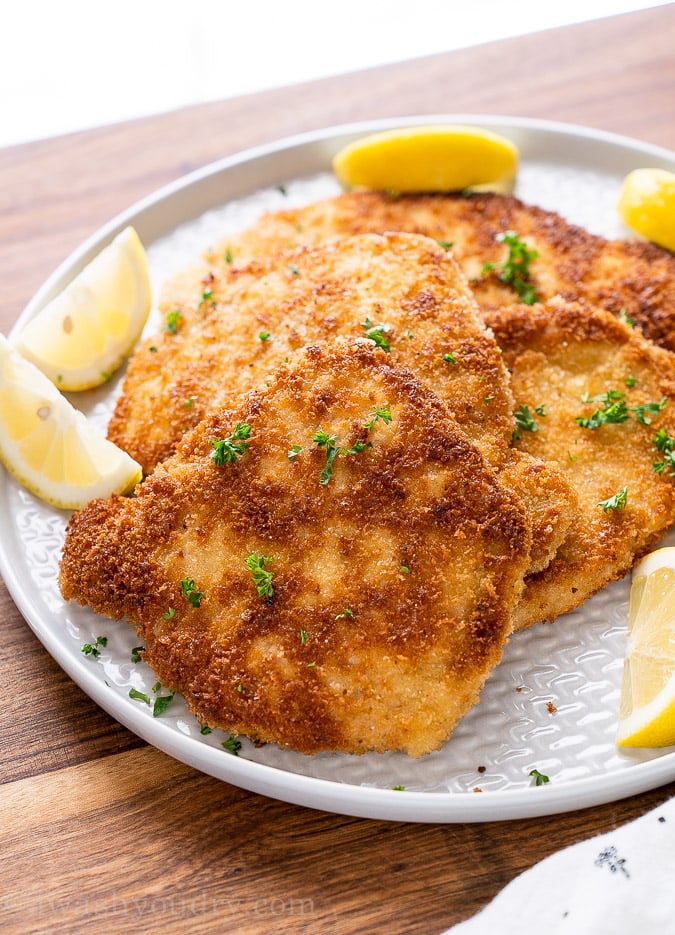
The quintessential German comfort food — thin pork cutlets pounded to uniform thickness, dredged in seasoned flour, egg, and fine breadcrumbs, then fried in butter and oil until golden, airy, and shattering-crispy on the outside and perfectly juicy inside. Served with a squeeze of lemon, a simple salad, and German potato salad or spaetzle. One of the greatest pan-fried dishes in the world. Perfect alongside our easy dinner ideas.
Ingredients:
- 4 boneless pork loin chops (about 6 oz each)
- ½ cup all-purpose flour, seasoned with salt and pepper
- 2 large eggs, beaten with 2 tablespoons water
- 1½ cups fine breadcrumbs (panko blended finer works well)
- Salt and pepper, to taste
- 3 tablespoons butter
- 3 tablespoons neutral oil
- Lemon wedges, for serving
Instructions:
- Place each pork chop between two sheets of plastic wrap. Pound with a meat mallet to a uniform ¼-inch thickness — this is the most important step. Even thickness ensures even cooking and the classic schnitzel shape.
- Season the pounded cutlets on both sides with salt and pepper. Set up a breading station: flour, beaten egg, and breadcrumbs. Dip each cutlet in flour (shake off excess), then egg, then breadcrumbs — press the breadcrumbs firmly. Do not press too hard — you want a loose crumb that puffs when fried.
- Heat the butter and oil in a large skillet over medium-high heat until the butter is foaming but not browning. The fat should be about ¼ inch deep — enough to shallow-fry.
- Fry the schnitzel for 2–3 minutes per side until deeply golden and crispy. The fat should sizzle actively — too low a temperature creates a greasy, soggy crust. Drain on a wire rack immediately. Serve with lemon wedges, lingonberry jam, and a simple salad or potato salad.
28. Sauerbraten — German Pot Roast (Domestic Man Version)
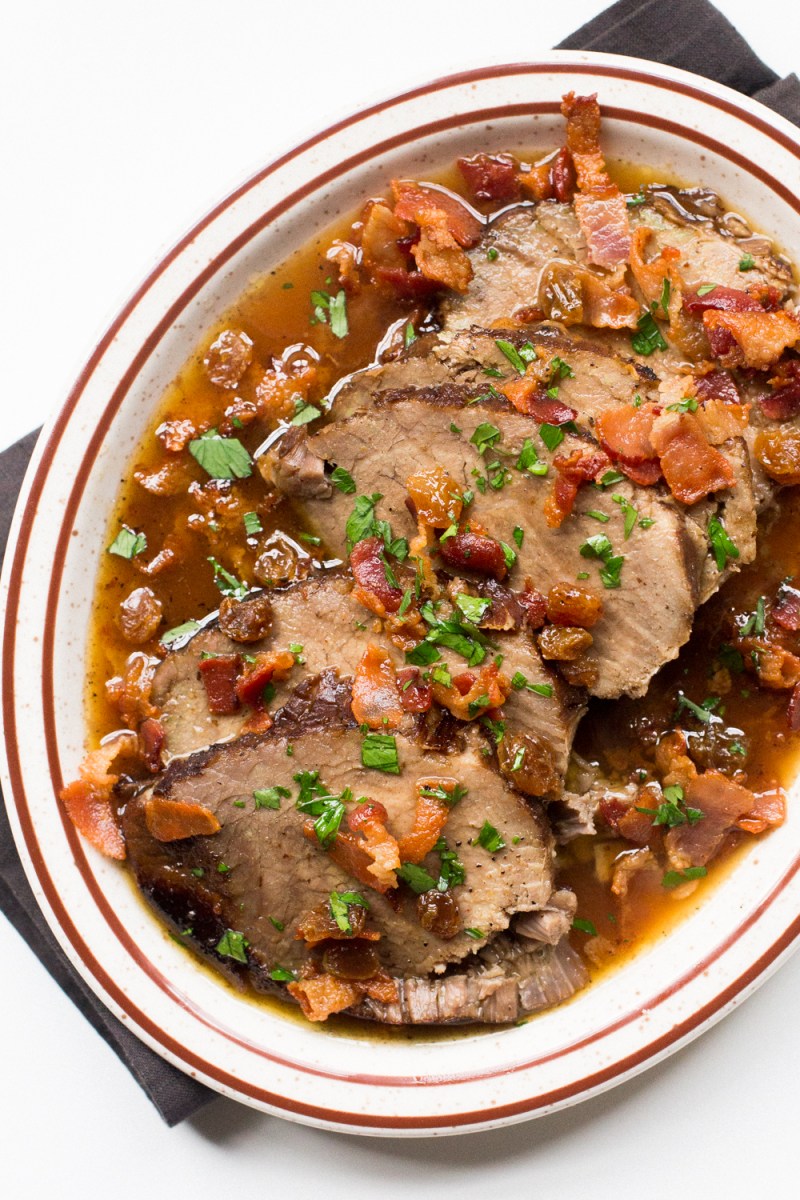
A beautifully flavourful, deeply traditional version of Germany's most iconic pot roast — beef marinated in vinegar, wine, and spices over several days, then slow-braised with vegetables until completely tender, with a rich gingersnap-thickened gravy that perfectly balances tangy, sweet, and savoury notes. Serve with red cabbage and spaetzle for a complete German feast. See our beef stew recipe for more slow-braised beef inspiration.
Ingredients:
- 3 lbs beef bottom round or chuck roast
- Marinade: 1 cup apple cider vinegar, 1 cup dry red wine, 1 cup beef broth, 1 large onion (sliced), 2 carrots (sliced), 2 bay leaves, 6 juniper berries (crushed), 8 black peppercorns, 4 whole cloves, 1 tablespoon brown sugar
- 2 tablespoons vegetable oil
- 8 gingersnap cookies, finely crushed
- 2 tablespoons red currant jelly or raisins
- Salt, to taste
Instructions:
- Combine all marinade ingredients, bring to a simmer, cool completely. Submerge the beef in the marinade and refrigerate for 3–5 days, turning daily. The longer the marinade, the more pronounced the sauerbraten flavour.
- Remove the beef and pat dry. Strain and reserve the marinade. Brown the beef deeply in oil in a Dutch oven over high heat. Sauté the strained vegetables from the marinade for 5 minutes. Return the beef. Pour the strained marinade over.
- Bring to a boil, then reduce to the lowest possible simmer. Cover and braise for 2.5–3 hours until completely tender. Remove the beef and tent with foil.
- Strain the braising liquid. Simmer in a saucepan with the crushed gingersnaps and red currant jelly until thick and glossy — about 10 minutes. Adjust seasoning. Slice the beef and ladle the gravy over generously.
27. Schweinshaxe — Crispy German Pork Knuckle
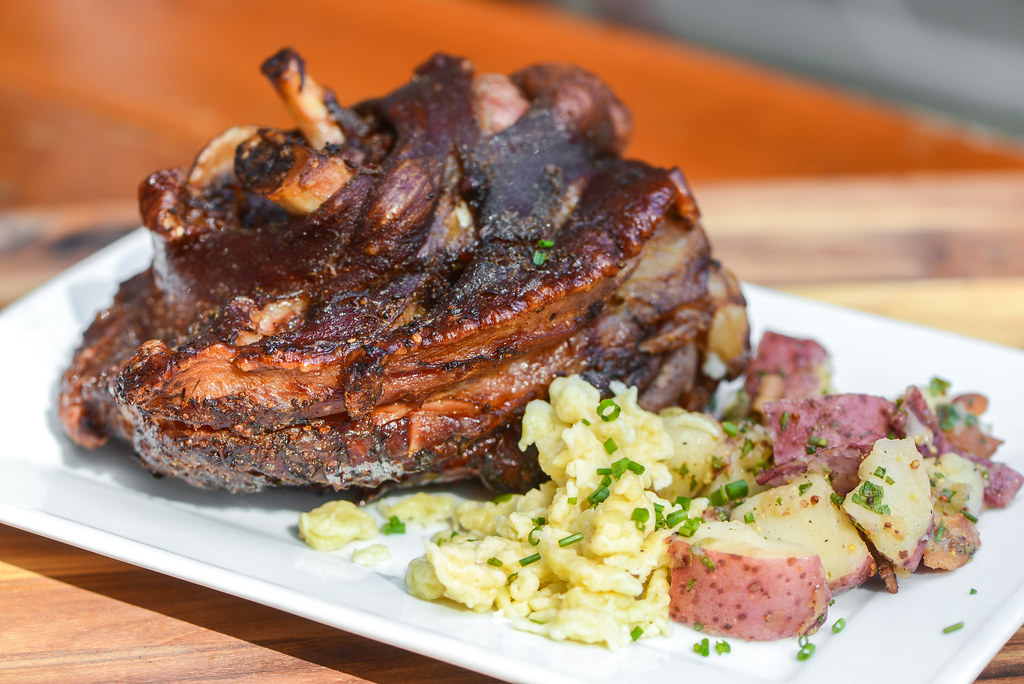
Bavaria's most dramatic and indulgent dish — a whole pork knuckle (hock) slow-roasted until the collagen melts into impossibly tender, juicy meat, then finished at high heat until the skin transforms into shatteringly crispy, golden crackling. A centrepiece dish at every Oktoberfest and Bavarian beer garden, served with sauerkraut, potato dumplings, and dark beer. For more impressive pork dishes see our best pork recipes.
Ingredients:
- 2 large pork knuckles (hocks), scored through the skin in a crosshatch pattern
- 1 large onion, quartered
- 2 carrots, roughly chopped
- 4 cloves garlic, smashed
- 2 cups dark German beer (or any dark lager)
- 1 cup beef or chicken broth
- 1 teaspoon caraway seeds
- 1 teaspoon salt and pepper
- 2 bay leaves
Instructions:
- Score the pork knuckle skin deeply in a crosshatch pattern — cut through the skin and into the fat but not into the meat. Rub all over with salt, pepper, and caraway seeds. Let rest uncovered in the fridge overnight — this dries the skin for better crackling.
- Preheat oven to 325°F. Place the onion, carrots, garlic, and bay leaves in a roasting pan. Sit the knuckles on top. Pour beer and broth around the base. Roast for 2.5–3 hours until the meat is completely tender and beginning to pull away from the bone.
- Increase oven temperature to 450°F. Roast for 20–30 more minutes until the skin is deeply golden, blistered, and crackling-crispy. Watch carefully — it can go from perfect to burnt quickly.
- Rest 10 minutes before serving. Strain and reduce the pan drippings into a simple gravy. Serve with sauerkraut, potato dumplings, and cold dark beer.
26. German Potato Salad — Rheinischer Kartoffelsalat

The Rhineland version of German potato salad — served warm with a tangy, bacon-enriched vinegar and mustard dressing rather than the mayonnaise-based version familiar in the US. Waxy potatoes sliced while still hot and tossed with bacon, onion, a hot vinegar-mustard-broth dressing, and fresh herbs create a light, flavourful salad that is both comforting and refreshing. A wonderful companion to our classic potato salad.
Ingredients:
- 2 lbs small waxy potatoes (Yukon Gold), boiled whole in salted water until just tender
- 4 oz bacon, diced
- 1 small onion, very finely diced
- 3 tablespoons white wine vinegar or apple cider vinegar
- ½ cup warm beef or chicken broth
- 1 tablespoon Dijon or German mustard
- 2 tablespoons olive oil
- Salt, pepper, and a pinch of sugar, to taste
- Fresh parsley and chives, finely chopped
Instructions:
- Boil the potatoes in their skins until just tender — do not overcook. While still hot, peel and slice into ¼-inch rounds. Place in a large bowl while warm — the potatoes absorb dressing better warm.
- Cook the bacon in a skillet until crispy. Remove and set aside. Sauté the onion in the bacon fat for 3 minutes until softened and translucent.
- Add the vinegar, warm broth, mustard, and oil to the skillet. Stir to combine and bring to a brief simmer. Season with salt, pepper, and a pinch of sugar.
- Pour the hot dressing over the warm potato slices immediately. Add the crispy bacon and fresh herbs. Toss gently to coat. The potatoes should absorb most of the dressing. Taste and adjust the balance of vinegar and salt. Serve warm — this salad is always served warm or at room temperature, never chilled.
25. Beef Rouladen — German Beef Rolls
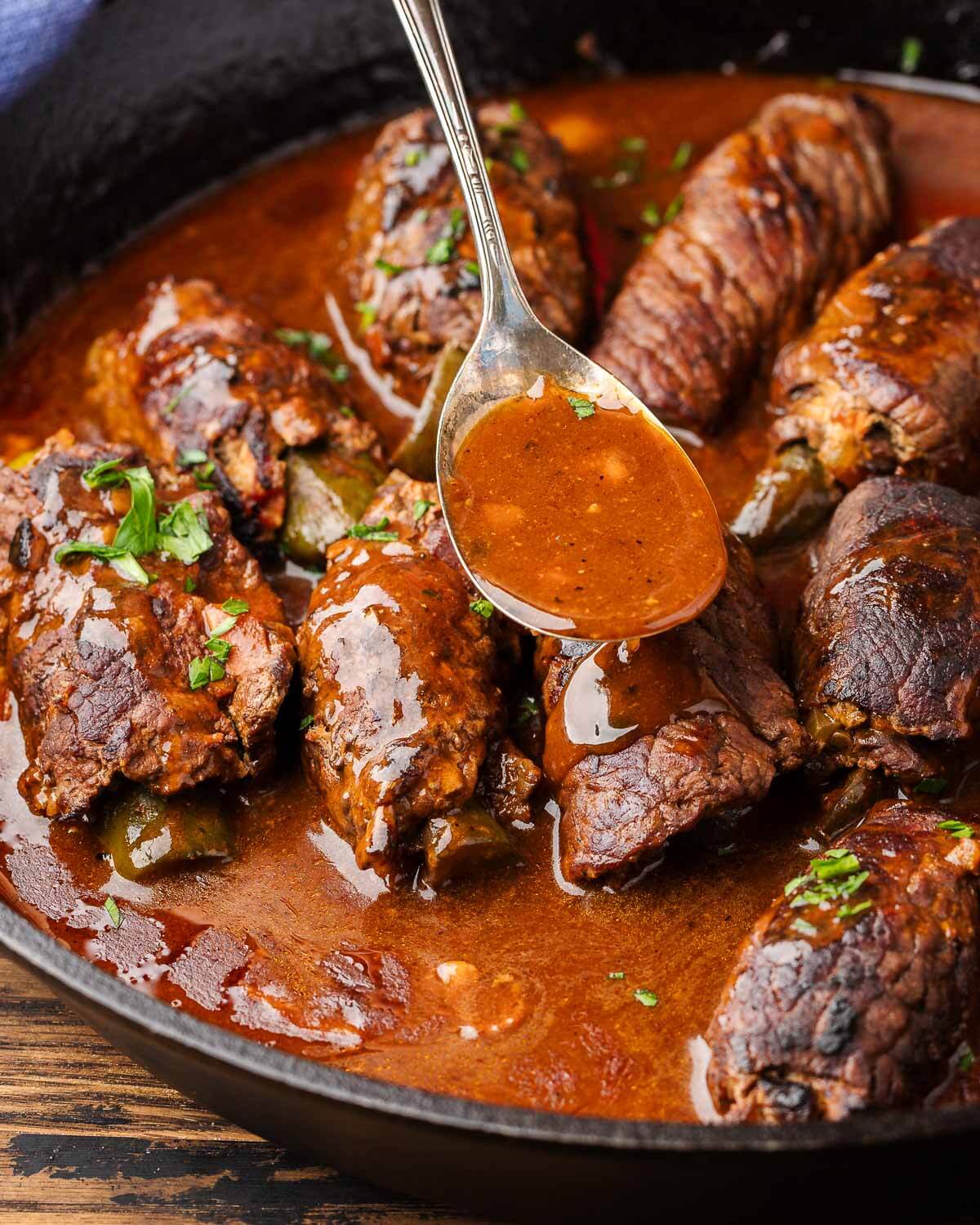
One of Germany's most beloved traditional Sunday dishes — thin slices of beef topside or round spread with spicy German mustard, layered with bacon, onion, and a pickle, then rolled tightly, secured with toothpicks or kitchen twine, and slow-braised in a rich red wine gravy until completely tender. The filling melts into the meat and the gravy is extraordinary. A perfect Sunday dinner.
Ingredients:
- 4 large thin slices beef top round or flank steak (about ¼ inch thick, pounded if needed)
- 4 tablespoons spicy German or Dijon mustard
- 4 slices bacon
- 1 large onion, half finely diced (for filling), half sliced (for braising)
- 4 dill pickles, cut into spears
- 2 tablespoons vegetable oil
- 1 cup dry red wine
- 2 cups beef broth
- 2 bay leaves
- 1 tablespoon cornstarch dissolved in 2 tablespoons cold water
- Salt and pepper, to taste
Instructions:
- Lay the beef slices flat. Season with salt and pepper. Spread a tablespoon of mustard on each slice, covering the entire surface. Lay a bacon strip on each. Scatter the finely diced onion over the bacon. Place a pickle spear along one short end.
- Roll up tightly from the pickle end, tucking in the sides as you roll. Secure firmly with two toothpicks or tie with kitchen twine.
- Heat oil in a Dutch oven over high heat. Brown the rolls deeply on all sides — about 8 minutes total. Remove and set aside. Sauté the sliced onion for 5 minutes. Add the red wine and cook 2 minutes. Add the beef broth and bay leaves. Return the rolls. Bring to a simmer.
- Cover and braise over very low heat for 1.5–2 hours until completely tender. Remove the rolls and remove toothpicks. Strain the braising liquid. Thicken with the cornstarch slurry, simmering until glossy. Serve the rouladen with the gravy over spaetzle, mashed potatoes, or potato dumplings.
24. Homemade German Spätzle
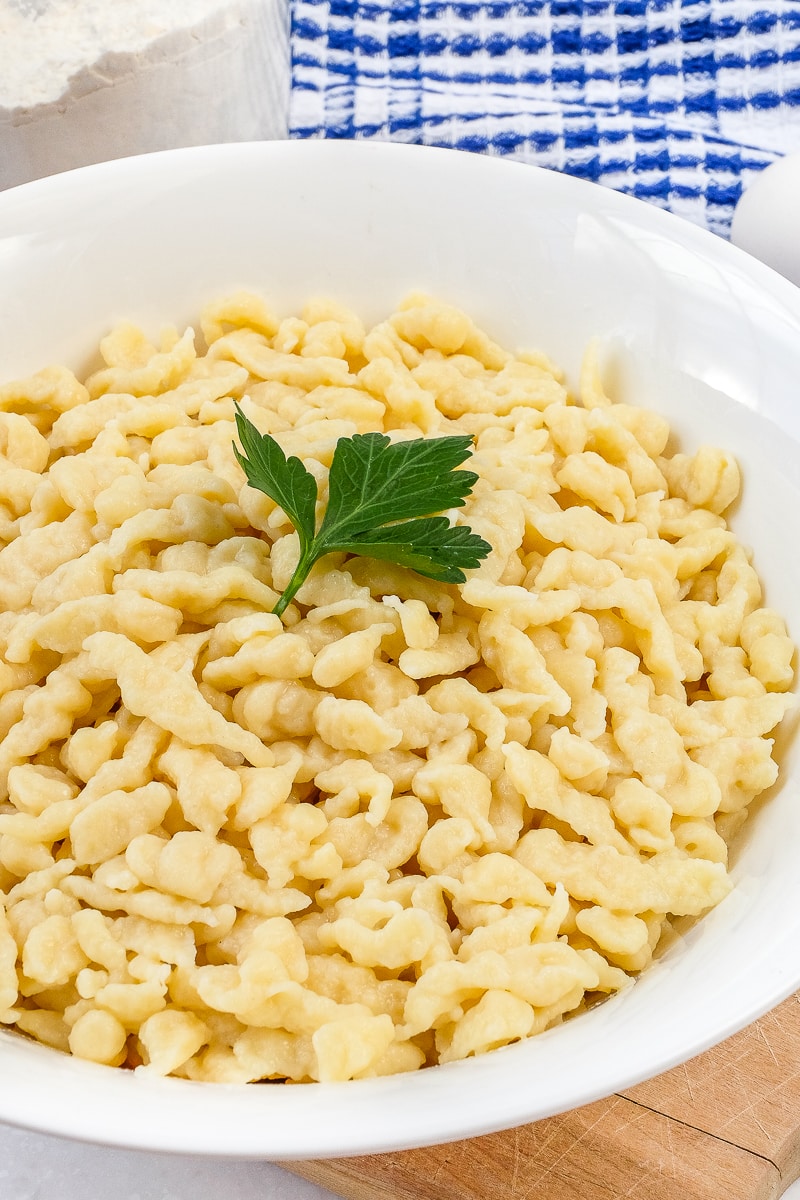
Germany's beloved egg noodle — spätzle is a soft, slightly chewy, irregularly shaped fresh pasta made by pressing a thick egg batter through a coarse sieve or spätzle maker directly into boiling salted water. Served buttered alongside sauerbraten, rouladen, or goulash, or pan-fried until golden and topped with cheese for käsespätzle. One of the most versatile and comforting German staples. See our homemade egg noodles recipe for a similar comfort.
Ingredients:
- 2 cups all-purpose flour
- 4 large eggs
- ½ cup whole milk
- ½ teaspoon salt
- ¼ teaspoon nutmeg
- 3 tablespoons butter, for finishing
- Salt, for the boiling water
Instructions:
- Combine flour, salt, and nutmeg in a large bowl. Make a well in the centre. Add the eggs and milk. Beat vigorously with a wooden spoon until a smooth, thick batter forms — it should be thicker than pancake batter and slightly elastic. Beat for 2–3 minutes until bubbles appear. Rest 10 minutes.
- Bring a large pot of salted water to a boil. Hold a spätzle maker, colander with large holes, or flat grater over the boiling water. Pour the batter in portions over the maker and press/scrape through the holes directly into the water.
- The spätzle will cook quickly — about 2–3 minutes until they float to the surface. Scoop out with a slotted spoon and transfer to a bowl. Repeat until all the batter is used.
- Melt the butter in a large skillet over medium heat until it begins to brown slightly. Add the cooked spätzle and toss to coat, letting them brown slightly in the butter for 2–3 minutes. Season with salt. Serve immediately as a side dish or proceed to make käsespätzle.
23. Königsberger Klopse — German Meatballs in Caper Sauce
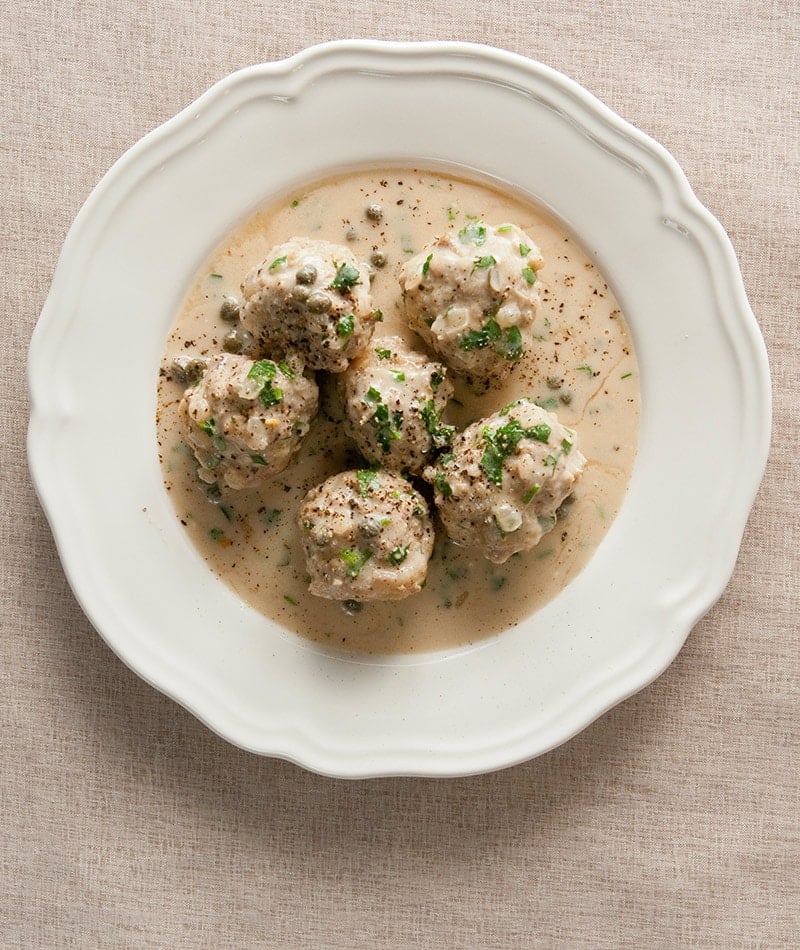
A distinctive and unusual German meatball dish from the former Prussian city of Königsberg — tender, delicately seasoned meatballs poached (not fried) in broth and served in a creamy, tangy white sauce enriched with lemon juice and brined capers. The result is completely different from any other meatball dish — elegant, savoury, and complex. Traditionally served with boiled potatoes and beets. See more ideas in our meatball collection.
Ingredients:
- 1 lb ground beef or a mix of beef and pork
- 2 slices white bread, soaked in water and squeezed dry
- 1 small onion, very finely minced
- 2 anchovy fillets, minced (optional but traditional)
- 1 large egg
- Salt, white pepper, and nutmeg, to taste
- Caper sauce: 3 tablespoons butter, 3 tablespoons flour, 2 cups cooking broth (from poaching the meatballs), 3 tablespoons capers plus 1 tablespoon caper brine, 2 tablespoons lemon juice, 2 egg yolks, ¼ cup cream
Instructions:
- Combine the ground meat, bread, onion, anchovy, egg, salt, white pepper, and nutmeg. Mix gently until combined. Form into balls about 1.5 inches in diameter — do not overwork or the meatballs will be tough.
- Bring 4 cups of lightly salted water or broth to a simmer. Gently lower the meatballs in and poach for 15–20 minutes until cooked through. Remove with a slotted spoon. Reserve 2 cups of the poaching broth.
- Make the caper sauce: melt butter in a saucepan. Whisk in flour and cook 1 minute. Gradually add the reserved poaching broth, whisking until smooth and thickened. Add the capers and caper brine. Simmer 5 minutes.
- Remove from heat. Whisk together the egg yolks and cream. Slowly add a ladleful of hot sauce to the yolk mixture to temper it, then whisk into the sauce. Add lemon juice. Season generously. Return the meatballs to the sauce and warm gently — do not boil or the sauce will curdle. Serve over boiled potatoes.
22. German Beef Goulash (Rindergulasch)

A hearty, deeply satisfying German beef goulash — beef chunks slow-braised with an enormous quantity of onions, sweet and hot paprika, tomato paste, and red wine until the beef is completely tender and the sauce is thick, rich, and intensely flavoured. The German version is less spiced than Hungarian goulash and relies primarily on the onions and paprika for its depth. Wonderful over spaetzle. See our old fashioned goulash recipe too.
Ingredients:
- 2 lbs beef chuck, cut into 1.5-inch cubes
- 3 large onions, thinly sliced (this seems like a lot — it is essential)
- 3 tablespoons sweet Hungarian paprika
- 1 teaspoon hot paprika or cayenne
- 2 tablespoons tomato paste
- 1 cup dry red wine
- 1 cup beef broth
- 2 cloves garlic, minced
- 1 teaspoon caraway seeds
- 2 tablespoons vegetable oil
- Salt and pepper, to taste
- Fresh parsley, for garnish
Instructions:
- Season the beef generously with salt and pepper. Heat oil in a large Dutch oven over high heat. Brown the beef in batches — do not crowd. Remove and set aside.
- Add the sliced onions to the same pot. Cook over medium heat, stirring frequently, for 20–25 minutes until the onions are completely softened, golden, and reduced to a third of their original volume. Add the garlic, tomato paste, and caraway seeds. Cook 3 minutes.
- Stir in both paprikas — cook 1 minute, stirring constantly. Add the red wine and cook 3 minutes. Return the beef. Add the broth. Bring to a boil, then reduce to the lowest possible simmer.
- Cover and braise for 1.5–2 hours until the beef is completely tender. The sauce should be thick and glossy from the reduced onions. If too thin, simmer uncovered for 15 more minutes. Taste and season generously. Serve over spätzle, egg noodles, or mashed potatoes with fresh parsley.
21. German Lye Pretzels (Brezeln)
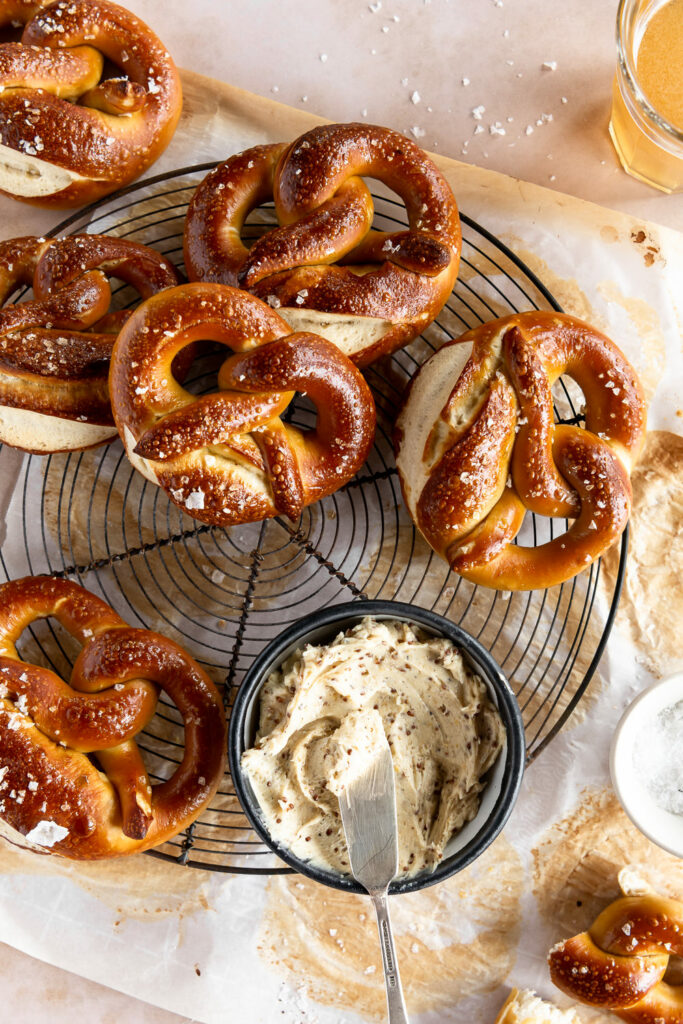
The most iconic German bread — soft, chewy, golden-brown pretzels with the characteristic deep mahogany colour and distinctive slightly bitter, salty crust achieved by dipping in a lye or baking soda solution before baking. Eaten throughout Germany with butter, mustard, or obatzda (Bavarian cheese spread). The ultimate accompaniment to cold beer. Also see our own homemade soft pretzel bites.
Ingredients:
- 3 cups all-purpose flour
- 1 teaspoon instant yeast
- 1 teaspoon salt
- 1 teaspoon sugar
- 1 cup warm water
- 2 tablespoons butter, softened
- Baking soda bath: 8 cups water + ½ cup baking soda
- Coarse sea salt or pretzel salt, for topping
Instructions:
- Combine flour, yeast, salt, and sugar. Add warm water and butter. Knead for 8–10 minutes until a smooth, elastic, non-sticky dough forms. Cover and rest for 1 hour until doubled.
- Divide the dough into 8 pieces. Roll each into a long rope about 20 inches long, thicker in the centre and thinner at the ends. Shape into a U, cross the ends over each other twice, then fold the ends down and press onto the bottom curve of the U to form the classic pretzel shape.
- Bring the baking soda bath to a boil in a large pot. Gently lower each pretzel into the bath for 30 seconds per side — this is what creates the characteristic colour and chewy crust. Remove with a slotted spoon and place on a parchment-lined baking sheet.
- Score the thick centre of each pretzel once with a sharp knife. Scatter coarse salt generously over the top. Bake at 425°F for 14–16 minutes until deeply golden brown. Serve warm with butter.
20. Krautwickel — German Cabbage Rolls

A deeply comforting German home-cooking classic — large cabbage leaves blanched until pliable, filled with a well-seasoned mixture of ground beef and pork with onion and rice, rolled tightly, and slow-braised in a savoury tomato broth with bacon and vegetables until completely tender and the filling is cooked through. Served with mashed potatoes and a generous ladle of the braising broth. A wonderful recipe alongside our stuffed cabbage rolls.
Ingredients:
- 1 large head green cabbage
- 1 lb ground beef
- ½ lb ground pork
- ½ cup cooked rice
- 1 small onion, finely grated
- 2 cloves garlic, minced
- 1 egg
- 1 teaspoon marjoram
- Salt and pepper, to taste
- Braising liquid: 1 (14 oz) can crushed tomatoes, 2 cups beef broth, 4 oz bacon (diced and fried), 1 onion (diced and sautéed), salt and pepper
Instructions:
- Core the cabbage and place whole in a large pot of boiling salted water. As the outer leaves soften and become pliable, peel them off one by one — about 12–14 leaves. Trim the thick centre rib of each leaf so they roll easily.
- Combine the ground meats, cooked rice, grated onion, garlic, egg, marjoram, salt, and pepper. Mix until just combined. Divide into 12 equal portions and shape into logs.
- Place a log of filling on each cabbage leaf. Roll up from the thick end, tucking in the sides tightly. Secure with a toothpick if needed.
- Make the braising base: combine the fried bacon, sautéed onion, crushed tomatoes, and broth in a Dutch oven. Arrange the cabbage rolls seam-side-down in a single layer. Pour the braising liquid over. Cover and braise at 325°F for 1.5 hours. Serve with the braising broth spooned over and mashed potatoes alongside.
19. Easy Apple Strudel with Puff Pastry
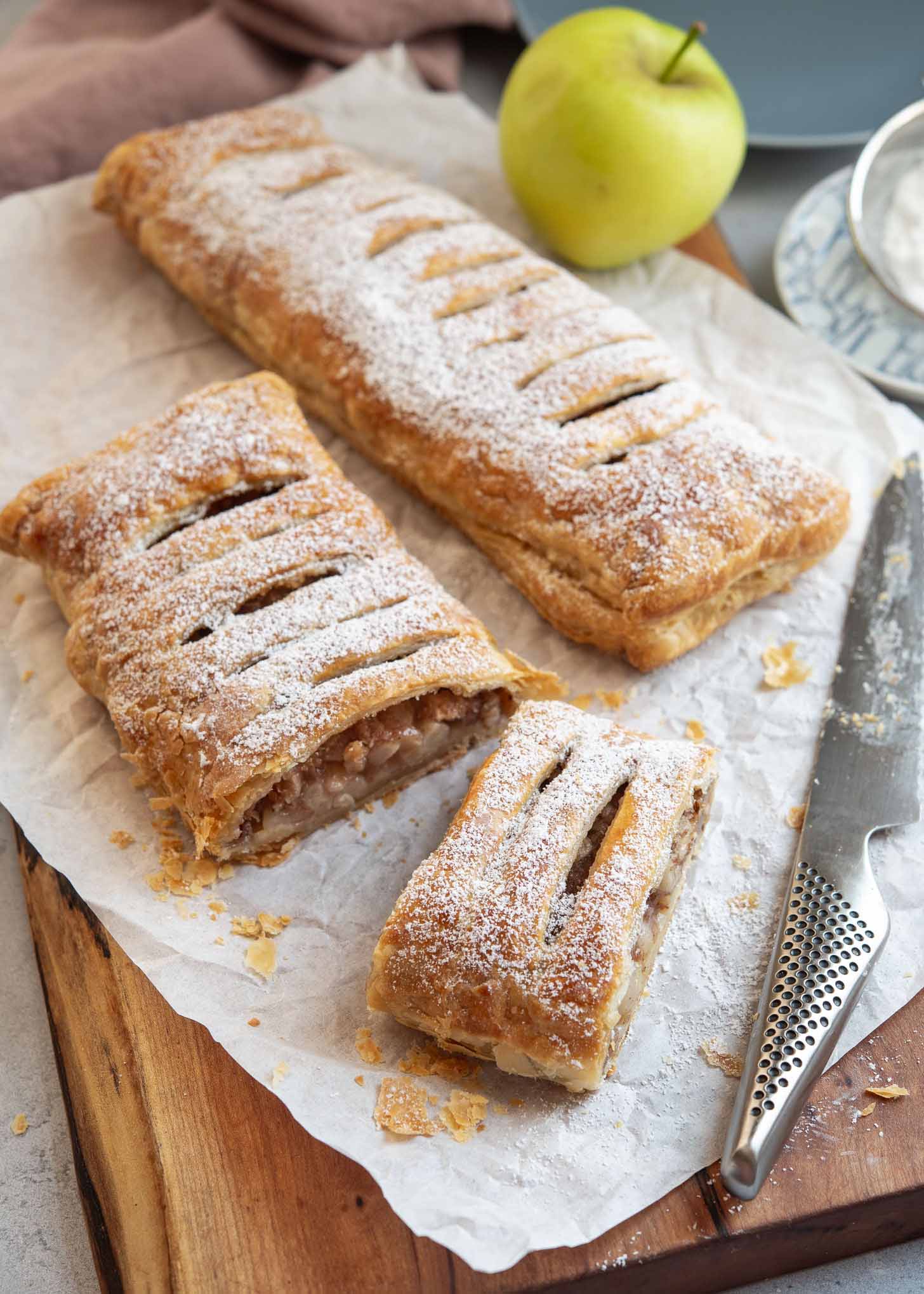
Austria and Germany's most beloved pastry dessert made accessible — spiced apples with raisins, cinnamon, brown sugar, and breadcrumbs wrapped in golden, flaky puff pastry and baked until caramelised and fragrant. Far easier than traditional hand-stretched strudel dough but just as satisfying. Served warm with vanilla sauce or whipped cream. A wonderful dessert alongside our apple dessert recipes.
Ingredients:
- 1 sheet store-bought puff pastry, thawed
- 3 large baking apples (Granny Smith or Braeburn), peeled, cored, and thinly sliced
- 3 tablespoons brown sugar
- 1 teaspoon cinnamon
- ¼ teaspoon nutmeg
- ¼ cup raisins (soaked in warm water 10 minutes and drained)
- ½ cup breadcrumbs, toasted in 2 tablespoons butter until golden
- Juice of ½ lemon
- 1 egg yolk mixed with 1 tablespoon milk, for egg wash
- Powdered sugar, for dusting
Instructions:
- Preheat oven to 400°F. Toss the apple slices with brown sugar, cinnamon, nutmeg, raisins, and lemon juice. The toasted breadcrumbs are essential — they absorb the apple juices and prevent the pastry from becoming soggy.
- Unroll the puff pastry on a parchment-lined baking sheet. Scatter the toasted breadcrumbs lengthwise down the centre third of the pastry, leaving a 2-inch border at each end.
- Mound the apple filling over the breadcrumbs. Fold one long side of the pastry over the filling. Fold in the ends, then fold the other side over, pressing the seam firmly to seal. Place seam-side-down.
- Brush all over with the egg wash. Score the top in a diagonal pattern. Bake for 30–35 minutes until deeply golden and the pastry is puffed and crispy. Cool 10 minutes. Dust with powdered sugar. Slice and serve warm with vanilla sauce or whipped cream.
18. Käsespätzle — German Cheese Spätzle
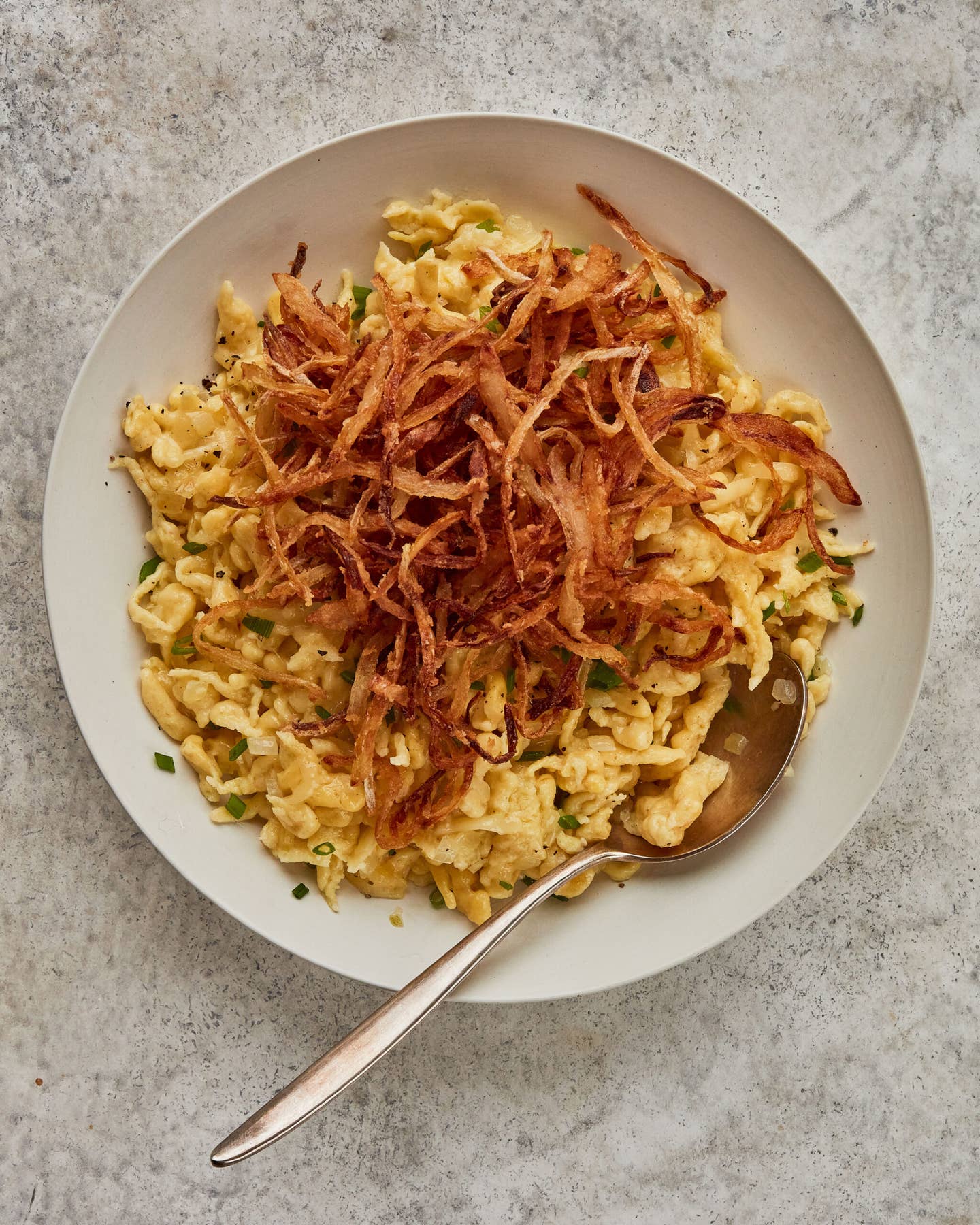
Germany's most indulgent and beloved comfort food — the German answer to mac and cheese. Freshly made spätzle layered with melted Emmental or Gruyère cheese and finished with a generous topping of deeply caramelised onions fried until mahogany and sweet. Rich, cheesy, and completely extraordinary. Also check our creamy mac and cheese and baked mac and cheese for more cheesy pasta ideas.
Ingredients:
- 1 batch homemade spätzle (recipe #24), cooked and ready
- 2 cups Emmental, Gruyère, or Allgäuer cheese, shredded
- 3 large onions, thinly sliced
- 3 tablespoons butter
- Salt and pepper, to taste
- Fresh chives, for garnish
Instructions:
- Make the caramelised onions: melt butter in a large heavy skillet over medium-low heat. Add all the onions with a pinch of salt. Cook very slowly for 35–45 minutes, stirring every 5 minutes, until deeply mahogany, sweet, and completely caramelised. Do not rush this step — low and slow is essential.
- Preheat oven to 375°F. Grease a large baking dish. Layer half the cooked spätzle in the dish. Scatter half the cheese over. Add the remaining spätzle and top with the rest of the cheese.
- Bake for 15–20 minutes until the cheese is completely melted and beginning to bubble and turn golden at the edges.
- Top generously with the caramelised onions. Garnish with fresh chives. Serve immediately directly from the baking dish — käsespätzle waits for no one.
17. Authentic Black Forest Cake (Schwarzwälder Kirschtorte)
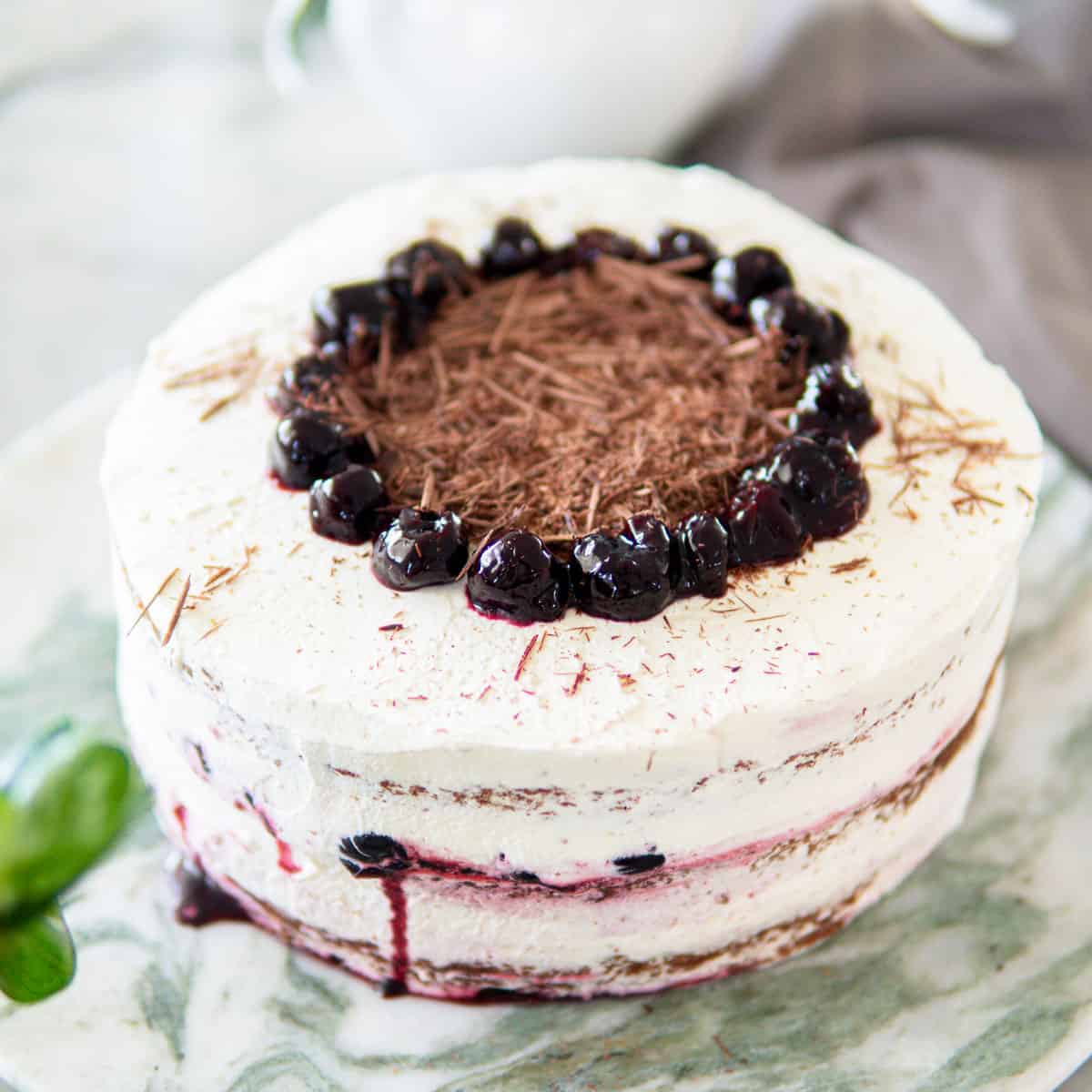
Germany's most internationally famous cake — layers of light, moist chocolate sponge soaked with Kirsch (cherry brandy), filled and covered with lightly sweetened fresh whipped cream and morello cherries, decorated with chocolate shavings and whole cherries. The Kirsch is essential for authenticity — it transforms the cake from a simple chocolate cream cake into something genuinely extraordinary. A spectacular dessert alongside our best dessert ideas.
Ingredients:
- Chocolate sponge: 5 large eggs, 1 cup sugar, 1 cup all-purpose flour, ½ cup unsweetened cocoa powder, 1 teaspoon baking powder, ¼ cup melted butter
- Kirsch syrup: ½ cup sugar + ½ cup water (simmered until dissolved) + 3 tablespoons Kirsch
- 3 cups cold heavy cream + 3 tablespoons powdered sugar, whipped to stiff peaks
- 2 (14 oz) cans morello cherries, drained (reserve the juice)
- Dark chocolate, for shaving
- 12 whole fresh or maraschino cherries, for decoration
Instructions:
- Make the sponge: beat eggs and sugar with an electric mixer for 8 minutes until very pale, thick, and tripled in volume. Sift flour, cocoa, and baking powder over the egg mixture. Fold very gently with a spatula. Fold in the melted butter. Pour into a greased and lined 9-inch round pan. Bake at 350°F for 25–30 minutes. Cool completely before slicing into 3 horizontal layers.
- Make the Kirsch syrup and brush generously over all three sponge layers.
- Assemble: place the first sponge layer on a serving plate. Spread a layer of whipped cream over. Scatter half the cherries. Place the second layer. Repeat cream and cherries. Top with the third layer.
- Cover the entire cake with whipped cream. Use remaining cream to pipe rosettes around the top edge. Place a fresh cherry on each rosette. Cover the sides with chocolate shavings. Refrigerate for at least 2 hours before serving.
16. German Braised Red Cabbage (Blaukraut)

The essential German side dish — red cabbage slowly braised with apples, red wine vinegar, brown sugar, and warming spices until meltingly tender and beautifully glossy. The flavour perfectly balances sweet and sour with a gentle warmth from cloves and bay leaves. A classic companion to sauerbraten, pork roast, and bratwurst and one of the finest things to come out of German cuisine. A brilliant easy side dish.
Ingredients:
- 1 small head red cabbage (about 2 lbs), quartered, cored, and thinly shredded
- 2 large apples, peeled, cored, and diced
- 1 large onion, thinly sliced
- 3 tablespoons butter
- ¼ cup red wine vinegar or apple cider vinegar
- ¼ cup dry red wine
- 3 tablespoons brown sugar
- 3 whole cloves
- 2 bay leaves
- Salt and pepper, to taste
Instructions:
- Melt the butter in a large heavy pot over medium heat. Add the onion and cook for 5 minutes until softened. Add the shredded red cabbage and toss to coat in the butter.
- Add the diced apples, red wine vinegar, red wine, brown sugar, cloves, and bay leaves. Stir to combine. Season with salt and pepper.
- Bring to a simmer. Reduce heat to low, cover, and cook for 45–60 minutes, stirring occasionally, until the cabbage is completely tender and the liquid has reduced to a glossy, syrupy consistency.
- Remove the cloves and bay leaves. Taste and adjust the balance of sweet and sour — add more vinegar for extra tang or more sugar for extra sweetness. The blaukraut should be beautifully balanced. Serve warm alongside any German meat dish. Keeps refrigerated for up to 5 days and improves with reheating.
15. Lebkuchen — German Christmas Cookies

Germany's most beloved and ancient Christmas cookie — a deeply spiced soft gingerbread made with honey, almonds, and a blend of Lebkuchengewürz (gingerbread spice mix including cinnamon, cardamom, cloves, anise, and allspice), baked on edible wafer rounds and finished with a chocolate or white sugar glaze. The aroma of lebkuchen baking is the smell of Christmas in Germany. A wonderful addition to our best holiday cookie collection.
Ingredients:
- 2½ cups all-purpose flour
- ½ cup honey
- ½ cup brown sugar
- 2 tablespoons butter
- 1 large egg
- 1 teaspoon baking soda dissolved in 1 tablespoon warm water
- 1 teaspoon cinnamon, ½ teaspoon cardamom, ¼ teaspoon each ground cloves, anise, and allspice
- ½ cup ground almonds
- Zest of 1 lemon and 1 orange
- Edible wafer rounds (Backoblaten), optional
- Glaze: 4 oz dark chocolate (melted) or 1 cup powdered sugar + 2 tablespoons water
Instructions:
- Combine honey, brown sugar, and butter in a saucepan over low heat until melted. Cool to room temperature. Stir in the egg, baking soda mixture, all spices, ground almonds, and citrus zest. Add the flour and mix until a soft, slightly sticky dough forms. Wrap and refrigerate overnight — the resting is essential for the flavour to develop.
- Preheat oven to 350°F. Roll the dough to ¼ inch thick on a floured surface. Cut into rounds or use a cookie cutter. If using wafer rounds, press the dough onto the wafers — this is traditional and prevents the cookies from sticking to the baking sheet.
- Bake for 12–15 minutes until set and the edges are just beginning to colour. Cool completely on a wire rack.
- Dip the tops in melted chocolate or brush with the sugar glaze. Let set completely at room temperature before storing in an airtight tin — lebkuchen improve with resting and keep for several weeks.
14. Wurstsalat — Austrian-German Sausage Salad
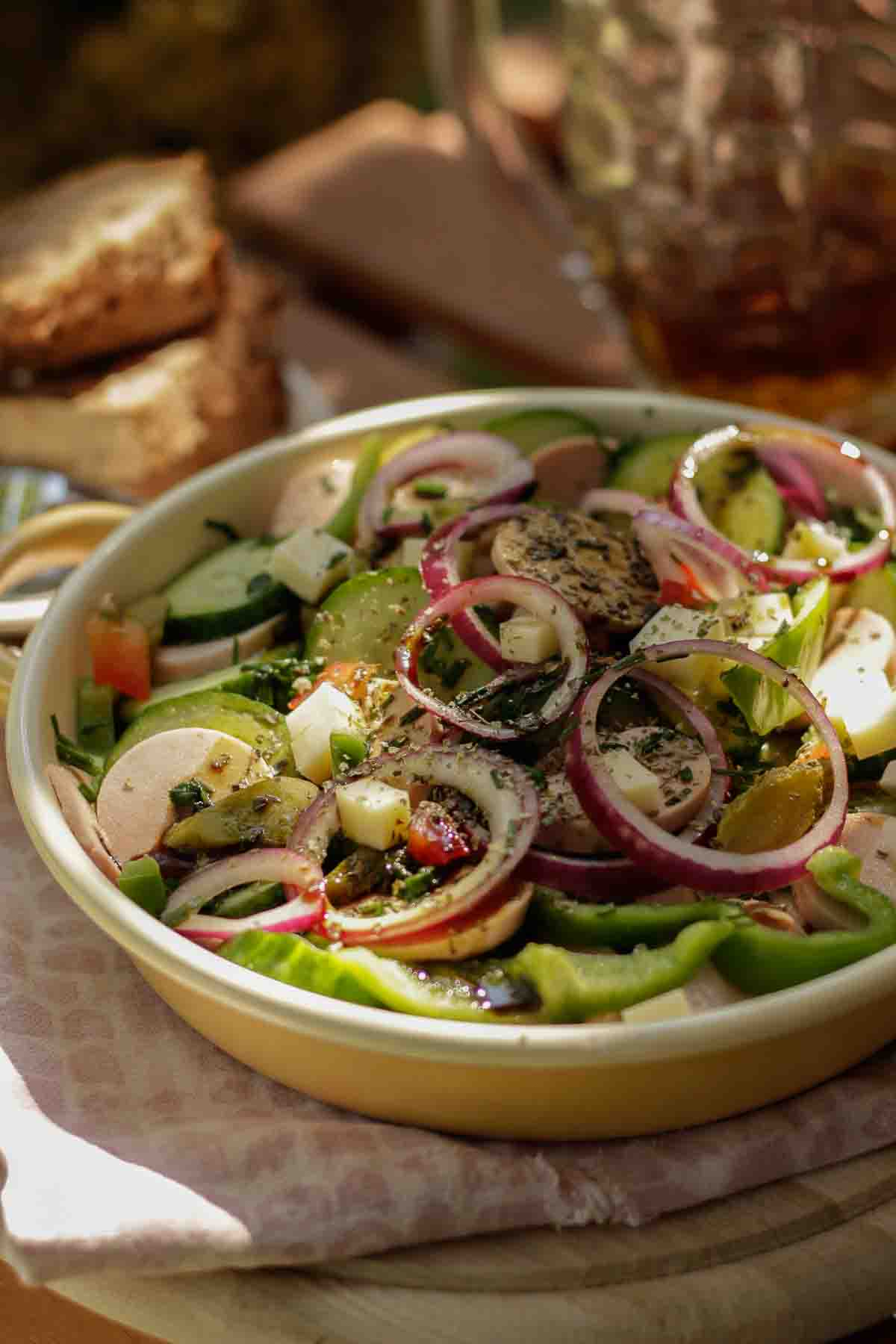
A popular cold sausage salad from southern Germany and Austria — thinly sliced cooked pork sausage (fleischwurst or baloney), shaved onions, dill pickles, and fresh parsley dressed in a sharp vinegar-and-oil dressing with mustard. Served as a light dinner, pub snack, or starter with crusty bread and a cold beer. Simple, satisfying, and distinctly German in character. A great recipe alongside our best salad recipes.
Ingredients:
- 1 lb fleischwurst, bologna, or lyoner sausage, thinly sliced then cut into thin strips
- 1 large red onion, halved and very thinly sliced into half-moons
- 3–4 dill pickles, thinly sliced into rounds
- 3 tablespoons white wine vinegar
- 3 tablespoons neutral oil or light olive oil
- 1 tablespoon German or Dijon mustard
- 1 teaspoon sugar
- Salt and white pepper, to taste
- Fresh parsley and chives, roughly chopped
- Crusty bread or pretzels, for serving
Instructions:
- Combine the thinly sliced sausage, onion, and dill pickle slices in a large bowl.
- Whisk together the vinegar, oil, mustard, sugar, salt, and white pepper until emulsified. The dressing should be bold and tangy.
- Pour the dressing over the sausage and vegetables. Toss well to coat. Add the fresh herbs and toss again.
- Rest at room temperature for at least 30 minutes before serving — this allows the onions to soften slightly in the vinegar and the flavours to meld. Taste and adjust seasoning. The Wurstsalat should be boldly tangy and savoury. Serve with crusty dark bread or pretzels.
13. Kartoffelpuffer — German Potato Pancakes
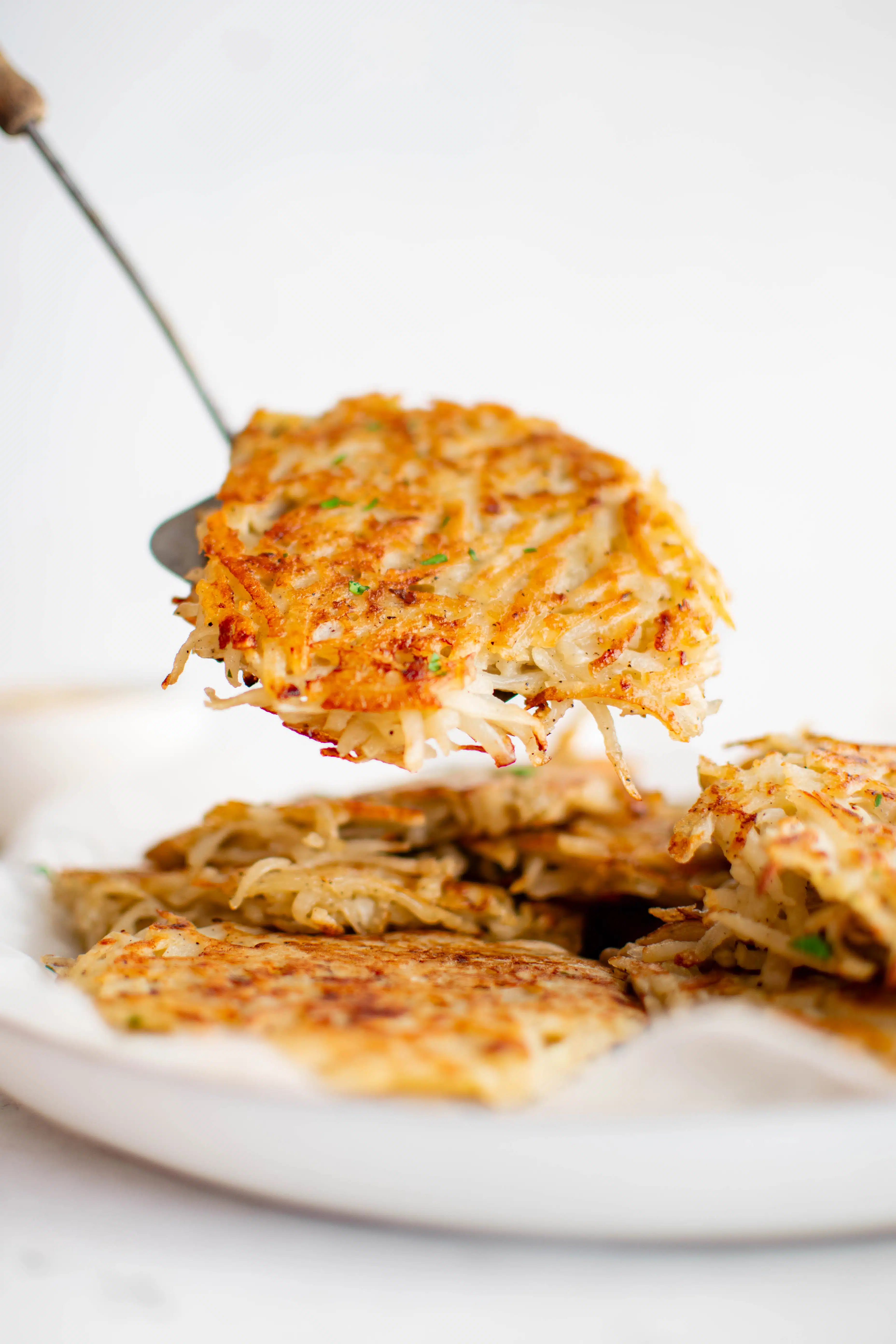
One of the most beloved German comfort foods — freshly grated potato pancakes fried in a generous amount of fat until the exterior is deeply golden and shattering-crispy while the interior remains tender and slightly custardy. Served sweet with homemade applesauce or savoury with sour cream. Found at every Christmas market across Germany and a staple of German home cooking. Also see our own German potato pancakes recipe.
Ingredients:
- 2 lbs Russet potatoes, peeled and coarsely grated
- 1 medium onion, coarsely grated
- 2 large eggs, beaten
- 3 tablespoons all-purpose flour
- 1 teaspoon salt
- ¼ teaspoon white pepper
- Vegetable oil or lard, for frying
- Applesauce and sour cream, for serving
Instructions:
- Grate the potatoes and onion together. Place in a clean kitchen towel and squeeze out as much liquid as possible — this step is critical for crispy pancakes. The more moisture you remove, the crispier the result.
- Combine the drained potato mixture with beaten eggs, flour, salt, and white pepper. Mix well. The mixture should just barely hold together.
- Heat ¼ inch of oil in a large heavy skillet over medium-high heat. Working in batches, add spoonfuls of the potato mixture and press flat with a spatula into thin rounds, about 3 inches in diameter. Do not crowd the pan.
- Fry for 3–4 minutes per side until deeply golden and very crispy. The key is not to flip too early — let the bottom crust form fully before turning. Drain on a wire rack, not paper towels. Serve immediately with applesauce and sour cream.
12. Gebratene Maultaschen — Fried German Dumplings with Egg
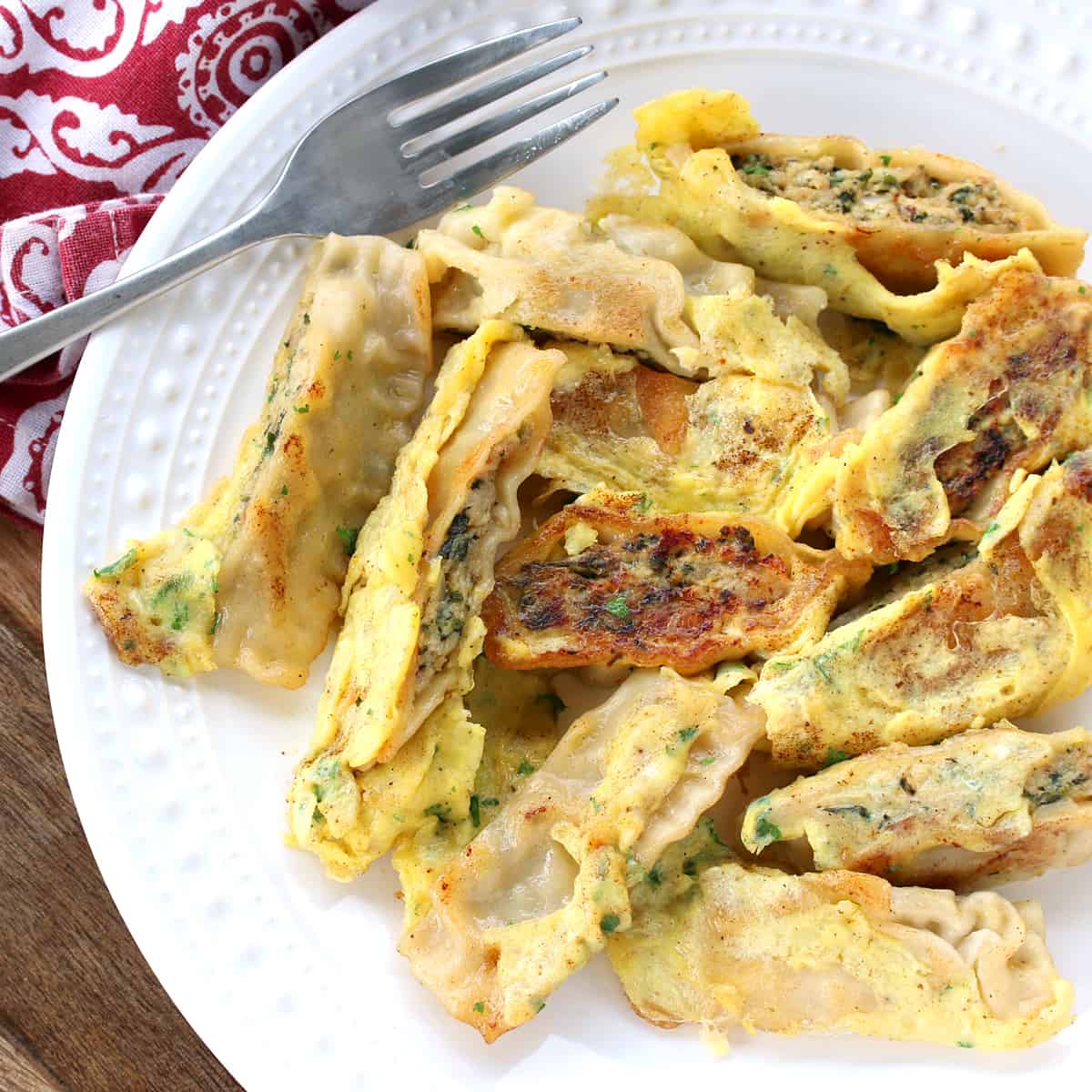
A delicious and creative use of maultaschen — Germany's large pasta dumplings filled with a traditional mixture of minced meat, spinach, bread, and herbs. Rather than serving them in broth (the most common preparation), this version slices the cooked maultaschen and pan-fries them in butter until golden, then pours beaten eggs over to create a scrambled egg coating. Simple, completely satisfying, and a beloved home-cooking classic in Baden-Württemberg. A great addition to our noodle and dumpling recipes.
Ingredients:
- 4 large store-bought or homemade maultaschen dumplings (or substitute large ravioli)
- 4 large eggs, beaten
- 1 large onion, thinly sliced
- 3 tablespoons butter
- Fresh chives, for garnish
- Salt and pepper, to taste
Instructions:
- If the maultaschen are raw or frozen, cook them first in gently simmering salted water for 8–10 minutes until tender. Drain and cool slightly.
- Slice the cooked maultaschen into ½-inch thick rounds.
- Melt the butter in a large skillet over medium heat. Add the onion slices and cook for 8–10 minutes until golden and caramelised. Push to the sides of the pan.
- Add the sliced maultaschen to the centre of the pan in a single layer. Cook for 2–3 minutes per side until golden and slightly crispy on the cut surfaces. Beat the eggs with salt and pepper and pour over everything. Stir gently and cook until the eggs are just set but still slightly creamy. Garnish with fresh chives and serve immediately.
11. Himmel und Erde — German Heaven and Earth Pie

A uniquely German combination that sounds unusual but is absolutely delicious — "Himmel" (heaven, the apples that grow in the sky) and "Erde" (earth, the potatoes that grow underground) combined together with black pudding or sausage into a wonderfully comforting dish. The sweet apple compote and savoury mashed potatoes with crispy fried onions and sausage is one of the most satisfying flavour combinations in all of German cooking. A perfect Sunday dinner.
Ingredients:
- 2 lbs potatoes, boiled and mashed with butter and milk
- 3 large cooking apples, peeled, cored, diced, and cooked with 2 tablespoons butter and 2 tablespoons sugar until soft
- 4 links black pudding (blood sausage) or bratwurst, fried until golden
- 2 large onions, thinly sliced and fried in butter until deeply golden and crispy
- 3 tablespoons butter
- Salt, pepper, and nutmeg, to taste
Instructions:
- Make the mashed potatoes: boil the potatoes until completely tender. Drain and mash with generous butter and warm milk until smooth and creamy. Season with salt, pepper, and a pinch of nutmeg.
- Make the apple compote: cook the diced apples with butter and sugar over medium heat, stirring, for 10 minutes until completely softened and slightly jammy. Season with a pinch of salt to enhance the sweetness.
- Fry the onion slices in butter over medium heat for 25–30 minutes, stirring frequently, until completely caramelised and golden. Fry the sausages in the same pan until golden all over.
- Serve in deep bowls or a large dish: mashed potatoes in the centre, warm apple compote spooned alongside, sliced sausage on top, and the caramelised onions scattered over everything. Everything can also be layered in a pie dish and baked at 375°F for 20 minutes if serving as a pie.
10. Zwiebelkuchen — German Onion Cake

A classic German savoury tart traditionally eaten in autumn alongside new wine (Federweißer) — deeply caramelised onions and crispy bacon in a rich sour cream and egg custard baked in a yeast dough or shortcrust pastry case. Warmly spiced with caraway and nutmeg, Zwiebelkuchen is a completely unique and deeply satisfying taste of German autumn. A wonderful savoury bake alongside our caramelised onion tart.
Ingredients:
- Yeast dough base: 2 cups flour, 1 teaspoon instant yeast, ½ teaspoon salt, 1 tablespoon sugar, ½ cup warm milk, 3 tablespoons butter — knead 5 minutes, rest 45 minutes
- 3 lbs onions, thinly sliced
- 6 oz smoked bacon, diced
- 3 tablespoons butter
- 3 large eggs
- 1 cup sour cream
- 1 teaspoon caraway seeds
- ¼ teaspoon nutmeg
- Salt and pepper, to taste
Instructions:
- Make the dough and let it rise while preparing the filling. Cook the bacon in a large pot until crispy. Remove and set aside. Add butter and the onions to the bacon fat. Cook over medium-low heat for 35–40 minutes, stirring frequently, until the onions are completely soft and golden — but not dark brown. Cool.
- Whisk together the eggs, sour cream, caraway seeds, and nutmeg. Season generously. Combine with the cooled onions and bacon.
- Preheat oven to 375°F. Roll out the risen dough to fit a 9x13-inch baking pan, pressing up the sides to form a rim. The dough should be thin.
- Pour the onion filling over the dough base, spreading evenly. Bake for 35–40 minutes until the custard is set, the edges of the dough are golden, and the top is beginning to colour. Cool 15 minutes before slicing into squares. Serve warm with a glass of new wine or apple cider.
9. Rote Grütze — German Red Berry Compote
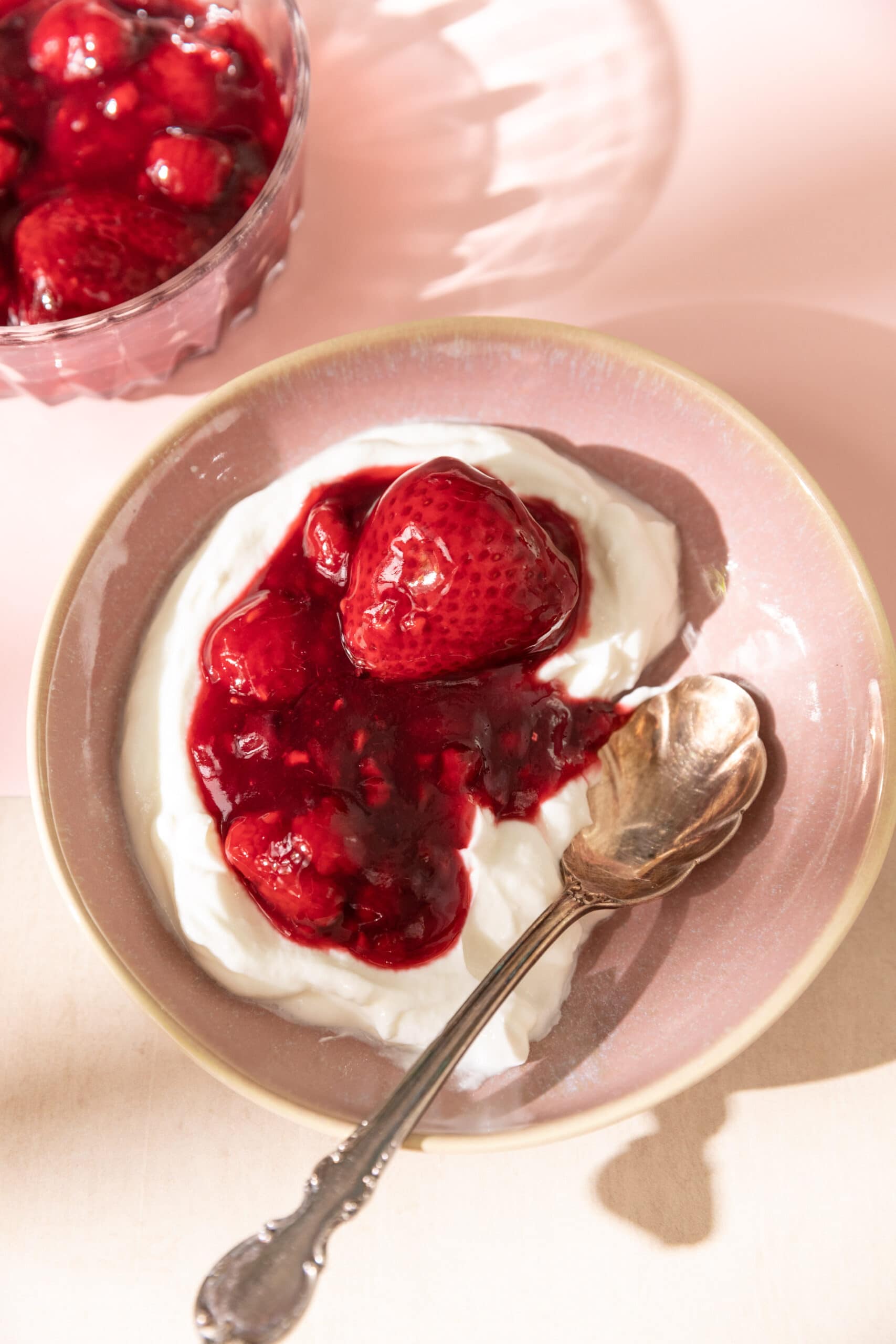
A refreshing, jewel-bright northern German dessert — a mixture of red summer berries (red currants, raspberries, strawberries, and cherries) cooked with sugar and thickened with cornstarch or potato starch into a glossy, vibrant compote that is served chilled with whipped cream or vanilla sauce. Beautifully simple and one of the most quintessentially German summer desserts. Wonderful alongside our easy summer desserts.
Ingredients:
- 2 cups fresh or frozen red currants
- 1 cup raspberries
- 1 cup strawberries, hulled and halved
- 1 cup sweet dark cherries, pitted
- ½ cup sugar, plus more to taste
- 3 tablespoons cornstarch or potato starch dissolved in 4 tablespoons cold water
- Juice of ½ lemon
- Whipped cream or vanilla sauce, for serving
Instructions:
- Combine all the berries and cherries in a medium saucepan with the sugar and lemon juice. Cook over medium heat, stirring gently, for 5–8 minutes until the fruits begin to break down and release their juices. Do not overcook — you want the fruit to retain some texture.
- Taste and adjust sugar. The compote should be pleasantly sweet-tart with the brightness of the currants coming through.
- Stir the cornstarch slurry and add to the hot fruit, stirring gently. Cook for 1–2 minutes until the compote thickens and becomes glossy. Remove from heat.
- Pour into individual serving bowls or a large serving dish. Cool to room temperature, then refrigerate for at least 2 hours until completely chilled and set. Serve very cold with a generous spoonful of whipped cream or warm vanilla sauce poured around or over.
8. Kohlsuppe — Authentic German Cabbage Soup
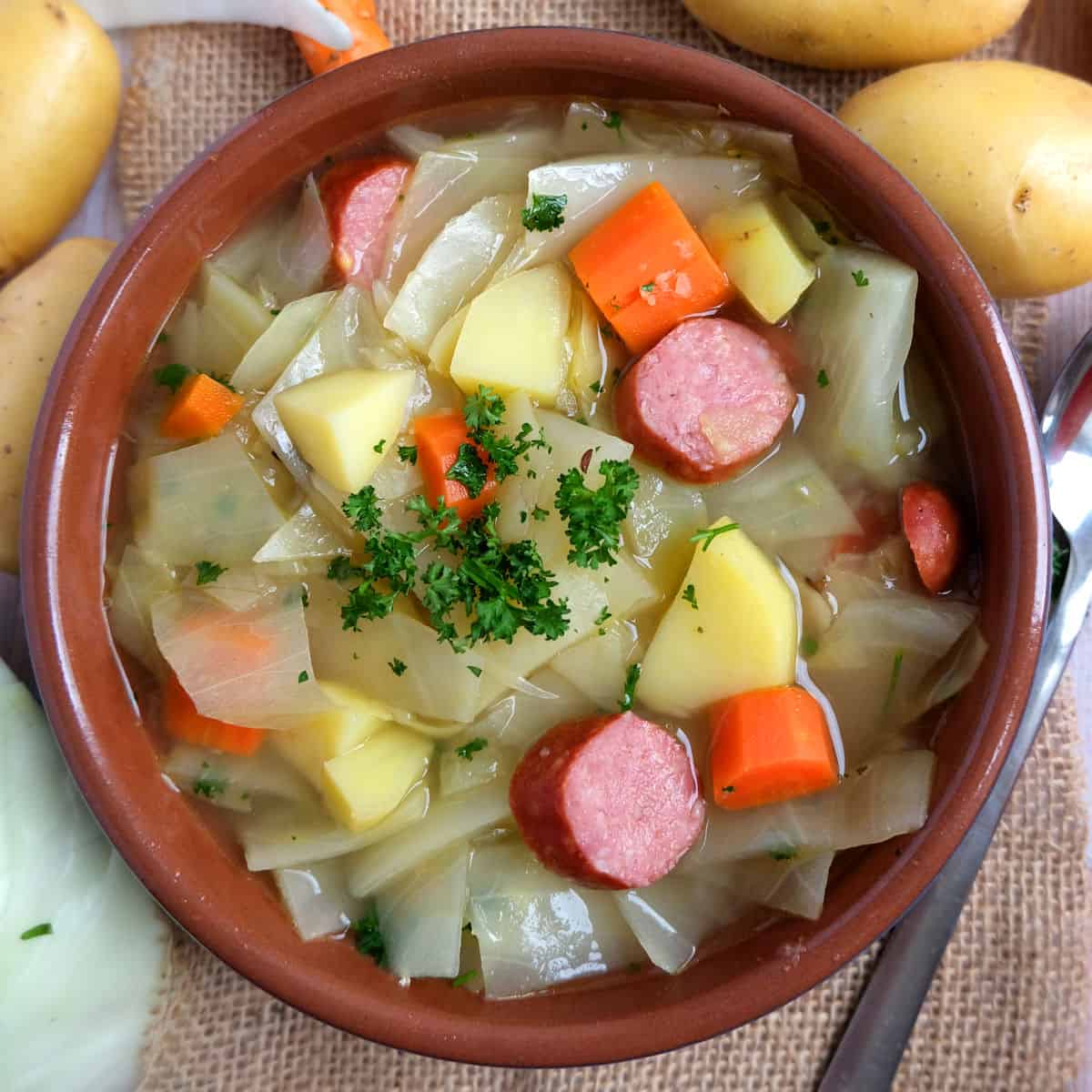
A hearty, deeply nourishing German country soup — green cabbage cooked with smoked bacon, sliced sausage, potatoes, carrots, and caraway seeds in a rich broth until everything is tender and the flavours have melded into something deeply warming and satisfying. Perfect for cold months and a wonderful representation of German Hausmannskost (home-cooking). A natural companion to our cabbage soup with hamburger and cabbage soup recipes.
Ingredients:
- ½ head green cabbage, cored and roughly chopped
- 6 oz smoked bacon, diced
- 6 oz smoked sausage or kielbasa, sliced
- 2 medium potatoes, peeled and diced
- 2 large carrots, diced
- 1 large onion, diced
- 3 cloves garlic, minced
- 6 cups beef or chicken broth
- 1 teaspoon caraway seeds
- 1 bay leaf
- 1 tablespoon vegetable oil
- Salt, pepper, and a splash of white wine vinegar, to taste
- Fresh parsley, for garnish
Instructions:
- Cook the bacon in a large pot over medium heat until it begins to render fat. Add the sausage and cook 2–3 minutes until lightly browned. Remove both and set aside.
- Add the oil and sauté the onion for 5 minutes. Add the garlic and caraway seeds and cook 1 minute. Add the carrots and potatoes and stir to coat.
- Add the chopped cabbage and broth. Add the bay leaf. Bring to a boil, then reduce to a simmer. Cook for 20 minutes until the vegetables are tender.
- Return the bacon and sausage to the pot. Simmer 5 more minutes. Season generously with salt, pepper, and a splash of white wine vinegar — the vinegar brightens the whole soup. Remove the bay leaf. Garnish with fresh parsley. Serve with crusty dark bread.
7. Frikadellen — Classic German Meatballs
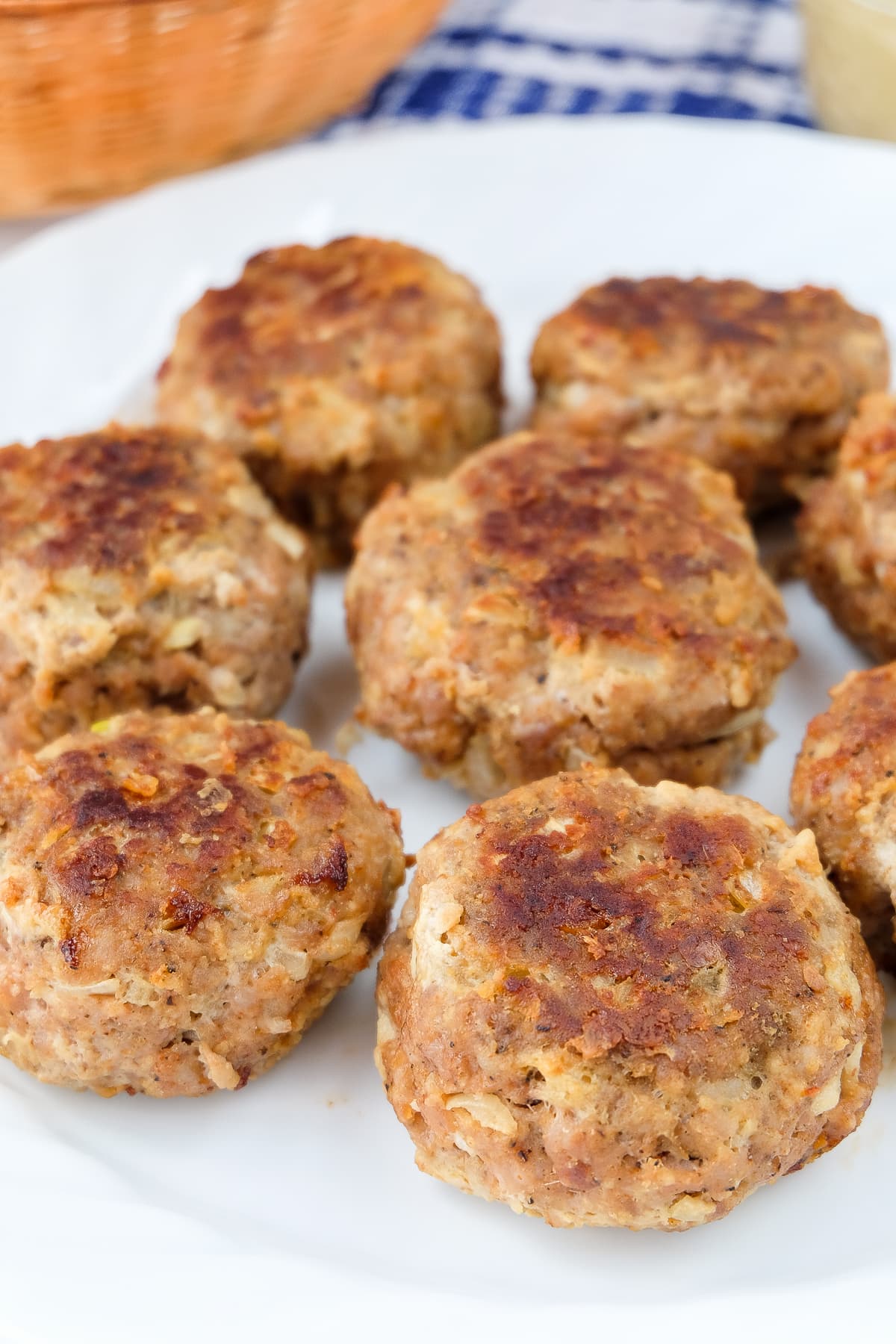
Germany's everyday meatball — larger and flatter than a traditional round meatball, pan-fried rather than braised, made with a mixture of ground beef and pork with onion, bread soaked in milk, egg, and marjoram. Frikadellen are eaten for lunch, as a snack, cold in a bread roll, or with potato salad at barbecues. Simple, deeply satisfying, and a staple of German home cooking. Also see our ground beef recipes.
Ingredients:
- ¾ lb ground beef
- ¾ lb ground pork
- 2 slices white bread, soaked in ½ cup milk for 5 minutes and squeezed
- 1 medium onion, finely grated or minced
- 2 large eggs
- 1 teaspoon dried marjoram
- 1 tablespoon German or Dijon mustard
- Salt and pepper, to taste
- 2 tablespoons vegetable oil for frying
Instructions:
- Combine the ground beef and pork in a large bowl. Add the bread (squeezed of all excess milk), grated onion, eggs, marjoram, mustard, salt, and pepper. Mix gently until just combined — overworking makes tough frikadellen.
- Shape into oval, slightly flattened patties about 3 inches across and ½ inch thick — thinner than a burger, flatter than a round meatball.
- Heat the oil in a large skillet over medium heat. Cook the frikadellen in batches for 4–5 minutes per side until deeply browned and cooked through. The flat shape means they cook quickly and evenly.
- Drain briefly on a plate. Serve warm with German potato salad, mustard, and bread — or cold in a bread roll the next day. They reheat beautifully and are equally good cold.
6. Vegan Weisswurst — Bavarian White Sausage

A creative and delicious plant-based version of Bavaria's iconic white sausage — typically eaten for breakfast before noon with sweet mustard and a pretzel — recreated using seitan, white kidney beans, and a characteristic blend of parsley, lemon, mace, and cardamom that gives weisswurst its unique flavour profile. A wonderful option for plant-based eaters exploring German cuisine. A great recipe for our vegan dinner recipes.
Ingredients:
- 1 cup vital wheat gluten
- ½ cup cooked white kidney beans, mashed
- 3 tablespoons nutritional yeast
- 2 tablespoons fresh parsley, finely chopped
- 1 teaspoon onion powder
- ½ teaspoon lemon zest
- ½ teaspoon ground mace
- ¼ teaspoon ground cardamom
- ¼ teaspoon white pepper
- ½ teaspoon salt
- ¾ cup cold vegetable broth
- Sweet German mustard and pretzels, for serving
Instructions:
- Combine the vital wheat gluten, mashed beans, nutritional yeast, parsley, and all spices in a bowl. Add the cold vegetable broth and mix until a cohesive, elastic dough forms.
- Divide the dough into 4 portions. Shape each into a thick sausage about 5 inches long. Wrap tightly in foil, twisting the ends to form a sausage shape. Wrap a second layer of foil if needed for a tight seal.
- Steam the wrapped sausages in a steamer over boiling water for 35–40 minutes. Cool slightly before unwrapping.
- Serve in the traditional Bavarian way — warm (not grilled), in a bowl of hot water to keep them warm, with sweet German mustard and a pretzel. The traditional way to eat weisswurst is to slit the skin and suck out the filling, though slicing also works perfectly for this vegan version.
5. Traditional Beef Rouladen
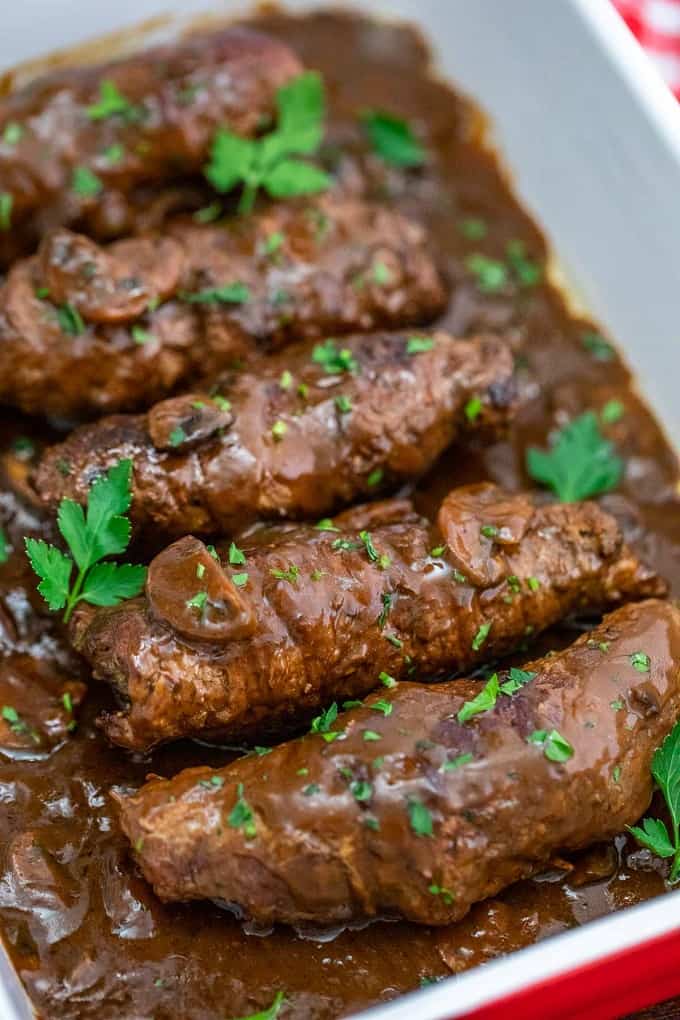
A second wonderful version of this beloved German Sunday roast — thin beef slices stuffed with bacon, onion, mustard, and a whole dill pickle spear, rolled and braised in a deeply savoury red wine and beef broth gravy until completely tender. Every German family has their own version and each is beloved. Serve with red cabbage and potato dumplings or mashed potatoes for a complete and deeply satisfying meal. See more dinner ideas in our best dinner recipes.
Ingredients:
- 4 large thin beef round slices (about ¼ inch thick — ask your butcher to slice these)
- 4 tablespoons spicy brown or German mustard
- 4 strips bacon
- 1 large onion — half diced finely for filling, half sliced for the braise
- 4 whole dill pickle spears
- 3 tablespoons vegetable oil
- 1 cup red wine
- 2 cups beef broth
- 2 tablespoons tomato paste
- 2 tablespoons flour (for thickening)
- Salt and pepper, to taste
Instructions:
- Lay the beef slices flat on a work surface. Season with salt and pepper. Spread a generous tablespoon of mustard on each. Lay a bacon strip on each. Scatter diced onion. Place a pickle spear along the bottom edge.
- Roll up tightly from the pickle end, tucking in the sides firmly. Secure with kitchen twine or two toothpicks at each end.
- Brown deeply in oil in a Dutch oven over high heat on all sides — about 8 minutes. Remove. Sauté the sliced onion in the same pot for 5 minutes. Add the tomato paste and flour. Stir 1 minute. Add the red wine and scrape up all the browned bits. Add the broth. Return the rouladen.
- Bring to a simmer. Cover and braise on very low heat for 1.5–2 hours until tender. Remove and remove toothpicks or twine. Strain and thicken the gravy if needed. Serve the rouladen sliced or whole with the gravy poured generously over.
4. Hackbraten — Traditional German Meatloaf
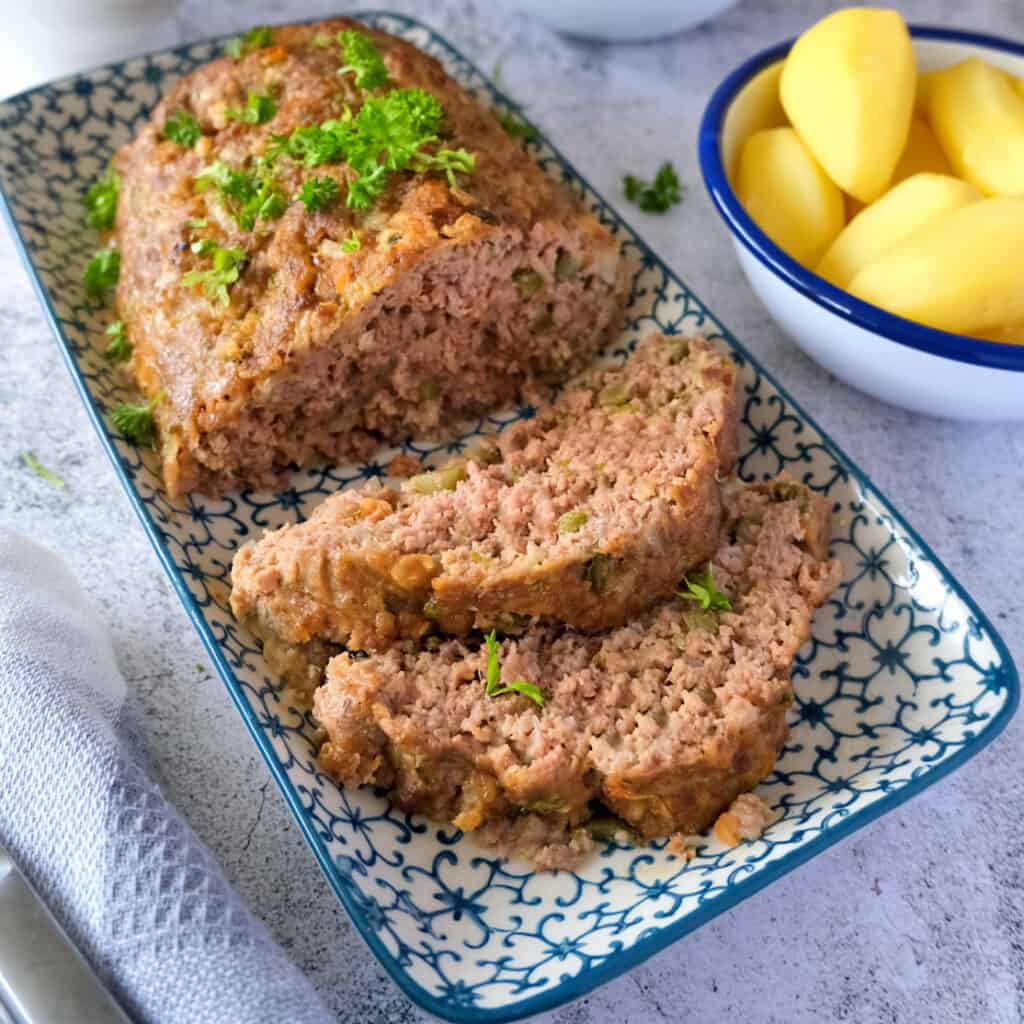
The German meatloaf with a surprise inside — a well-seasoned mixture of ground beef and pork wrapped around two hard-boiled eggs, then baked until juicy and golden, sliced to reveal the beautiful egg cross-section inside each serving. Served with a simple pan sauce, mashed potatoes, and braised red cabbage for a complete and deeply comforting German family meal. See more ideas in our best meatloaf recipes.
Ingredients:
- 1 lb ground beef
- 1 lb ground pork
- 2 slices bread, soaked in ½ cup milk and squeezed
- 1 medium onion, finely diced and sautéed
- 2 large eggs, beaten
- 2 tablespoons fresh parsley, chopped
- 1 teaspoon marjoram
- 1 teaspoon mustard
- Salt and pepper, to taste
- 2 hard-boiled eggs, peeled (for the centre)
- 2 tablespoons breadcrumbs
- 1 cup beef broth, for the pan
Instructions:
- Preheat oven to 375°F. Combine the ground meats, soaked bread, sautéed onion, beaten eggs, parsley, marjoram, mustard, breadcrumbs, salt, and pepper. Mix gently until combined.
- Lay the meat mixture out in a rectangle on a work surface — about 12 inches long and 8 inches wide. Place the two hard-boiled eggs end to end along the centre.
- Lift the long sides of the meat mixture up and over the eggs, pressing firmly to seal and enclosure the eggs completely. Shape into an oval loaf with the eggs running lengthwise through the centre.
- Place in a roasting pan. Add broth around the base. Bake for 55–65 minutes until the internal temperature reaches 160°F and the outside is golden. Rest 10 minutes. Slice to reveal the eggs inside. Use the pan drippings to make a simple gravy.
3. Kartoffelklöße — Bavarian Potato Dumplings

Bavaria's magnificent potato dumplings — made from a combination of raw and cooked potatoes, shaped into large round dumplings and poached in salted water until they float, then served alongside sauerbraten, rouladen, or Schweinshaxe to soak up the extraordinary gravies. Each dumpling often contains a small crouton in the centre that absorbs the gravy. A wonderful comfort food alongside our favourite potato recipes.
Ingredients:
- 2 lbs Russet potatoes — 1 lb boiled, riced, and cooled; 1 lb raw, finely grated and squeezed dry
- ½ cup potato starch or cornstarch
- 1 large egg yolk
- ½ teaspoon salt
- ¼ teaspoon nutmeg
- 6 small cubes of white bread, fried in butter until golden (for the centres)
Instructions:
- Combine the riced boiled potato and the grated raw potato (squeezed very dry in a kitchen towel). Add the potato starch, egg yolk, salt, and nutmeg. Mix until a smooth, uniform dough forms. It should hold its shape when pressed.
- Divide the dough into 6 equal portions. Flatten each in your palm. Place a crouton cube in the centre of each. Wrap the dough around the crouton and roll firmly into a smooth ball. The smooth, seamless exterior is important.
- Bring a large pot of salted water to a gentle simmer — not a rolling boil. Lower the dumplings in gently. Poach for 20–25 minutes until the dumplings float and are cooked through. Test one by cutting it in half — it should be uniform and cooked throughout with no raw starchy centre.
- Remove with a slotted spoon. Serve immediately alongside any braised German meat dish, with plenty of gravy spooned over the top.
2. Streuselkuchen — German Crumb Cake

One of Germany's most beloved Kaffeekuchen (coffee cakes) — a soft, slightly sweet yeast dough base topped with a generous, buttery, crumbly streusel that bakes into an irresistibly crunchy, golden topping. Found in every German bakery and enjoyed with coffee or tea at Kaffee und Kuchen (the German 4pm coffee and cake tradition). Simple but completely irresistible. A wonderful companion to our coffee cake with streusel crumb recipe.
Ingredients:
- Yeast base: 2 cups flour, 2 teaspoons instant yeast, 3 tablespoons sugar, ½ teaspoon salt, ¾ cup warm milk, 3 tablespoons butter (softened), 1 egg — knead 5 minutes, rise 1 hour
- Streusel topping: 1½ cups flour, ¾ cup sugar, ½ cup cold butter (cut into cubes), 1 teaspoon vanilla extract — rub together until clumpy crumbs form
Instructions:
- Make the yeast dough: combine all dough ingredients and knead until smooth and elastic — about 5 minutes. The dough should be soft and slightly tacky. Cover and let rise in a warm place for 1 hour until doubled.
- Make the streusel: combine flour, sugar, and vanilla. Add the cold butter cubes and rub between your fingertips until the mixture resembles coarse, clumpy crumbs — some large chunks are desirable for a good streusel texture. Do not overwork. Refrigerate while the dough rises.
- Preheat oven to 375°F. Grease a 9x13-inch baking pan. Press the risen dough evenly into the pan — use wet fingers to avoid sticking. Let rest 15 minutes.
- Scatter the streusel very generously over the entire surface of the dough — press lightly so it adheres. Bake for 25–30 minutes until the streusel is golden and the base is cooked through. Cool 20 minutes before slicing. Serve with coffee or tea.
1. Bienenstich — German Bee Sting Cake

The most spectacular German cake — a sweet yeast dough baked with a caramelised honey and almond topping that creates a shatteringly crunchy, golden layer, then split and filled with a thick, luxurious vanilla cream or pastry cream. The legend says it was named when a beekeeper was stung while picking the honey used in the recipe. Whatever its origin, Bienenstich is one of the greatest and most beautiful German bakes. A showstopper alongside our best cake recipes.
Ingredients:
- Yeast dough: 2 cups flour, 2 teaspoons instant yeast, 3 tablespoons sugar, ½ teaspoon salt, ½ cup warm milk, 3 tablespoons softened butter, 1 egg — knead 8 minutes, rise 1 hour
- Almond topping: 5 tablespoons butter, 4 tablespoons honey, 3 tablespoons sugar, 2 tablespoons heavy cream, 1½ cups sliced almonds
- Vanilla cream filling: 2 cups whole milk, 3 egg yolks, ¼ cup sugar, 3 tablespoons cornstarch, 1 teaspoon vanilla — cook until thick, cool, then fold in 1 cup whipped cream
Instructions:
- Make the yeast dough and let rise 1 hour. Meanwhile, make the vanilla filling: whisk egg yolks, sugar, and cornstarch. Whisk in warm milk. Cook over medium heat, stirring constantly, until very thick. Add vanilla. Press plastic wrap directly onto the surface. Cool completely, then fold in the whipped cream. Refrigerate.
- Make the almond topping: melt butter with honey, sugar, and cream in a saucepan over medium heat. Bring to a boil, stir in the almonds. Cool slightly.
- Preheat oven to 375°F. Press the risen dough into a greased 9-inch round or 9x13-inch pan. Spread the almond topping evenly over the surface — it will be sticky. Let rest 15 minutes. Bake for 20–25 minutes until the almonds are deeply golden and caramelised and the dough is cooked through. Cool completely.
- Slice the cooled cake horizontally in half with a long serrated knife. Spread the vanilla cream filling generously over the bottom layer. Place the almond-topped layer back on top, pressing gently. Refrigerate 1 hour before slicing carefully. Serve in thick slices.
FAQs
What are the most essential ingredients to stock for cooking authentic German food at home?
German cooking is built on a relatively accessible set of pantry staples. Good German or spicy brown mustard is used constantly — as a condiment, in marinades, and inside dishes like rouladen and frikadellen. Caraway seeds appear in everything from bread to cabbage to sausages and are unmistakably German in flavour. Smoked paprika and sweet paprika are essential for goulash and many spiced dishes. White wine vinegar and apple cider vinegar are the acidic backbone of German potato salad and braised dishes. Sauerkraut (fermented cabbage) is essential as a condiment and ingredient. Good quality pork sausages — bratwurst, knockwurst, and smoked sausage — are central to German cooking. Dried marjoram is used more in German cooking than in almost any other European cuisine. Potato starch and cassava flour are useful for dumplings. Gingersnap cookies are the traditional thickener for sauerbraten gravy. With these ingredients plus the usual onions, garlic, and root vegetables, you can cook authentically across the entire German repertoire.
What is the best cut of beef for making sauerbraten?
The best cuts for sauerbraten are those that benefit from long, slow braising — connective tissue-rich cuts that become extraordinarily tender with time. Bottom round (Silverside) is the most traditional and historically accurate choice and produces a very firm, sliceable result. Chuck roast is more marbled with fat and becomes slightly more tender and less dry — it is a good choice for home cooks who prefer a softer result. Rump roast is also excellent. What all three have in common is that they need the extended marination (3–5 days) and the long, slow braise (2.5–3 hours at a very gentle simmer) to truly transform. If you use a very tender cut like tenderloin, the acid in the marinade will actually break it down too much and the result will be mushy rather than tender. The firmer the cut, the better the sauerbraten.
How do I get really crispy pork knuckle (Schweinshaxe) skin at home?
Three things are absolutely critical. First, the skin must be completely dry before roasting — leave the scored knuckle uncovered in the refrigerator overnight or up to 48 hours. The drying is what makes the skin crackle rather than steam. Second, score the skin deeply and thoroughly in a tight crosshatch pattern — the cuts need to go all the way through the skin and into the fat beneath, which allows the fat to render out and the skin to puff. Third, use two-stage cooking: first a long, slow roast at low temperature (325°F) to render the fat and cook the meat through completely, then a very high heat blast (450°F+) at the end to puff and crackle the skin. Some recipes also recommend rubbing the skin with oil and coarse salt just before the high-heat stage, which helps achieve even crisping and seasons the crackling.
What is the difference between German potato salad and American potato salad?
The difference is fundamental and goes beyond just the dressing. American potato salad uses a mayonnaise base, is served cold, typically uses starchier potatoes that are chunkier, and is seasoned with mustard and often sweet pickle relish. Southern German potato salad (Schwäbischer Kartoffelsalat) also uses a non-mayonnaise dressing but uses warm beef broth with vinegar and oil, and is served warm or at room temperature. Northern German potato salad uses mayonnaise and is somewhat closer to the American version. The Rhineland version (Rheinischer Kartoffelsalat, recipe #26) uses a hot bacon and vinegar-mustard dressing that is poured over warm potatoes, producing a light, tangy, deeply savoury result that is fundamentally different from both the mayonnaise versions and more delicate in flavour. The waxy potato variety used in German salads also holds its shape better and has a lower starch content, producing a firmer, less mushy salad than versions made with Russet potatoes.
Share This Post!
If you loved these authentic German recipes, share this post with every food lover in your life! Pin it, share it on Facebook, or send it to whoever is ready to bring the hearty, comforting flavours of Germany into their kitchen. 🥨🍺🇩🇪





Comments
No Comments