
What makes freezer jam specifically so valuable beyond its exceptional flavor is its accessibility — it is genuinely the most achievable homemade jam preparation available, requiring no candy thermometer, no boiling water bath, no sterilized jars, no worrying about set points or pectin chemistry gone wrong. The uncooked pectin method used in freezer jam is designed to work reliably with the exact sugar and fruit ratios specified on the package, which means the jam sets properly the first time and every time as long as the directions are followed. I have taught this recipe to first-time jam makers, to children, and to experienced cooks who had never made jam before — every person who makes it returns the next week wanting to make a double batch.
This post covers the classic strawberry freezer jam in full detail plus variations for every flavor direction and every occasion — a low-sugar version using less-sweet pectin, a chia seed version for a naturally thickened, no-pectin approach, a mixed berry version, a strawberry basil version for sophisticated palates, and a honey-sweetened version for those avoiding refined sugar. Every version captures the same bright, fresh strawberry character that makes freezer jam so extraordinary.
Let's make the most vibrant strawberry jam of the season!
WHY YOU WILL LOVE THIS RECIPE
- Tastes More Like Fresh Strawberries Than Any Cooked Jam: The no-cook process of freezer jam preserves every volatile flavor compound in the raw strawberries that heat destroys — the bright, sharp, forward strawberry flavor that makes eating a perfectly ripe strawberry so satisfying is fully present in every spoonful of freezer jam. Cooked jam, by contrast, develops a deeper, more complex, more jammy flavor as the fruit breaks down and caramelizes during cooking — genuinely good in its own right but fundamentally different from the raw fruit's character. If fresh strawberry flavor is the goal, freezer jam is the only preparation that truly delivers it.
- No Cooking, No Canning, No Special Equipment: A large bowl, a potato masher or fork, measuring cups, clean jars or freezer-safe containers, and 30 minutes — the complete equipment list for strawberry freezer jam. No candy thermometer, no boiling water bath, no jar tongs, no sterilization, no worrying about whether the set is correct. The uncooked method is specifically designed to be accessible to anyone at any skill level and to produce consistent results every single time the correct ratios are used.
- Ready to Eat in 24 Hours and Stores for a Year: Freezer jam sets in the refrigerator within 24 hours and stores refrigerated for 3 weeks or frozen for up to 12 months. Making a large batch during peak strawberry season in June and stocking the freezer means having fresh-tasting strawberry jam available through the following spring — including the winter months when fresh strawberries are either unavailable or prohibitively expensive and flavorless. Frozen freezer jam thaws overnight in the refrigerator and tastes as bright and fresh as the day it was made.
- The Best Possible Use of Peak Strawberries: The strawberries available for one brief window in late May and June — deeply red all the way through, intensely fragrant, genuinely sweet — are so superior to every other form of strawberry available at any other time that preserving them specifically in a form that captures their flavor in its most undamaged state is one of the highest-value food preservation activities of the entire year. Freezer jam made from peak-season strawberries in June tastes dramatically better than freezer jam made from off-season strawberries at any other time.
- Makes the Most Thoughtful Homemade Gift Available: A jar of homemade strawberry freezer jam — labeled with the date and the variety of strawberry, tied with a ribbon — is consistently one of the most appreciated food gifts available across every age group and every occasion. The implied care and attention of making jam from scratch communicates thoughtfulness in a way that purchased gifts rarely match, and the gift is genuinely consumable and genuinely excellent rather than decorative and forgotten.
- Endlessly Versatile Beyond Toast: Strawberry freezer jam works as a pancake and waffle topping, a yogurt swirl, a cheesecake filling, a layer in trifle and trifle cups, a filling for crepes, a topping for pound cake, a swirl in vanilla ice cream, a filling for thumbprint cookies, a sauce for pork tenderloin, and a component in vinaigrettes. A well-stocked jar of freezer jam in the refrigerator is one of the most useful flavor resources in any kitchen. Find more strawberry ideas in our strawberry lemonade concentrate and our fresh strawberry pie.
INGREDIENTS
- 2 lbs fresh strawberries — hulled and crushed to yield exactly 2 cups crushed fruit. The measurement of crushed fruit rather than whole berries is what ensures proper pectin set — measure after crushing, not before
- 4 cups granulated sugar — the ratio of sugar to fruit is critical for the pectin to set correctly. Do not reduce the sugar quantity in the classic recipe; use the low-sugar variation below if less sweetness is desired
- 1 package (1.75 oz) Sure-Jell original pectin — the powder form, not liquid pectin. Sure-Jell and Ball brands are both reliable and widely available. Read the package directions before starting since different pectin brands specify slightly different ratios
- ¾ cup water — used to dissolve the pectin
- 2 tablespoons fresh lemon juice — amplifies the strawberry flavor and adds necessary acidity that helps the pectin set properly
- Clean freezer-safe jars or containers with tight-fitting lids — 8 oz mason jars are ideal. Leave ½ inch headspace in each jar to allow for expansion during freezing
DIRECTIONS
- Step No.1: Prepare the strawberries
Hull the strawberries by removing the stem and white core with a small paring knife or a strawberry huller. Cut into quarters. Working in batches, crush the strawberries thoroughly using a potato masher, a fork, or a pastry cutter — the goal is a mixture of small pieces and juice rather than a smooth purée. Leave some texture for the best jam eating experience; a completely smooth blended purée produces jam that lacks the satisfying fruit-piece presence that distinguishes homemade from commercial. Do not use a blender or food processor — both puree too completely and produce a thinner, less textured jam. Measure the crushed strawberries after crushing and adjust to reach exactly 2 cups — too little fruit produces a jam that sets too firm; too much produces a jam that may not set properly.
- Step No.2: Combine fruit with sugar and lemon juice
Transfer the measured crushed strawberries to a large bowl — the bowl needs to be significantly larger than the volume of the jam since the mixture will look much more substantial than its actual volume suggests when the sugar is added. Add lemon juice and stir to combine. Add all 4 cups of sugar at once and stir thoroughly — use a wide silicone spatula or wooden spoon and stir continuously for a full 3 minutes to dissolve as much sugar as possible. The sugar will not dissolve completely in 3 minutes — visible undissolved sugar granules are normal and expected at this stage. Let the mixture stand at room temperature for the full 10 minutes specified in the pectin directions, stirring occasionally. During this 10-minute rest, the sugar continues drawing moisture from the strawberries and the mixture becomes noticeably more liquid and slightly more glossy. Do not rush this rest period — it is an important step in the pectin activation process.
- Step No.3: Prepare the pectin solution
While the fruit and sugar mixture rests, combine the pectin powder and ¾ cup water in a small saucepan. Stir to dissolve the pectin powder as much as possible. Bring to a full rolling boil over medium-high heat, stirring constantly — a full rolling boil is one that cannot be stirred down and that maintains its vigorous bubbling when the spoon passes through it. Boil and stir for exactly 1 minute after reaching the full rolling boil, then remove from heat immediately. The pectin solution should look slightly thickened and glossy. Add the hot pectin solution immediately to the fruit and sugar mixture — do not allow it to cool before adding. Stir vigorously and continuously for exactly 3 minutes — this stirring is what activates the pectin and produces a proper set. After 3 minutes of stirring, the mixture should look slightly thicker and the sugar should be more fully dissolved than before the pectin was added.
- Step No.4: Fill jars and seal
Ladle the jam immediately into clean freezer-safe jars or containers — work quickly since the pectin begins setting as soon as it contacts the sugar-fruit mixture and the jam becomes progressively harder to pour as it sits. Fill each jar to within ½ inch of the top — the headspace is essential for frozen jam since the jam expands during freezing and will push the lid off a too-full jar. Wipe the jar rims clean with a damp cloth before sealing — any jam residue on the rim prevents the lid from sealing cleanly. Seal with tight-fitting lids. Do not use containers that are not freezer-safe for portions going to the freezer — standard glass jars crack at freezer temperatures unless they are specifically labeled freezer-safe or wide-mouth mason jars designed for freezing.
- Step No.5: Set and store
Leave filled jars at room temperature for 24 hours before refrigerating or freezing — the jam needs the full 24 hours at room temperature to set to its final consistency. During this time the jam will transform from a loose, pourable liquid to a soft, spreadable set — checking it every few hours is genuinely satisfying as the set develops. After 24 hours, the jam should hold its shape softly when a spoonful is placed on a cold plate — it will be looser than traditional cooked jam but firmer than sauce. If the jam has not set after 24 hours, it is still usable as a sauce but may indicate an issue with the fruit-to-sugar ratio or the pectin preparation. Refrigerate jars for immediate use (keeps 3 weeks) and freeze the remainder (keeps 12 months). Label each jar with the date and fruit variety.
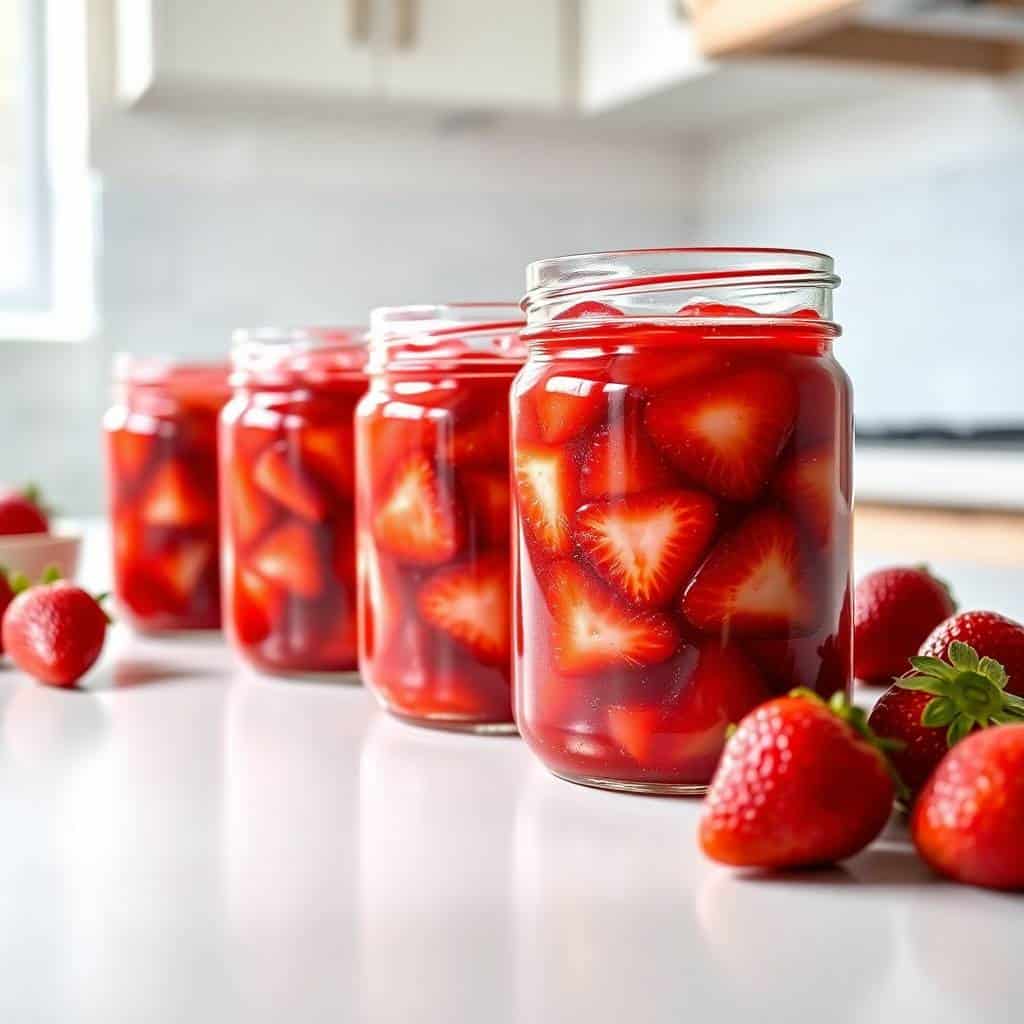
TIPS FOR SUCCESS
- Measure the Crushed Fruit — Not the Whole Berries: The pectin-to-sugar-to-fruit ratio in freezer jam is a precise chemistry that produces a proper set only when the fruit quantity is exactly correct. Different strawberries have different water content — 2 pounds of whole strawberries crushes to anywhere from 1.5 to 2.5 cups of crushed fruit depending on the variety and ripeness. Always measure after crushing and adjust to the exact quantity specified. Too little fruit produces a jam that sets rock-hard and tastes overly sweet. Too much fruit produces a jam that never fully sets and remains saucy.
- Use Fully Ripe Strawberries for the Best Flavor: Freezer jam made from under-ripe, pale, flavorless strawberries tastes like sweetened water with a slight strawberry suggestion — the jam only amplifies the flavor the fruit brings to it and cannot compensate for poor raw material. Use the ripest, most fragrant strawberries available — deeply red throughout with no white core, yielding slightly to pressure, and smelling intensely of strawberry before they are cut. Farmer's market strawberries at peak season produce the most extraordinary freezer jam. If the strawberries smell sweet and delicious in the container, the jam will taste sweet and delicious.
- Bring Pectin Solution to a Full Rolling Boil: A gentle simmer or a partial boil is not sufficient for activating the pectin — the package directions specify a full rolling boil that cannot be stirred down for a reason. Under-boiled pectin does not activate fully and produces a jam that sets looser than intended or does not set at all. Watch the saucepan and wait for the vigorous, unmistakable full boil before starting the 1-minute timer. This is the step where cutting corners most directly affects the final result.
- Stir the Fruit-Pectin Mixture for the Full 3 Minutes: The 3-minute stirring after adding the hot pectin solution to the fruit and sugar is not optional vigorous stirring for 30 seconds — it is specifically 3 minutes of continuous, thorough stirring that ensures the pectin is fully and evenly distributed through the entire fruit mixture. Inadequate stirring produces jam with areas that set and areas that don't — pockets of loose, saucy jam surrounded by properly set jam, which is visually unattractive and texturally inconsistent. Set a timer and stir continuously for every second of those 3 minutes.
- Leave Adequate Headspace in Every Jar: Freezer jam expands as it freezes — a jar filled to the top will crack or push off its lid in the freezer. Leave exactly ½ inch of headspace in every jar destined for the freezer. For jars going only to the refrigerator, the headspace is less critical but still recommended to prevent the lid from being forced off by any expansion during the initial setting period.
- Allow the Full 24-Hour Setting Period Before Judging the Set: Freezer jam that looks loose and sauce-like immediately after filling jars is behaving completely normally — the pectin set is a gradual process that takes the full 24 hours to complete. Checking the jam at 2 hours, concluding that it hasn't set, and adding more pectin is the single most common freezer jam mistake. Wait the full 24 hours at room temperature, then refrigerate. The jam you find 24 hours later is genuinely different — firmer, more cohesive, and properly set — from what you filled the jars with the evening before.
VARIATIONS
- Low-Sugar Strawberry Freezer Jam: Use Sure-Jell for Less or No Sugar Needed pectin (the pink box) instead of the original — this formulation works with significantly less sugar and still sets properly. Follow the low-sugar package directions which specify different ratios than the original. Reduce sugar to 1.5–2 cups rather than 4 cups for a noticeably less sweet jam that allows more of the strawberry's natural tartness and complexity to come through. The low-sugar version is the choice for people who find standard freezer jam too sweet, for anyone reducing sugar intake, and for using the jam as a savory component in sauces and dressings where full-sugar jam would be too sweet.
- Chia Seed Strawberry Jam (No Pectin): Combine 2 cups crushed strawberries with 3 tablespoons honey or maple syrup, 1 tablespoon lemon juice, and 3 tablespoons chia seeds. Stir thoroughly and let stand at room temperature for 30 minutes, stirring every 10 minutes, until the chia seeds have absorbed the liquid and the mixture has thickened to a spreadable consistency. Refrigerate for up to 2 weeks or freeze for up to 3 months. The chia seed version requires no pectin, no cooking, and no sugar and produces a naturally thickened jam with a slightly different texture — the chia seeds are visible as small dark specks and create a different mouthfeel than pectin-set jam. The flavor is less sweet and more complex, with the fresh strawberry flavor even more prominent due to the absence of large quantities of sugar.
- Mixed Berry Freezer Jam: Replace 1 cup of crushed strawberries with ½ cup crushed raspberries and ½ cup crushed blueberries for a mixed berry jam with a deeper, more complex flavor than strawberry alone. The combined berry flavors produce a jam that is simultaneously sweeter (blueberries), more tart (raspberries), and more aromatic (strawberries) than any single berry alone. Keep the total crushed fruit at exactly 2 cups and follow the same recipe with the same ratios. The mixed berry version produces a deeper, more dramatically red-purple color that is visually striking and that makes an outstanding gift jam.
- Strawberry Basil Freezer Jam: Add 3 tablespoons of very finely minced fresh basil to the crushed strawberry and sugar mixture before adding the pectin — the basil infuses into the jam during the 10-minute resting and the subsequent setting period, producing a jam with a subtle, unexpected herbal note that is genuinely sophisticated and that works beautifully on savory preparations like bruschetta with ricotta, alongside cheese on a charcuterie board, or as a glaze for grilled chicken. Use sweet basil rather than Thai basil for the most natural complementary flavor. This is the variation to make when you want to impress guests who assume all fruit jam is interchangeable.
- Honey Sweetened Strawberry Freezer Jam: Use Sure-Jell for Less or No Sugar Needed pectin. Replace granulated sugar with an equal volume of mild honey — choose a honey with a delicate flavor such as clover, acacia, or orange blossom rather than a strongly flavored honey like buckwheat that would overpower the strawberry. Follow the low-sugar package directions, substituting honey for sugar in equal volume. The honey adds a subtle floral complexity to the jam that sugar alone doesn't contribute — the result tastes of both strawberry and honey simultaneously, each making the other taste better. This version pairs particularly well with aged cheeses and fresh ricotta.
SERVING AND STORAGE
Serving
Strawberry freezer jam is at its absolute best spread generously on toasted bread with good salted butter — the combination of cold jam on warm toast with butter is one of the most universally satisfying simple food experiences available. Beyond toast, use it as a topping for pancakes and waffles, swirled into plain Greek yogurt, spooned over vanilla ice cream, layered in trifle, as a filling for crepes, as a glaze for pound cake, or as the strawberry component in our strawberry lemonade poke cake. Serve from a small bowl with a dedicated jam spoon to prevent cross-contamination with butter or other spreads that shorten the jam's storage life.
Storage
Refrigerated strawberry freezer jam keeps for 3 weeks in a sealed jar — the jam is not shelf-stable at room temperature due to the no-cook process and must always be refrigerated or frozen. Frozen freezer jam keeps for 12 months at 0°F — label each jar with the date and place in the back of the freezer where temperature is most consistent. To use frozen jam, transfer a jar to the refrigerator 24 hours before needed and allow to thaw completely at refrigerator temperature — never thaw at room temperature or in the microwave. Thawed jam should be used within 3 weeks. Once opened, keep refrigerated and use a clean, dry spoon each time to extend the storage life. If a jar of freezer jam doesn't set to the expected consistency after 24 hours, use it as a sauce for ice cream, cheesecake, or pancakes — it is completely delicious in this form regardless of the set.
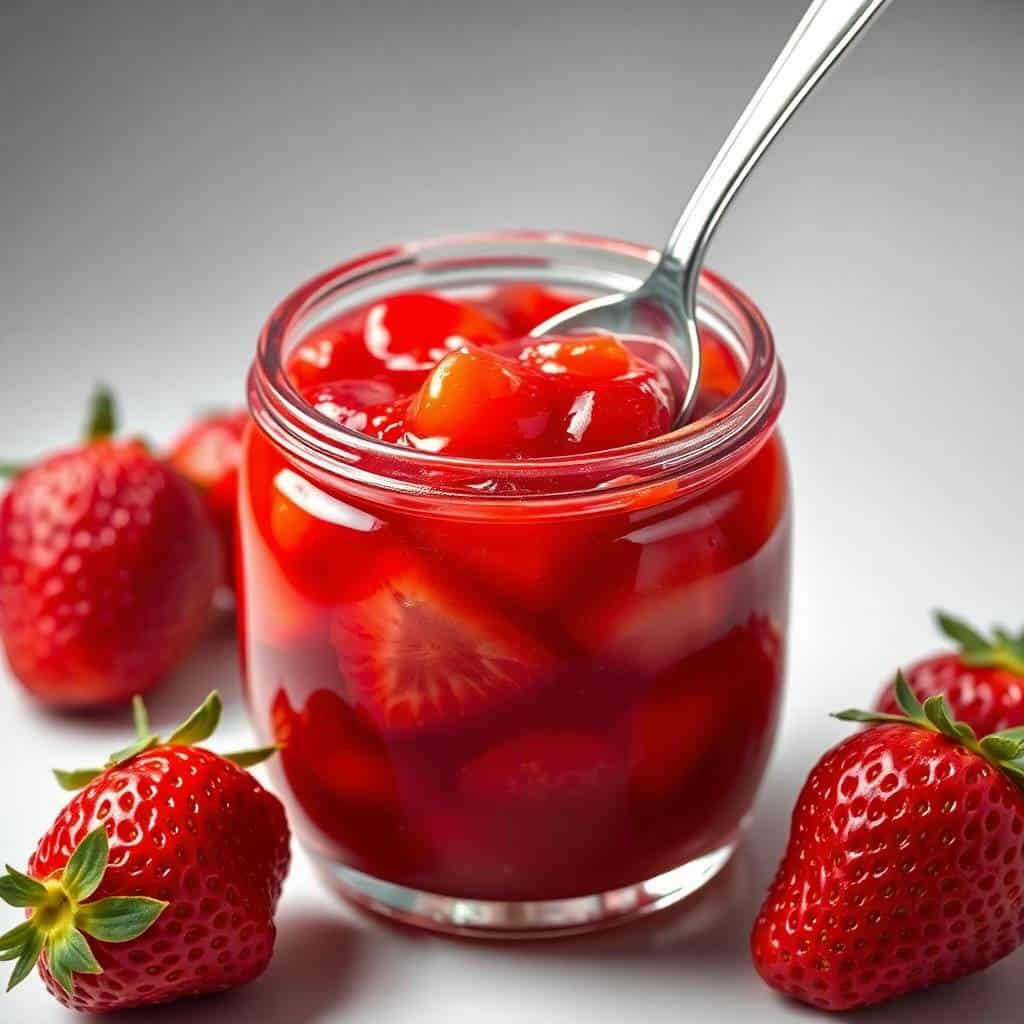
FAQ
Freezer jam that doesn't set has one of five causes: the crushed fruit was not measured accurately and there was too much fruit relative to the pectin and sugar; the pectin solution was not brought to a full rolling boil that could not be stirred down; the pectin was not stirred into the fruit mixture for the full 3 minutes; the jam was not given the full 24-hour setting time at room temperature before being judged; or the pectin package was old or expired. The most common cause is premature judgment — checking the jam after 4 hours rather than the full 24. If the jam truly hasn't set after 24 hours, it can be re-done: empty jars back into the bowl, prepare a new half-package of pectin solution, stir in and refill jars. Or simply use the unsetting jam as a vibrant fresh strawberry sauce.
Not in the classic Sure-Jell original (yellow box) recipe — the sugar is a functional ingredient that activates the pectin, not merely a sweetener. Reducing sugar in the original formula produces jam that does not set because the pectin chemistry requires the specified sugar concentration to function. For a reduced-sugar version, use Sure-Jell for Less or No Sugar Needed pectin (pink box) which is specifically formulated to set with less sugar and follow its package directions precisely. Alternatively, the chia seed version described in the variations section requires no pectin and works with minimal sweetener.
Freezer jam and regular (cooked) jam differ in three fundamental ways: cooking process, flavor, and storage requirements. Regular cooked jam is made by boiling the fruit, sugar, and pectin together until the mixture reaches the gel point — the heat concentrates flavors, develops a deeper, more complex cooked fruit flavor, and makes the jam shelf-stable without refrigeration when properly canned. Freezer jam is made without any cooking — the pectin is dissolved separately and stirred in cold, preserving the raw fruit's bright, fresh flavor completely. Freezer jam must always be refrigerated or frozen because it is not shelf-stable at room temperature. Flavor-wise: freezer jam tastes more like fresh raw fruit; cooked jam tastes more like deeply concentrated, cooked fruit preserves. Both are genuinely excellent with different flavor characters.
Yes — frozen strawberries work for freezer jam and are a reliable option during seasons when fresh strawberries are unavailable or poor quality. Thaw completely, drain off most but not all of the accumulated liquid (some liquid is part of the 2-cup measurement), and crush as you would fresh strawberries. Measure after crushing and draining to ensure the correct fruit quantity. Frozen strawberries generally produce a slightly softer set than fresh since the cell walls break down during freezing, releasing more liquid. If the finished jam seems looser than desired, it is still completely usable — the flavor of frozen strawberries at peak-season quality is genuinely good in freezer jam. Avoid using frozen strawberries packed in syrup — the added sugar disrupts the pectin chemistry.
Properly set freezer jam holds its shape softly when a spoonful is placed on a cold plate — it will settle slightly but should not run or spread aggressively across the plate. It should have a slightly glossy, jammy appearance and should mound slightly when scooped rather than pouring off the spoon like a sauce. Freezer jam sets noticeably softer than traditional cooked jam — a proper set for freezer jam looks almost like a loose jelly that holds its shape rather than the firm, sliceable set of commercial cooked jams. If the jam runs completely flat on a cold plate after 24 hours, it has not set properly. If it holds a soft mound with slight settling, it is correctly set. Remember: judge only after the full 24-hour room-temperature setting period.
Yes — frozen strawberries work for freezer jam and are a reliable option during seasons when fresh strawberries are unavailable or poor quality. Thaw completely, drain off most but not all of the accumulated liquid (some liquid is part of the 2-cup measurement), and crush as you would fresh strawberries. Measure after crushing and draining to ensure the correct fruit quantity. Frozen strawberries generally produce a slightly softer set than fresh since the cell walls break down during freezing food safely, releasing more liquid. If the finished jam seems looser than desired, it is still completely usable — the flavor of frozen strawberries at peak-season quality is genuinely good in freezer jam. Avoid using frozen strawberries packed in syrup — the added sugar disrupts the pectin chemistry.
Try the chia seed version for the simplest possible no-pectin approach, or the strawberry basil version for the most sophisticated flavor. Pair with our fresh strawberry pie, our strawberry galette, and our balsamic roasted strawberries for the complete peak-season strawberry recipe collection. 🍓✨🫙
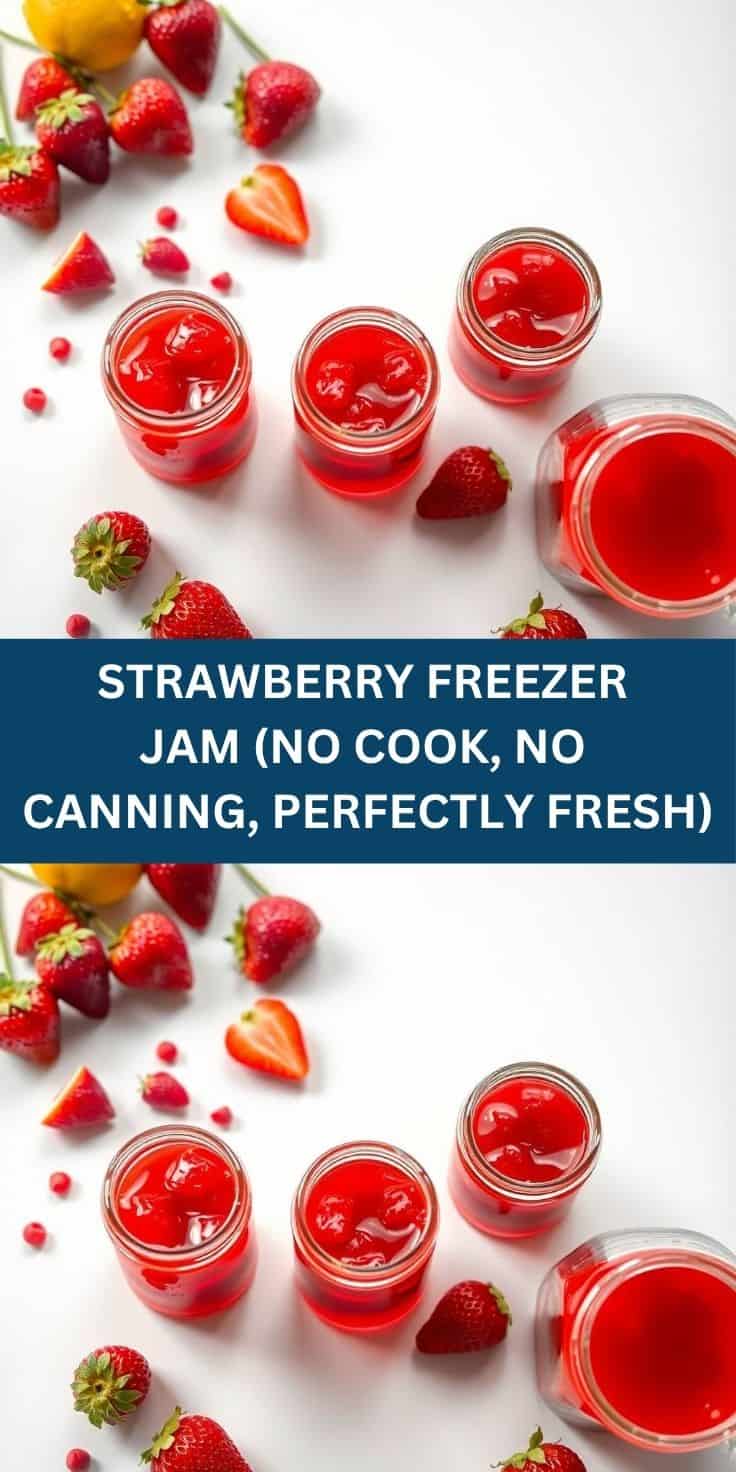
STRAWBERRY FREEZER JAM (NO COOK, NO CANNING, PERFECTLY FRESH)
Equipment
- Mixing Bowl
- Potato masher
- Measuring cups
- Freezer-safe jars or containers
Ingredients
Jam Ingredients:
- 2 cups fresh strawberries crushed
- 4 cups granulated sugar
- 1 package fruit pectin
- ¾ cup water
Optional Serving Ideas:
- toast or biscuits
- yogurt
- ice cream
Instructions
Prepare Strawberries:
- Wash, hull, and crush strawberries using a potato masher. Do not puree completely.
Mix Sugar:
- In a large bowl, combine crushed strawberries and sugar. Stir well and let sit for 10 minutes.
Prepare Pectin:
- In a saucepan, bring water and fruit pectin to a boil for 1 minute, stirring constantly.
Combine:
- Pour hot pectin mixture into strawberry mixture and stir for 3 minutes until sugar is mostly dissolved.
Store:
- Pour jam into freezer-safe containers, leaving a little space at the top. Let stand at room temperature for 24 hours.
Freeze:
- Store in freezer for up to 1 year or refrigerate for up to 3 weeks after thawing.
Notes
- Use ripe strawberries for the best flavor.
- Do not reduce sugar or jam may not set properly.
- Great homemade gift idea during strawberry season.

Comments
No Comments