
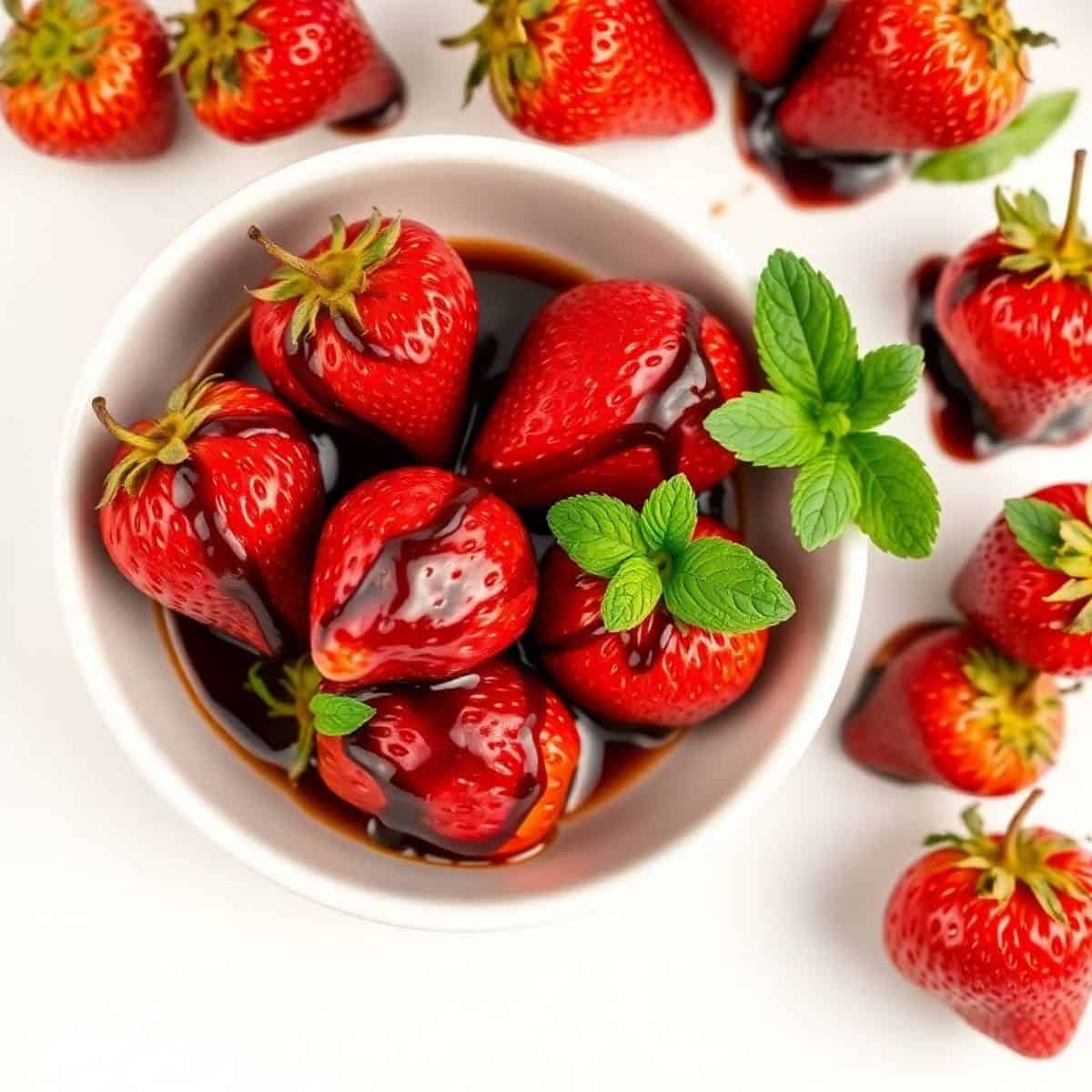
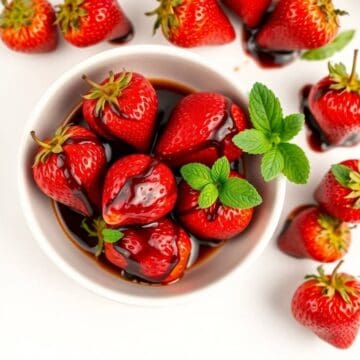
The recipe that I return to more consistently than almost any other during strawberry season — and that earns the most surprised, most appreciative responses from anyone who tastes it for the first time — is a sheet pan of balsamic roasted strawberries: halved fresh strawberries tossed with good balsamic vinegar, honey, vanilla, and a pinch of black pepper, roasted at high heat until they collapse into an intensely concentrated, deeply jewel-toned, syrupy preparation that is simultaneously simpler and more extraordinary than any other strawberry preparation I know. The roasting concentrates the strawberries' natural sweetness, the balsamic vinegar adds a complex acidity and depth, and the combination produces something that tastes like the distilled essence of the very best summer strawberry — amplified, deepened, and transformed into a sauce-adjacent preparation that works on everything.
What makes balsamic roasted strawberries so genuinely indispensable is their range of application — they are the most versatile prepared strawberry available in any kitchen. Spooned over vanilla ice cream, they are one of summer's most satisfying simple desserts. Swirled into Greek yogurt at breakfast, they transform a routine morning into something genuinely exciting. Spread onto a slice of pound cake with whipped cream, they replace an entire dessert preparation. Drizzled over a cheese board, they provide the most elegant sweet-acidic counterpoint to aged cheese available. Used as a sauce for pancakes or waffles, they are substantially better than any syrup. The roasted strawberries you make on Sunday are useful in genuinely different ways for every meal through the following week.
This post covers the classic balsamic roasted strawberry recipe in full detail with five variations for different flavor directions — a vanilla bean and brown sugar version for the sweetest and most dessert-appropriate result, a rosemary and black pepper version for the most sophisticated savory application, a orange zest and cardamom version for a warmly spiced direction, a honey and thyme version for an herbal elegance, and a balsamic strawberry sauce version for a completely smooth, syrupy preparation that works as the world's best ice cream topping and cake filling. Every version takes under 30 minutes from start to finish with less than 5 minutes of active preparation.
Let's make the most versatile strawberry recipe of the entire summer!
WHY YOU WILL LOVE THIS RECIPE
- The Roasting Process Creates a Flavor No Raw Strawberry Has: When strawberries roast at high heat, three things happen simultaneously — the natural sugars concentrate as moisture evaporates; the Maillard reaction creates caramelized flavor compounds at the cut surfaces; and the balsamic vinegar reduces and intensifies, its acidity softening and its sweetness deepening. The result is a preparation that tastes like strawberry taken to its most intense, most complex expression — sweeter, deeper, more acidic, and more interesting than the same fruit raw. This transformation is available only through heat and it is genuinely extraordinary.
- Transforms Underripe or Out-of-Season Strawberries into Something Outstanding: The greatest practical value of roasting strawberries is what it does to mediocre fruit — the pale, flavorless, out-of-season strawberries that taste of nothing raw are transformed by the roasting process into something genuinely flavorful as the sugar concentrates and the balsamic contributes complexity. This recipe is useful during peak season with extraordinary fruit and equally useful in the off-season with disappointing supermarket berries — the roasting process produces excellent results from both. No other strawberry preparation achieves this same redemption of mediocre fruit.
- Five Minutes of Active Preparation — The Oven Does Everything: Hull and halve the strawberries, toss with balsamic, honey, vanilla, and pepper, spread on a sheet pan, and roast for 20–25 minutes. The total active preparation time is under 5 minutes and the remainder is passive oven time. There is no monitoring required, no stirring during roasting, and no technique beyond the initial toss. This is genuinely one of the lowest-effort highest-impact recipes in the entire summer collection.
- Works as Dessert, Breakfast, Snack, and Appetizer Simultaneously: No other single recipe preparation works as effectively across as many meal contexts as balsamic roasted strawberries — over ice cream for dessert, swirled into yogurt for breakfast, on toast with ricotta for a snack, alongside aged cheese as an appetizer, and as a sauce for pancakes as brunch. A single batch made on Sunday serves genuinely different purposes for every meal through the week without any modification to the preparation.
- The Most Beautiful Deep Red Color in Any Summer Kitchen: Roasted balsamic strawberries develop a deep, lacquered, ruby-to-garnet color that is genuinely one of the most beautiful natural food colors available — the syrupy, shiny, deeply red preparation looks more like a high-end restaurant preparation than a simple sheet pan recipe, and spooning it over anything white (ice cream, yogurt, cheesecake, ricotta) creates a visual contrast of extraordinary beauty from almost zero effort.
- Stores for a Week and Improves Over 24 Hours: Balsamic roasted strawberries stored in a sealed jar in the refrigerator keep for 7 days and actually improve over the first 24 hours as the flavors continue developing and the syrup thickens slightly from the continued interaction of the balsamic and the berry juices. Making a batch at the beginning of the week means having genuinely outstanding roasted strawberries available for every meal throughout without any repeated preparation.
INGREDIENTS
- 1.5 lbs fresh strawberries — hulled and halved. For very large berries, quarter them so all pieces are approximately the same size and cook evenly. Uniform size is important for even roasting — pieces of very different sizes produce some overcooked and some undercooked berries in the same pan
- 3 tablespoons good balsamic vinegar — the quality of the balsamic matters significantly here since it is a primary flavor. A good-quality commercial balsamic (not the cheapest available, but not aged balsamico tradizionale either) produces excellent results. Look for one labeled "Modena" with a syrupy rather than thin consistency
- 2 tablespoons honey — or substitute maple syrup or granulated sugar
- 1 teaspoon pure vanilla extract
- ¼ teaspoon freshly cracked black pepper — the pepper is subtle but essential; it amplifies the strawberry and balsamic flavors in a way that is perceptible as "more interesting" without being identifiable as pepper
- Pinch of flaky sea salt
- Optional: 1 tablespoon granulated sugar if the strawberries are particularly tart or under-ripe
DIRECTIONS
- Step No.1: Preheat and prepare
Preheat oven to 400°F. Line a rimmed sheet pan with parchment paper — the parchment is non-negotiable for this recipe since the balsamic and berry juices create a sticky, caramelized coating on the pan surface that is very difficult to clean from bare metal and that burns easily if not on parchment. A silicone baking mat also works and is the most reliable non-stick surface for very sticky preparations. Hull the strawberries and halve them from tip to stem — cutting from tip through stem (rather than around the equator) produces the most visually attractive pieces with the pointed tip naturally visible in each half. Spread the halved strawberries in a single layer on the prepared sheet pan with the cut sides facing up — cut side up maximizes the direct exposure of the cut surface to the oven heat and produces more caramelization and more flavor development than cut side down.
- Step No.2: Make the balsamic mixture and toss
Whisk together balsamic vinegar, honey, vanilla extract, black pepper, and flaky salt in a small bowl until the honey is fully incorporated and the mixture is uniform. Drizzle this mixture evenly over the strawberries on the pan — do not toss in the bowl before transferring to the pan since the halved berries are fragile and tossing produces broken pieces that cook faster than intact halves and create an uneven roasting result. Use a pastry brush or a spoon to distribute the balsamic mixture across every berry if it pools in the center of the pan. Every berry half should be lightly, evenly coated with the balsamic mixture — the coating is what produces the beautiful caramelized surface during roasting rather than simply a wet, uncoated berry that steams rather than roasts.
- Step No.3: Roast to concentrated perfection
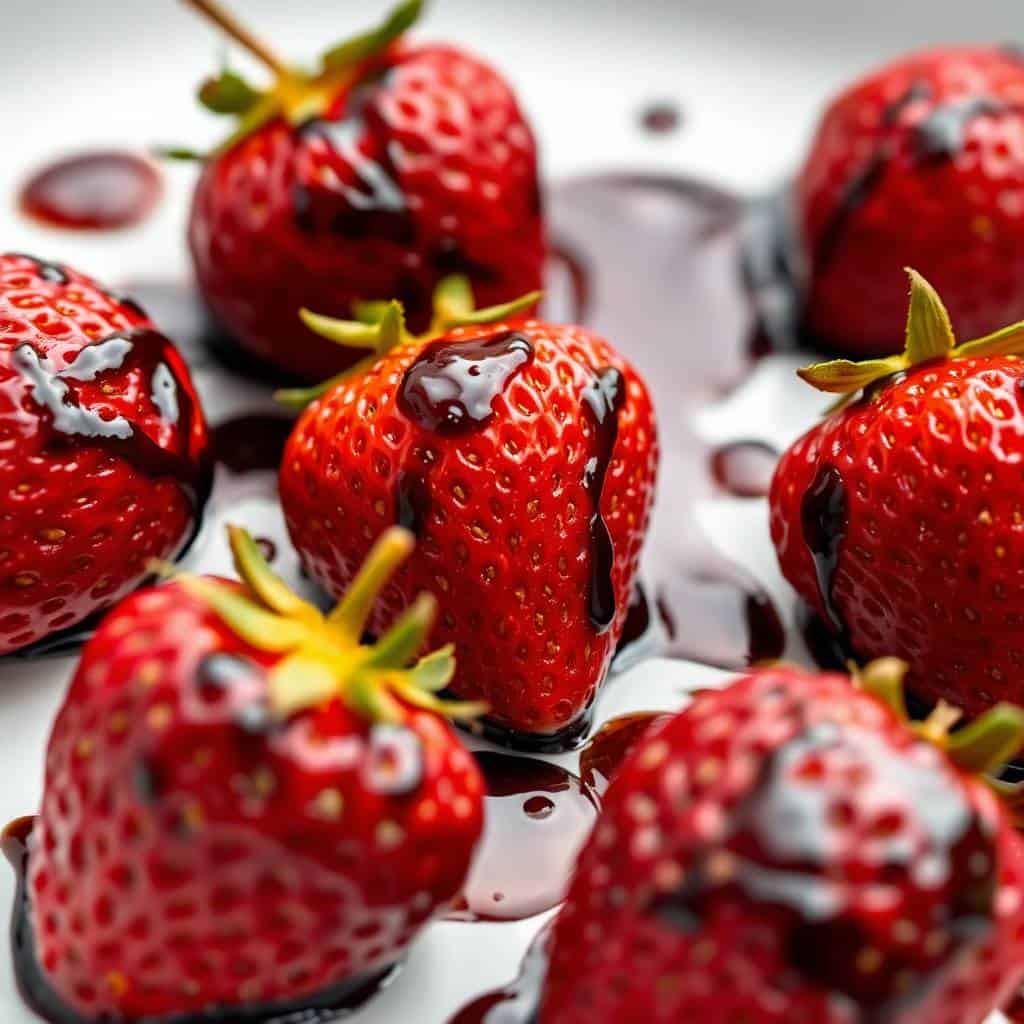
Roast at 400°F for 20–25 minutes without stirring — the high heat caramelizes the cut surfaces of the berries and reduces the balsamic-honey mixture into a thick, glossy syrup that pools around the berries and coats them as they cook. Check at 20 minutes: the berries should be collapsed, deeply red-purple in color, slightly caramelized at the cut edges, and sitting in a thick, syrupy liquid at the bottom of the pan. If the liquid is still thin and the berries are still holding their shape, continue roasting for 3–5 more minutes. Do not roast beyond the point where the syrup begins to darken at the edges of the pan — at that point the sugars are close to burning and the pan should come out immediately. The finished roasted strawberries should look deeply colored, slightly collapsed, and glossy with the reduced balsamic syrup pooled around them. A few lightly caramelized dark edges on some berries is ideal.
- Step No.4: Rest, transfer, and serve or store
Remove from the oven and allow to cool on the pan for at least 10 minutes before transferring — the syrup is extremely hot immediately from the oven and will burn instantly on contact with skin. As the strawberries cool, the syrup thickens further and the berries absorb some of the surrounding liquid, producing a more cohesive, more intensely flavored preparation than the fresh-from-oven result. Use a wide spatula or spoon to transfer the roasted strawberries and all their syrup from the pan into a jar or serving bowl — scrape every bit of the caramelized syrup from the parchment, as it is the most concentrated and most flavorful component of the entire preparation. Serve warm or at room temperature immediately, or refrigerate in a sealed jar for up to 7 days. The preparation thickens further during refrigeration and loosens slightly when brought to room temperature — stir before using from refrigerated storage.
TIPS FOR SUCCESS
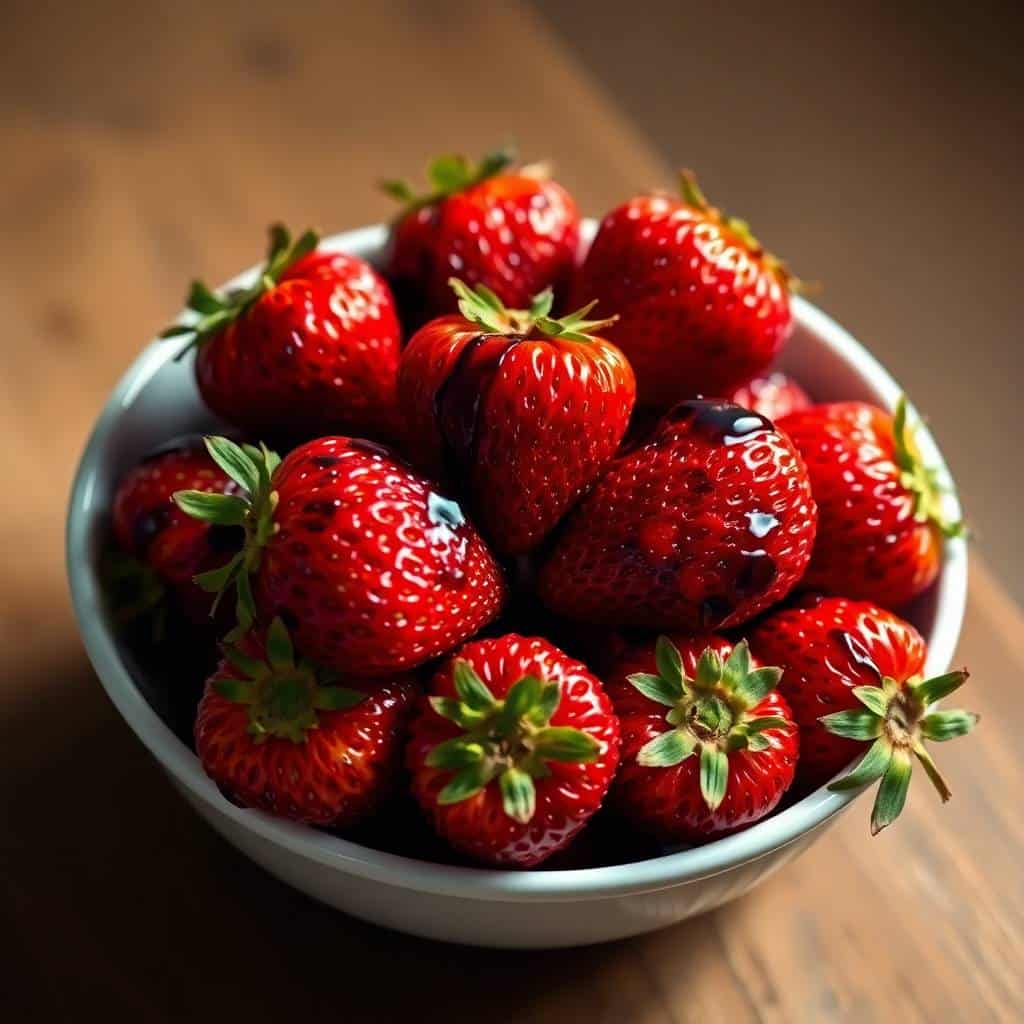
- Use a Rimmed Sheet Pan — Never a Flat Pan: The balsamic-honey mixture and the strawberry juice released during roasting need to be contained by the pan's rim — a flat sheet pan or a pan with only a very low lip allows the liquid to run over the edges and onto the oven floor where it burns immediately and produces acrid smoke. A standard half-sheet rimmed pan is the correct vessel and contains the released liquids throughout the roasting process.
- Don't Crowd the Pan — Single Layer Only: Crowded berries steam rather than roast — the moisture released by packed-together strawberries has nowhere to evaporate and the berries cook in their own steam rather than caramelizing in direct dry heat. Spread the halved strawberries in a genuinely single layer with small gaps between pieces if possible. If roasting a larger quantity, use two sheet pans rather than overloading one — two pans in the oven simultaneously is more practical than one crowded pan that produces inferior results.
- Use Good Balsamic — Not the Cheapest Bottle: The balsamic vinegar in this recipe is a primary flavoring component, not a background accent — the difference between a thin, sharp, low-quality balsamic and a good-quality, slightly syrupy balsamic from Modena is immediately and dramatically tasteable in the finished roasted strawberries. A good balsamic has genuine sweetness alongside its acidity, a complex flavor with wine notes and slight caramel undertones, and a viscosity that coats rather than runs. It does not need to be aged tradizionale — a mid-price good-quality balsamic produces excellent results for significantly less than artisan aged versions.
- Scrape Every Bit of Syrup from the Parchment: The caramelized balsamic-honey-strawberry syrup that pools on the parchment around and beneath the berries during roasting is the most intensely concentrated, most deeply flavored part of the entire preparation — it tastes like the essence of balsamic-roasted strawberry reduced to its most powerful form. Scraping this syrup from the parchment and incorporating it into the transferred strawberries is not optional housekeeping; it is harvesting the most valuable component of the recipe. Use a wide, flexible spatula and work the parchment surface thoroughly before discarding it.
- The Black Pepper Is Subtle but Essential: Black pepper in a fruit preparation sounds counterintuitive and the quantity used here is small enough that the result doesn't taste of pepper — but the piperine compound in black pepper amplifies the perception of other flavors, making the strawberry taste more strawberry-like and the balsamic taste more complex. Omitting the black pepper produces a preparation that tastes very good; including it produces one that tastes genuinely extraordinary in a way that is difficult to identify but immediately perceptible. Trust the pepper.
- Serve at Room Temperature Rather Than Straight from the Refrigerator: Cold balsamic roasted strawberries from the refrigerator have muted flavor and a thick, slightly stiff texture — the same preparation at room temperature has noticeably more vibrant flavor and a flowing, syrupy consistency that coats whatever it touches beautifully. Take the jar out of the refrigerator 20–30 minutes before serving for maximum flavor impact. For ice cream service specifically — where the contrast between cold ice cream and room-temperature roasted strawberries is part of the experience — the room-temperature strawberries against cold ice cream produces the most satisfying temperature contrast.
VARIATIONS
- Vanilla Bean and Brown Sugar Roasted Strawberries: Replace honey with 2 tablespoons of dark brown sugar and add the seeds scraped from half a vanilla bean (or 1.5 teaspoons of vanilla bean paste) to the balsamic mixture. The brown sugar adds a deeper, more molasses-forward sweetness than honey and the vanilla bean seeds create visible flecks throughout the preparation that look beautiful and contribute a more intense vanilla character than extract alone. This version is the sweetest and the most straightforwardly dessert-oriented of all the variations — the most natural pairing with vanilla ice cream, pound cake, and any preparation where the strawberries are the primary dessert component. Find more vanilla and strawberry pairings in our fresh strawberry pie.
- Rosemary and Black Pepper Roasted Strawberries: Add 2 teaspoons of very finely chopped fresh rosemary to the balsamic mixture and increase black pepper to ½ teaspoon. Replace vanilla extract with 1 teaspoon of good benefits of olive oil added after roasting. The rosemary version produces the most savory and most genuinely sophisticated of all the variations — the piney, slightly resinous herb against the sweet-acidic roasted berries creates a combination that is genuinely extraordinary on cheese boards (particularly with aged pecorino or parmigiano), on crostini with ricotta, alongside roasted pork or lamb, and on any preparation where the strawberries serve a savory or appetizer function rather than a dessert function. This version is the one to make when you want guests to ask what the flavor is.
- Orange Zest and Cardamom Roasted Strawberries: Add the zest of 1 large orange and ¼ teaspoon of ground cardamom to the balsamic mixture. The orange and cardamom combination gives the roasted strawberries a warmly spiced, slightly floral, Middle Eastern-adjacent flavor profile that is genuinely extraordinary — the cardamom amplifies both the strawberry and the orange in a way that makes the combination taste more complex and more interesting than either alone. This version is the most versatile across cultural contexts and the most interesting flavor variation for anyone wanting something beyond the classic. It pairs beautifully with labneh or thick Greek yogurt at breakfast, with orange blossom water whipped cream at dessert, or as part of a Middle Eastern-inspired dessert spread.
- Honey and Thyme Roasted Strawberries: Replace the balsamic vinegar with 1 tablespoon of balsamic and 2 tablespoons of good honey for a lighter, less intensely acidic version. Add 1 teaspoon of fresh thyme leaves — stripped from the stem — to the mixture before roasting. The thyme version is the most delicately herbal and the most genuinely elegant of all the variations — the earthy, slightly floral thyme against the sweet honey-roasted strawberries creates a combination that works beautifully on fresh ricotta toast, alongside a simple salad, as a component in a sophisticated cheese board, and as a filling for crêpes. The reduced balsamic quantity produces a lighter, slightly thinner syrup that is less intensely acidic and more approachable for guests who find full-balsamic preparations too sharp.
- Balsamic Strawberry Sauce (Completely Smooth): After roasting according to the classic recipe, transfer the entire pan contents — berries and all accumulated syrup — to a blender or food processor. Add 1 tablespoon of additional honey and 1 tablespoon of water. Blend on high for 60 seconds until completely smooth. Pass through a fine-mesh sieve if an extremely smooth, seed-free sauce is desired. The resulting sauce is a deeply colored, intensely flavored, completely smooth balsamic strawberry sauce that is one of the most extraordinary ice cream toppings available — it pours beautifully, coats the back of a spoon, and tastes of pure concentrated roasted strawberry with complex balsamic depth. It also works as a cake filling, a cheesecake topping, a coulis for plated desserts, and a sauce for panna cotta. Store refrigerated for up to 10 days and use in every dessert context that calls for a strawberry component. Find more ways to use this sauce in our strawberry lemonade poke cake.
HOW TO USE BALSAMIC ROASTED STRAWBERRIES
For dessert: Spoon generously over vanilla ice cream, onto a slice of pound cake or angel food cake with whipped cream, over a cheesecake slice, atop a pavlova with whipped cream and fresh mint, onto panna cotta, or as the fruit component in a trifle alongside custard and ladyfingers. The balsamic roasted strawberries work on any creamy, neutral dessert base as the most complex and most genuinely interesting strawberry topping available. Find perfect pairings in our strawberry icebox cake and our strawberry lemonade poke cake.
For breakfast: Swirl through plain or vanilla Greek yogurt for an instantly elevated breakfast bowl. Spoon over pancakes, waffles, or French toast in place of syrup for the most outstanding breakfast fruit topping available. Spread onto toast with ricotta and a drizzle of additional honey for an effortlessly beautiful morning toast. Fold through overnight oats with granola for a make-ahead breakfast that tastes genuinely special rather than routine.
For entertaining: Serve alongside a cheese board with aged pecorino, manchego, or brie — the sweet-acidic roasted strawberries against the salty, complex cheese is one of the most reliably exciting flavor combinations at any gathering. Spoon onto crostini with whipped ricotta and fresh basil for an elegant appetizer that takes under 10 minutes to assemble. Use as a glaze for roasted pork tenderloin in the final 10 minutes of cooking for an extraordinary savory application of the sweet preparation.
SERVING AND STORAGE
Serving
balsamic roasted strawberries are best served at room temperature or slightly warm — not hot from the oven (where the syrup is dangerously hot and runny) and not cold from the refrigerator (where the flavors are muted and the syrup is stiff). Remove from the refrigerator 20–30 minutes before serving. For a composed dessert presentation, spoon generously over a white surface — vanilla ice cream, ricotta, crème fraîche, or whipped cream — and allow the deep ruby syrup to pool visibly around the strawberries for the most visually striking presentation. Finish with a few fresh basil or mint leaves, a crack of black pepper, and an additional drizzle of good balsamic for the most complete flavor profile at the table.
Storage
Balsamic roasted strawberries store refrigerated in a sealed glass jar for up to 7 days — the flavor genuinely improves over the first 24–48 hours as the components continue melding and the syrup thickens further. The preparation does not freeze well in its chunky form — the berries become watery and lose their texture on thawing. The blended sauce version (the smooth variation) freezes excellently for up to 3 months in a sealed container or in ice cube trays — frozen sauce cubes can be thawed individually as needed. Store in glass rather than plastic when possible since the balsamic can stain plastic containers permanently and can absorb into plastic in a way that affects both the container and the flavor of subsequent preparations stored in it.
FAQ
Balsamic vinegar does several things to strawberries simultaneously when roasted together. The acid in the balsamic draws moisture from the strawberries and interacts with their natural pectin, helping the released juice thicken into a syrup during roasting. The balsamic's residual sugars caramelize during the high oven heat alongside the strawberry's natural sugars, creating caramelized flavor compounds at the berry surfaces. The balsamic's complex flavor — wine notes, slight caramel, deep acidity — amplifies and deepens the strawberry's natural flavor rather than competing with it. Raw balsamic on strawberries produces a pleasant bright-acidic result; roasted balsamic on strawberries produces a deeply complex, concentrated, syrupy preparation that is fundamentally more interesting than either component alone.
Yes — a stovetop version produces a genuinely good result, though the texture and flavor are slightly different from the oven-roasted version. Combine halved strawberries, balsamic vinegar, honey, vanilla, and pepper in a wide, heavy skillet over medium-high heat. Cook without stirring for 3–4 minutes until the berries begin releasing juice, then stir gently and continue cooking for 4–5 more minutes until the liquid reduces to a syrupy consistency and the berries are softened but still holding some shape. The stovetop version produces berries that are more uniformly cooked through and a syrup that is less caramelized than the oven version. The oven version produces better caramelization and a more complex flavor from the dry heat, but the stovetop version is faster and entirely acceptable when oven use is impractical.
The single best pairing for balsamic roasted strawberries is vanilla ice cream — the contrast between the warm-or-room-temperature deeply flavored roasted berries and the cold, neutral ice cream, with the syrup pooling in the bowl and coating every bite, is one of the most genuinely satisfying simple desserts available. The second-best pairing is fresh ricotta on toasted bread — the creamy, mild ricotta provides the perfect neutral backdrop that lets the complex roasted strawberry flavor dominate. Third is cheesecake — the dense, tangy cheesecake against the sweet-acidic strawberries is extraordinary. Beyond these top three, the strawberries work beautifully on yogurt, pancakes, pound cake, panna cotta, and pavlova — essentially any preparation with a white or neutral base that allows the deep color and complex flavor to be the primary visual and flavor element.
Yes — frozen strawberries work for balsamic roasting and produce a genuinely good result, though with some differences from fresh. Thaw the strawberries completely and drain them thoroughly, pressing gently to remove as much liquid as possible before roasting. The cell walls of frozen strawberries have already broken down during freezing food safely, which means they release significantly more liquid during roasting than fresh strawberries and produce a thinner, more sauce-like result rather than the semi-intact berries that fresh produces. To compensate, roast at 425°F rather than 400°F and expect a slightly longer roasting time of 25–30 minutes as the additional liquid evaporates. The flavor of frozen strawberries roasted with balsamic is genuinely excellent — arguably better than fresh out-of-season supermarket strawberries since the freezing was done at peak ripeness.
Balsamic roasted strawberries stored in a sealed glass jar in the refrigerator keep for 7 days and improve over the first 24–48 hours as the flavors continue developing and the syrup thickens slightly. The high sugar and acid content of the preparation (from the honey and balsamic) acts as a natural preservative that extends the storage life significantly beyond plain cooked fruit. Discard if any off-smell, visible mold, or unusual fermentation signs develop — though in practice these are extremely rare within the 7-day storage period. The smooth blended sauce version stores refrigerated for 10 days and frozen for up to 3 months.
These balsamic roasted strawberries are the 5-minute preparation that earns the most consistent, most enthusiastic responses of any simple recipe in the summer collection — make a jar on Sunday and watch how every meal through Friday benefits from its presence in the refrigerator.
Try the rosemary and black pepper version for the most sophisticated savory application, or the smooth balsamic strawberry sauce for the most versatile dessert component. Pair with our fresh strawberry pie, our strawberry galette, and our strawberry freezer jam for the complete peak-season strawberry collection that covers every occasion from casual to celebratory. 🍓🫙✨
BALSAMIC ROASTED STRAWBERRIES (THE MOST VERSATILE SUMMER RECIPE YOU'LL MAKE)
Equipment
- Baking sheet
- Parchment paper
- Mixing Bowl
- Oven
Ingredients
Strawberries:
- 4 cups fresh strawberries hulled and halved
Flavoring:
- 2 tablespoon balsamic vinegar
- 2 tablespoon honey
- 1 tablespoon brown sugar
- 1 teaspoon vanilla extract
- pinch of salt
Instructions
Prep Oven:
- Preheat oven to 400°F (200°C). Line a baking sheet with parchment paper.
Season Strawberries:
- In a bowl, toss strawberries with balsamic vinegar, honey, brown sugar, vanilla, and a pinch of salt.
Roast:
- Spread strawberries in a single layer on the baking sheet. Roast for 15–20 minutes until soft and syrupy.
Cool Slightly:
- Let strawberries cool for 5–10 minutes so the syrup thickens.
Serve:
- Serve warm or chilled over yogurt, ice cream, pancakes, cheesecake, or toast.
Notes
- Roasting intensifies strawberry flavor and sweetness.
- Great as a topping or sauce base.
- Store in fridge for up to 5 days.


Comments
No Comments