
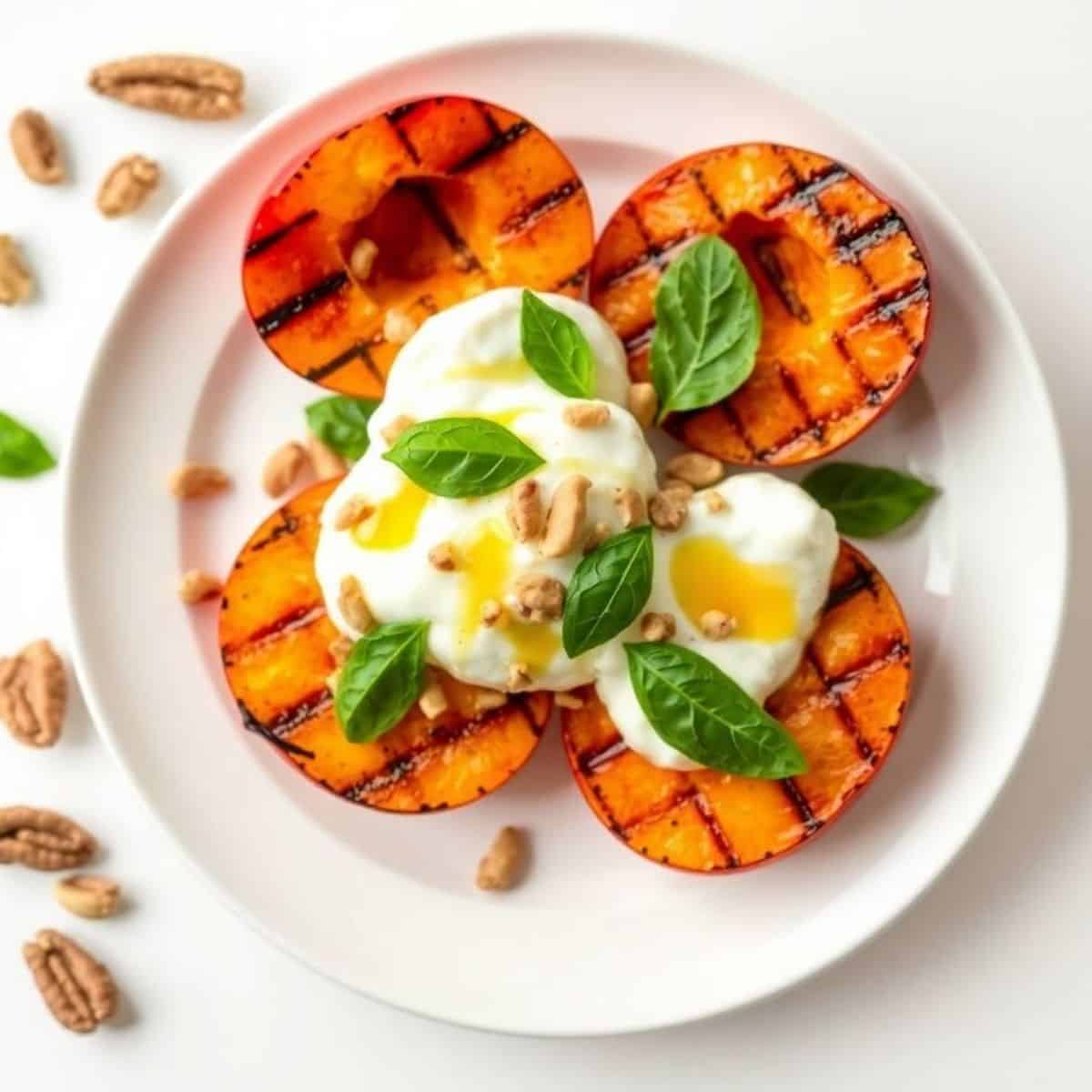
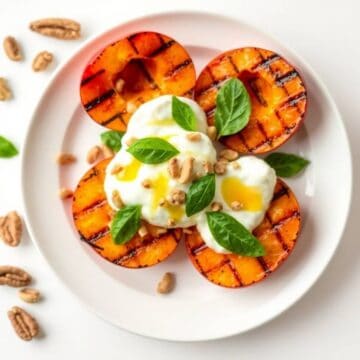
The dish that earns the most genuine, most immediate admiration of anything I make at summer dinner parties — served as either a starter or a dessert depending on the occasion and the crowd — is a platter of grilled peaches with burrata: caramelized, smoky peach halves straight from the grill with their cut surfaces deeply golden and slightly charred, placed alongside torn balls of room-temperature burrata whose cream spills out dramatically, with a generous drizzle of good honey, crushed toasted pistachios, fresh basil leaves, a crack of black pepper, and a pinch of flaky sea salt across everything. It is one of those preparations where the whole is so dramatically greater than the sum of its parts that people stop mid-conversation to ask what they are eating and how it was made.
What makes this combination so genuinely extraordinary is the specific contrast of flavors and temperatures operating simultaneously in every bite — the warm, caramelized, slightly smoky peach flesh against the cool, milky, almost liquid cream interior of torn burrata; the sweetness of the honey amplifying both the peach's natural sugar and the burrata's fresh milk character; the crunch of the toasted pistachios providing the textural contrast that makes each bite more interesting; and the fresh basil's fragrance brightening every element it touches. This is the kind of dish that tastes like someone spent hours calibrating every component when the entire preparation takes under 15 minutes from first peach on the grill to platter on the table.
This post covers the classic grilled peaches with burrata in full technical detail — the peach selection, the grill preparation, the burrata handling, and the finishing — plus five genuinely different variations for different occasions and flavor directions: a savory prosciutto version that works as an appetizer, a balsamic reduction version with deeper complexity, a honey lavender version with floral elegance, a spiced brown butter version for the most indulgent result, and a version with grilled nectarines and whipped ricotta for a different stone fruit direction. Every version produces a preparation that looks and tastes genuinely restaurant-quality from a home grill with minimal effort.
Let's make the most elegant summer dish on your grill!
WHY YOU WILL LOVE THIS RECIPE
- The Most Impressive 15-Minute Summer Dish Available: From cold peaches to plated presentation is under 15 minutes — 8 minutes of grill time, 5 minutes of assembly and garnishing, and 2 minutes of plating. The visual result looks like something assembled by a trained chef for a restaurant menu, and the flavor is extraordinary in a way that no amount of effort or complexity can substitute for the genuinely perfect simplicity of the ingredient combination. This is the dish where the quality of each individual component does all the work and technique is simply about not getting in the way.
- Works as Both Appetizer and Dessert: The savory elements — burrata, black pepper, fresh basil, flaky salt — make this preparation as appropriate as a first course at a dinner party as a dessert course. Served before the main as an appetizer, it reads as a sophisticated composed salad; served after the main as dessert, the honey and the peach sweetness reframe it entirely as a fruit dessert. The flexibility across meal contexts makes it the single most versatile plated summer preparation available from the grill.
- The Ingredient Quality Does All the Work — No Technique Required: Grilled peaches with burrata is a recipe where buying the best available ingredients is the entire difference between a preparation that is very good and one that is genuinely extraordinary. A peak-season peach from a farmer's market at its maximum ripeness, a high-quality burrata from a good Italian market, single-origin raw honey, and the best benefits of olive oil available — these four ingredient choices produce a dish that no technique upgrade can replicate with inferior materials. Shop well for this recipe and the cooking is almost incidental.
- The Visual Presentation Is Inherently Stunning: The caramelized golden-to-amber cut surfaces of grilled peaches, the white burrata whose cream spills across the plate in a pool, the deep green of fresh basil, the golden drizzle of honey, and the pale green of crushed pistachios create one of summer's most beautiful color palettes on a plate — all produced naturally by the ingredients themselves without any staging, arranging, or presentation skill beyond placing components beside each other on a platter.
- Celebrates Peak Peach Season at Its Most Pure: The grilling process concentrates and caramelizes the peach's natural sugars without adding sweetness from external sources — the result is peach flavor at its most intense and most purely expressed. This is the preparation to make specifically during the 3–4 week window when local peaches are at their absolute peak in late July and August, and to repeat as many times as that window allows before the season passes.
- The Combination Converts Peach Skeptics Immediately: People who claim to not particularly love peaches — who find fresh peaches either too sweet, too soft, or too generic — consistently love grilled peaches with burrata. The grilling's caramelization adds complexity beyond fresh-peach sweetness; the burrata's creaminess changes the textural experience completely; the salt and pepper reframe the entire preparation as savory-leaning. This is the dish that most reliably produces enthusiastic responses from guests who didn't expect to love what they were eating.
INGREDIENTS
- The Peaches:
- 4 ripe but firm peaches — halved and pitted. The firmness is critical: very ripe, very soft peaches collapse on the grill before they develop proper caramelization. Choose peaches that smell deeply fragrant (indicating peak ripeness and sugar content) but yield only slightly to gentle pressure rather than feeling soft. Freestone peaches separate from the pit cleanly — clingstone peaches require cutting around the pit with a small knife
- 1 tablespoon neutral oil or a very light brush of olive oil — for the cut surfaces before grilling
- 1 tablespoon honey — for the cut surfaces before grilling, which encourages caramelization
- The Burrata and Garnishes:
- 2–3 balls fresh burrata (4 oz each) — at room temperature. Cold burrata from the refrigerator doesn't flow properly and its flavors are muted — remove from the refrigerator 30–45 minutes before serving and drain from its liquid before plating
- 3–4 tablespoons good honey for drizzling — the best quality honey available. A single-varietal artisan honey — orange blossom, wildflower, or acacia — contributes flavor complexity that commercial blended honey doesn't provide
- ¼ cup pistachios, toasted and very roughly crushed — leave some pieces almond-sized and some smaller for textural variety. Toast in a dry skillet for 3–4 minutes until fragrant and beginning to color
- 12–15 fresh basil leaves, left whole or very roughly torn — added at the very last moment before serving
- Flaky sea salt — Maldon or fleur de sel
- Freshly cracked black pepper — generously
- 2 tablespoons good extra-virgin olive oil for finishing — the best bottle available, used as a finishing drizzle rather than a cooking oil
DIRECTIONS
- Step No.1: Prepare and temper the components
Remove burrata from the refrigerator 30–45 minutes before serving and allow to come to room temperature — this is the most important preparation step in the entire recipe. Cold burrata does not flow when torn, its flavor is muted compared to room-temperature burrata, and its creamy center stays solid rather than pooling beautifully across the plate. Drain the burrata from its liquid and place on a plate lined with paper towels to absorb surface moisture — excess moisture from the packing liquid dilutes the plate's juices and makes the presentation watery. Toast the pistachios in a dry skillet over medium heat for 3–4 minutes until fragrant, then roughly crush on a cutting board with the flat side of a knife — aim for a mix of sizes. Halve the peaches and remove the pits — for clingstone varieties, cut around the pit with a small paring knife.
- Step No.2: Prepare the grill
Preheat the grill to medium-high — 400–425°F. Grilled peaches need lower heat than most grilled items because their high natural sugar content burns at very high temperatures before the interior can warm through. Clean grill grates with a wire brush and oil thoroughly with a paper towel dipped in neutral oil applied with tongs. Brush the cut surfaces of each peach half very lightly with neutral oil — just enough to prevent sticking and promote caramelization. Drizzle a very small amount of honey across the cut surfaces as well — the honey caramelizes against the hot grates and creates a deeper, more complex caramelized surface than oil alone produces.
- Step No.3: Grill the peaches
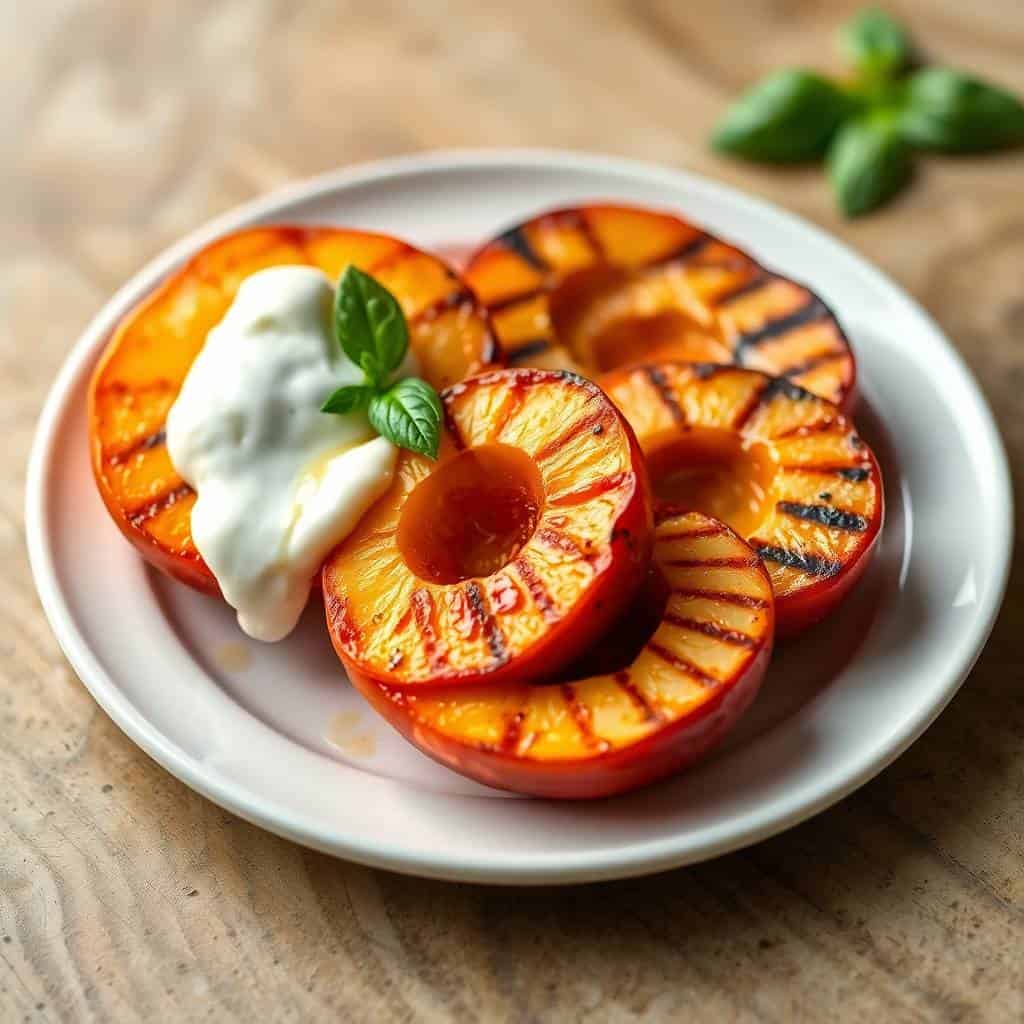
Place peach halves cut-side down on the preheated, oiled grill. Do not move them for the first 3 minutes — undisturbed contact with the hot grates is what produces the dramatic grill marks and caramelization that make grilled peaches visually extraordinary. After 3 minutes, check by gently lifting one edge with tongs — the cut surface should show distinct deep grill marks with golden-to-amber caramelization between the marks and should release cleanly from the grates. If it sticks, wait 60 more seconds. The cut surface should look like deeply caramelized stone fruit — slightly charred at the grill mark lines, golden in between, fragrant with cooked peach sugar. Turn the peaches and grill on the skin side for 2–3 more minutes until the skin is slightly charred and the peach flesh is warmed through but still holds its shape. Total grill time: 5–7 minutes. Remove from the grill and allow to rest on the platter for 2–3 minutes before adding burrata — the brief rest allows the interior to finish warming from residual heat without continuing to cook on the grill.
- Step No.4: Assemble the platter
Arrange the grilled peach halves across a large, wide serving platter — a wide platter displays every component simultaneously rather than stacking them in a bowl where individual elements are hidden. Place the grilled peaches in a natural, slightly casual arrangement with the caramelized cut surfaces facing up. Drain the room-temperature burrata balls and place them between and around the peach halves on the platter — two or three balls for 8 peach halves, depending on the size. Do not tear the burrata yet — the dramatic tearing happens at the table. Drizzle honey generously over the entire platter — across the peach cut surfaces and across the still-intact burrata, letting it pool in the cavity left by the pit and drip down the sides of each peach half.
- Step No.5: Finish and serve immediately
Scatter toasted crushed pistachios generously across the entire platter — they should be visible on every component. Drizzle the best available olive oil across everything in a thin stream — the olive oil adds a fruity, peppery finish that bridges the sweet peach and the rich burrata. Crack black pepper generously across the platter — more than seems comfortable is the correct amount, as the pepper provides the savory note that keeps this preparation from being only sweet. Scatter flaky sea salt across everything. Add fresh basil leaves last — whole or gently torn, scattered naturally across the platter. Bring the platter to the table intact so guests can see the assembled presentation before serving — then tear the burrata open at the table allowing the cream to spill across the platter for the most dramatic serving moment. Serve immediately while the peaches are still warm against the cool burrata.
TIPS FOR SUCCESS
- The Burrata Must Be at Room Temperature: This instruction appears twice in this recipe because it is that important. Burrata served cold is a fundamentally different product from burrata served at room temperature — the stracciatella cream filling is solid and unflowing when cold, its flavor is muted and milky without complexity, and it doesn't interact with the warm peaches in the temperature-contrast way that makes the dish extraordinary. Room-temperature burrata flows, its flavor opens fully, and against warm grilled peaches it creates the temperature contrast that makes every bite simultaneously warm and cool. Set a phone reminder when you take the burrata from the refrigerator — 30–45 minutes is the minimum, 45–60 minutes is better.
- Choose Ripe But Firm Peaches — Not Overripe: Overripe, very soft peaches collapse on the grill before their cut surfaces can develop proper caramelization — the flesh turns to mush against the hot grates rather than caramelizing to a firm, golden surface. The peach should smell deeply of ripe peach and feel like a firm ripe avocado — yielding slightly to firm pressure but not soft or squishy. If the only available peaches are slightly underripe, this is preferable to overripe for grilling — the heat will soften slightly underripe fruit while caramelizing its surface, producing a better result than soft overripe fruit that collapses.
- Grill at Medium-High Rather Than High Heat: Peaches' high natural sugar content burns at the temperatures appropriate for daily protein needss — the sugars caramelize and quickly transition to bitter char at 500°F+ grill temperatures. Medium-high heat (400–425°F) produces the most beautiful golden caramelization on the cut surfaces without burning the sugars before the interior warms. The slower caramelization at medium-high also produces a more evenly caramelized surface — dramatic golden color across the entire cut surface rather than dark char at the grill marks with pale areas between them.
- Use the Best Honey Available: The honey drizzled over grilled peaches and burrata is one of the most prominent flavors on the plate — it directly coats the peach surfaces, mixes into the burrata cream, and coats every pistachio and basil leaf it contacts. A complex, fragrant, genuinely high-quality honey contributes flavor dimension beyond mere sweetness — floral notes, mineral complexity, a slight wildflower bitterness — that commercial blended honey doesn't provide. This is one of the relatively few recipes where upgrading the honey produces an immediately noticeable improvement in the finished result.
- Don't Skip the Black Pepper and Flaky Salt: The combination of honey sweetness, peach sweetness, and burrata creaminess without the counterbalance of salt and pepper produces a preparation that is one-dimensionally sweet and lacks the complexity that makes it genuinely extraordinary. The black pepper's slight heat and the flaky salt's mineral contrast are the components that elevate this from a sweet fruit and cheese combination to something with genuine culinary sophistication. Season more generously than seems comfortable — the sweet components absorb seasoning and need more of it than a savory dish at the same volume.
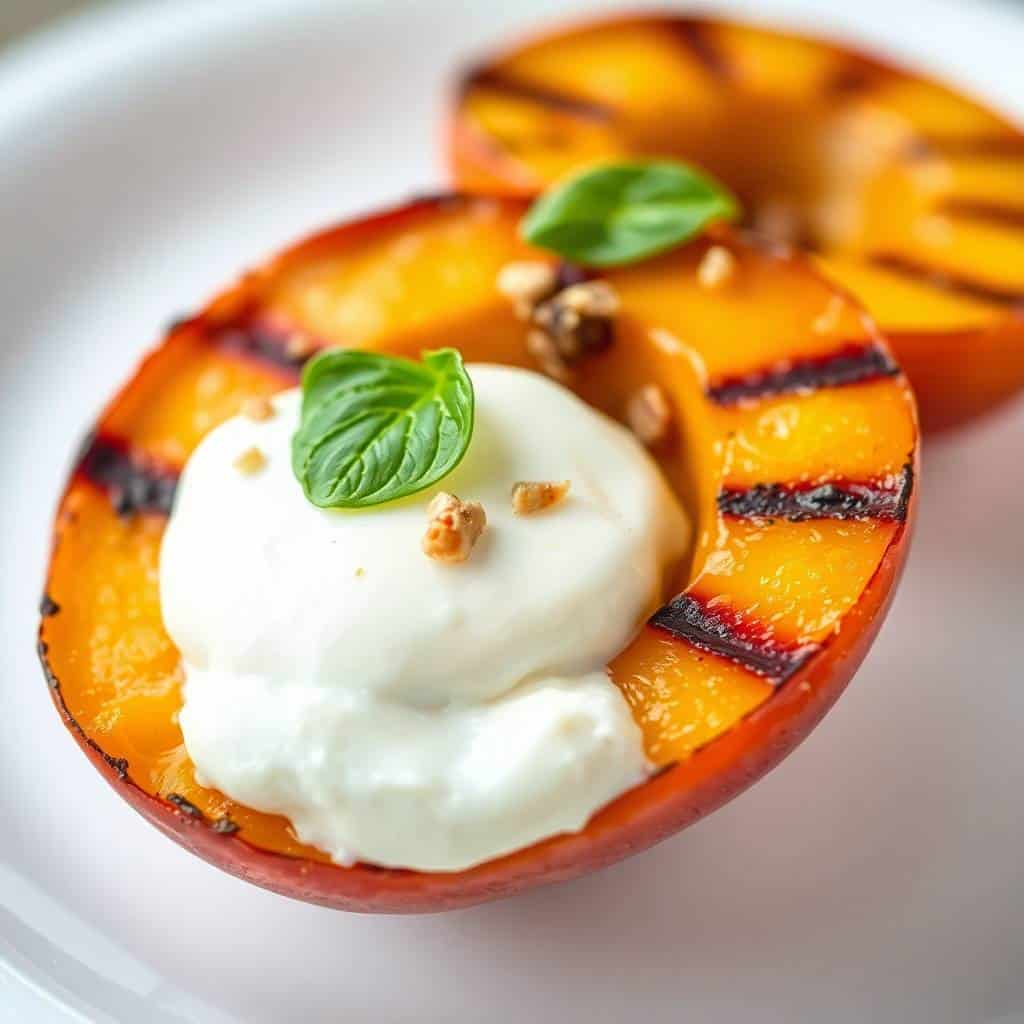
- Tear the Burrata at the Table: An intact burrata ball is beautiful on the platter and creates anticipation. A torn burrata ball with cream spilling across the platter is extraordinary — the visual of the white cream flowing across the caramelized amber peaches and pooling among the pistachios and basil is the single most dramatic moment of the entire presentation. Preserve this moment for the table rather than tearing in the kitchen — the 30-second presentation of the platter before the burrata is torn is genuinely one of the most impressive plated dish presentations available from any home cooking preparation.
VARIATIONS
- Prosciutto and Arugula Grilled Peach Burrata (Savory Appetizer Version): Add 4–6 thin slices of prosciutto crudo draped across the assembled platter alongside the burrata and peaches, and replace the basil with a small handful of lightly dressed arugula (olive oil, lemon juice, salt, pepper) piled in the center of the platter. The addition of prosciutto and arugula shifts this preparation fully into savory appetizer territory — the combination of salty prosciutto, peppery arugula, sweet grilled peach, and creamy burrata is one of the most classically Italian and most thoroughly satisfying flavor combinations available. Find more prosciutto and burrata pairings in our grilled pizza recipe.
- Balsamic Reduction and Thyme Version: Replace the honey drizzle with a reduction of good balsamic vinegar — simmer ½ cup balsamic vinegar in a small saucepan for 8–10 minutes until it reduces to a thick, syrupy consistency that coats a spoon. Drizzle the warm balsamic reduction across the platter in place of honey. Replace basil with fresh thyme leaves. Add a small handful of toasted walnuts instead of pistachios. The balsamic reduction version is deeper, more acidic, more complex, and more genuinely sophisticated than the honey version — it is the choice for the most elegant dinner party occasions where you want the preparation to taste like something from a serious restaurant kitchen. Find more balsamic inspiration in our balsamic roasted strawberries.
- Honey Lavender Grilled Peaches with Burrata: Make a lavender-infused honey — combine ¼ cup honey with 1 tablespoon dried culinary lavender in a small saucepan, warm gently for 5 minutes until fragrant, then strain out the lavender. Use the lavender honey as the drizzle. Replace fresh basil with fresh mint. The lavender honey version is the most delicate and the most floral of all the variations — its subtle herbal fragrance elevates the combination into something that feels distinctly Provençal and genuinely special. This is the version to make for bridal showers, garden parties, and any occasion where the aesthetic leans toward elegant femininity.
- Spiced Brown Butter Grilled Peaches with Burrata: Make a spiced brown butter — cook 4 tablespoons butter in a small skillet over medium heat until the milk solids turn golden and the butter smells deeply nutty and toasted (approximately 3–4 minutes), then remove from heat and add ¼ teaspoon cinnamon, ¼ teaspoon cardamom, and a pinch of cayenne. Brush the grilled peaches with this spiced brown butter immediately after removing from the grill. Drizzle additional brown butter across the burrata on the assembled platter. The spiced brown butter version is the richest, most warming, and most deeply indulgent of all the variations — the combination of caramelized butter, warm spices, and grilled peach sweetness against the cool burrata is genuinely extraordinary and makes this preparation appropriate for early fall evenings when the warmth of spice is welcome.
- Grilled Nectarines with Whipped Ricotta: Replace peaches with firm-ripe nectarines — their slightly more acidic, slightly less sweet character provides a different counterpoint to the dairy component than peaches. Replace burrata with whipped ricotta — beat 1 cup whole milk ricotta with 2 tablespoons good olive oil, 1 teaspoon lemon zest, ½ teaspoon salt, and black pepper until smooth and light. Spread the whipped ricotta across the base of a platter and arrange the grilled nectarines on top. The whipped ricotta version is lighter and less rich than the burrata version while maintaining the same essential character — warm grilled stone fruit against cool, creamy, slightly tangy dairy. It is the better choice when burrata is unavailable or when a lighter preparation is desired. Find more nectarine inspiration in our grilled desserts collection.
SERVING AND STORAGE
Serving
Bring the fully assembled platter to the table before tearing the burrata — the intact presentation creates anticipation and the act of tearing at the table is the most dramatic serving moment available from this preparation. Serve immediately after tearing, while the peaches are still warm and the burrata is at room temperature — the temperature contrast between the two is fundamental to the eating experience and diminishes quickly as both components approach room temperature. Serve with good bread alongside for absorbing the honey, olive oil, and burrata cream that pools on the platter — the residual liquid on the plate is one of the best things available for bread-dipping at any summer table.
Storage
Grilled peaches with burrata does not store well in its assembled form — the burrata weeps and loses its character within 30 minutes of tearing, and the grilled peaches cool and lose their caramelized surface character over time. This is a make-to-order preparation that should be assembled and served within 15 minutes of the peaches coming off the grill. For advance preparation: the peaches can be grilled up to 2 hours ahead and held at room temperature — briefly warm in a 350°F oven for 5 minutes or in a skillet before assembling. The burrata should be tempered from the refrigerator no more than 1 hour before serving. Do not refrigerate assembled plates. Leftover grilled peaches (without burrata) store refrigerated for 2 days and work excellently in overnight oats, yogurt bowls, and as a topping for pancakes or waffles the following morning.
FAQ
Burrata is a fresh Italian cheese made from mozzarella and cream — it consists of a thin outer shell of solid mozzarella filled with stracciatella, a mixture of shredded mozzarella and fresh cream that is soft, loose, and flows when the outer shell is torn. Regular fresh mozzarella is solid throughout with a uniform elastic texture and a clean, milky flavor. Burrata has the same mozzarella exterior flavor but a dramatically richer, creamier, more indulgent interior that pours out when torn — it is significantly richer, more luxurious, and more perishable than regular mozzarella. Burrata is available at most Whole Foods, Italian markets, and increasingly at standard grocery stores in the cheese section, typically packaged in water in small plastic containers.
Yes — both work as substitutes with different results. Fresh mozzarella torn into pieces and scattered across the grilled peaches produces a similar visual and a lighter, less rich result — the firm texture of mozzarella provides less of the creamy flow of burrata but still delivers the fresh dairy character. Whole milk ricotta whipped with olive oil, lemon, and salt (as in the whipped ricotta variation above) produces a lighter, tangier result that works beautifully and is more accessible at most grocery stores. Mascarpone produces the richest and most indulgent substitute. Crème fraîche is the most acidic and the most sophisticated non-Italian substitute. All four work well — burrata is simply the most dramatically beautiful and most texturally extraordinary option when available.
Yes — a cast iron grill pan preheated over high heat for 4–5 minutes produces very good grill marks and reasonable caramelization on peach halves. The result lacks the smoke flavor of outdoor grilling but produces the essential caramelization and temperature contrast that makes this preparation distinctive. Heat the grill pan until it is very hot — a drop of water should evaporate immediately on contact — oil lightly, place peach halves cut-side down, and cook 3–4 minutes without moving until grill marks develop and the cut surface caramelizes. The oven broiler also works: broil on high with peach halves cut-side up, 4 inches from the element, for 4–6 minutes until caramelized with slightly charred edges.
Stone fruits are the most natural substitutes — nectarines, plums, apricots, and cherries (on skewers or a grill basket) all work beautifully with burrata and honey. Nectarines are the most similar to peaches in flavor, texture, and grilling behavior. Plums are more tart and produce a deeper, more dramatic color against the burrata. Apricots are smaller and cook faster — use whole halved apricots with a reduced grill time of 2–3 minutes per side. Figs halved and grilled cut-side down for 2–3 minutes are extraordinary with burrata and honey — the fig version is arguably even more elegant than the peach version when figs are in season in late summer and early fall. Watermelon rounds grilled as in our grilled desserts post work beautifully as a summer substitute.
Grilled peaches with burrata works genuinely well in both roles and the same preparation serves either function depending on context, accompaniments, and positioning in the meal sequence. As an appetizer: emphasize the savory elements — add prosciutto, use more black pepper and salt, add arugula, and position it as a composed stone fruit and cheese salad to open the meal. As a dessert: emphasize the sweet elements — use more honey, omit prosciutto, position basil as the only herb, and serve with a small glass of dessert wine alongside. The savory prosciutto variation is the most clearly appetizer-oriented version; the spiced brown butter and honey lavender variations are the most clearly dessert-oriented. The classic honey and pistachio version occupies the middle ground and works as either.
Grilled peaches with burrata is the summer preparation that earns the most genuine, most immediate admiration from every guest who encounters it — make it once at peak peach season with the best available ingredients and it becomes the dish you make at every summer gathering for the rest of the season without fail.
Try the prosciutto and arugula version for the most elegant appetizer course, or the balsamic reduction version for the most sophisticated dinner party dessert. Pair with our grilled pizza, our grilled shrimp skewers, our BBQ chicken drumsticks, and our grilled chicken marinades for the complete and genuinely extraordinary summer grill collection. 🍑🧀✨
GRILLED PEACHES WITH BURRATA (THE MOST ELEGANT SUMMER DESSERT)
Equipment
- Grill or grill pan
- Tongs
- Basting brush
- Serving plate
Ingredients
Fruit:
- 4 ripe peaches
Cheese:
- 8 oz burrata cheese
Flavoring:
- 2 tablespoon olive oil
- 2 tablespoon honey
- ¼ teaspoon sea salt
Optional Toppings:
- fresh basil
- balsamic glaze
- crushed pistachios
Instructions
Prep Peaches:
- Preheat grill or grill pan to medium heat. Cut peaches in half and remove pits. Brush lightly with olive oil.
Grill Peaches:
- Place peaches cut-side down on grill. Cook for 2–3 minutes until grill marks form and peaches soften slightly.
Assemble:
- Arrange grilled peaches on a serving plate. Tear burrata and place over warm peaches.
Finish:
- Drizzle with honey and sprinkle with sea salt. Add balsamic glaze if desired.
Serve:
- Garnish with fresh basil or pistachios and serve immediately.
Notes
- Use ripe but firm peaches for best grilling results.
- Burrata is best served at room temperature.
- This also works beautifully as a savory appetizer.


Comments
No Comments