
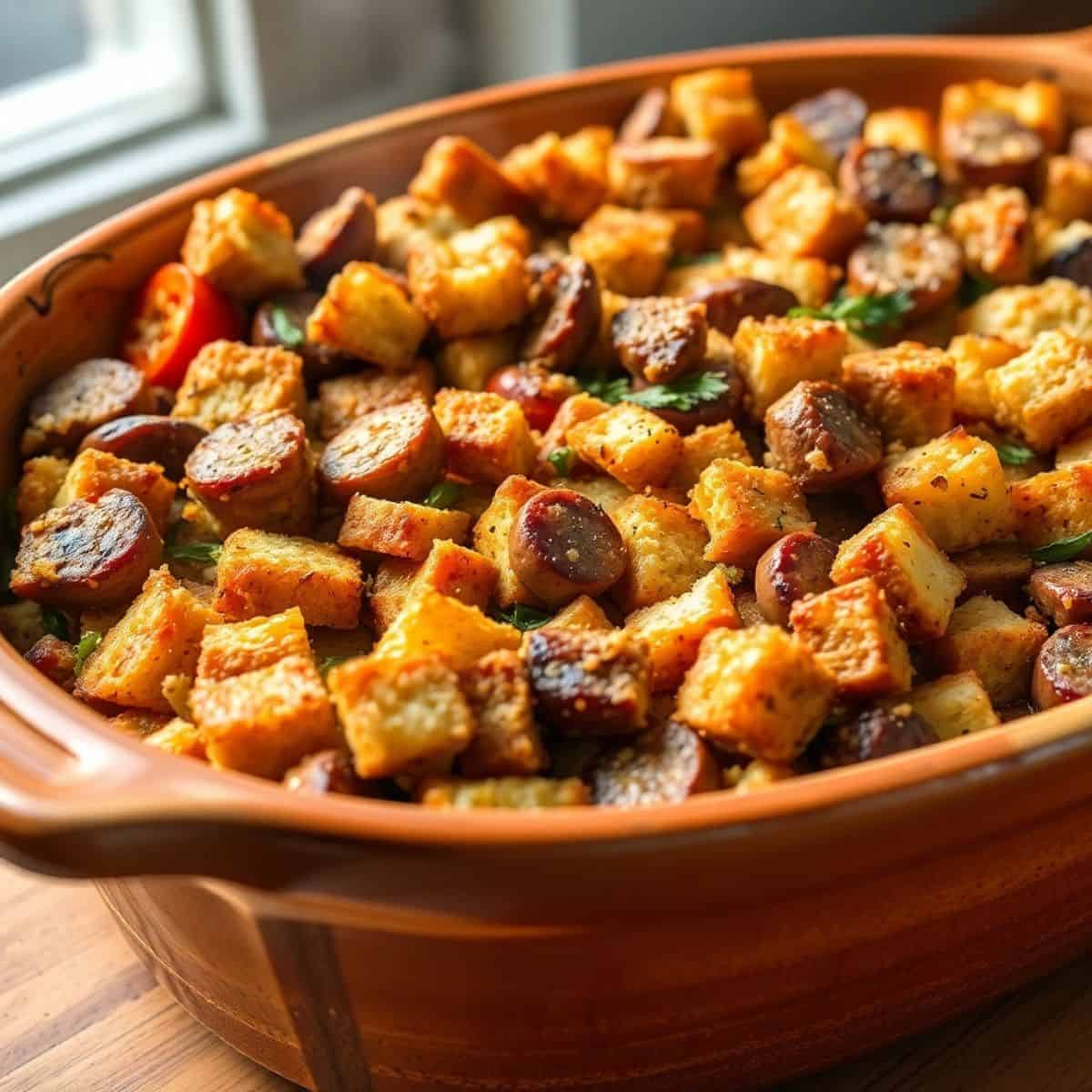
The side dish that consistently outshines the turkey it is meant to complement — the one that gets fought over at the end of the meal, packed into to-go containers by guests on their way out, and specifically requested for years afterward — is this Grandma's Thanksgiving stuffing: a deeply savory blend of day-old bread cubes, browned Italian sausage, sautéed celery and onion, fragrant fresh and dried herbs, and rich chicken broth, baked until the top is golden and crispy and the interior is tender, moist, and infused with every flavor in the pan. It is the dish that defines Thanksgiving for so many families, the one that captures the warmth and tradition of the holiday in a single bite, and the one that legitimately deserves a permanent spot at the center of the table next to the turkey.
What makes this stuffing genuinely special — and what separates it from the boxed mixes and overly-fancy gourmet versions — is the careful balance between simplicity and depth. The bread provides structure and absorbs every drop of flavorful broth; the sausage adds richness and meaty savoriness; the celery, onion, and butter create the aromatic backbone that defines all classic American stuffing; and the herbs — sage, thyme, and rosemary — bring that distinct, unmistakable smell that turns any kitchen into a holiday kitchen the moment they hit the pan. It is exactly the kind of recipe that tastes like it has been passed down through generations because it actually has been.
This post covers everything you need to nail this stuffing the first time and every time after — the critical bread-drying step that prevents mushy stuffing, the proper sausage browning technique, the herb-toasting trick that deepens flavor, and five variation ideas including apple cranberry, mushroom, chestnut, cornbread, and oyster versions. Find more holiday side inspiration in my 21 best Thanksgiving food ideas, my 19 make-ahead Thanksgiving recipes, and my classic stuffed peppers recipe.
Let's make the most flavorful, most memorable stuffing your Thanksgiving table has ever seen!
WHY YOU WILL LOVE THIS RECIPE
- Classic, Quintessential Thanksgiving Flavor That Tastes Like the Holiday Itself: This recipe captures every single element people expect from traditional American Thanksgiving stuffing — the savory, slightly buttery base, the meaty depth from the sausage, the aromatic celery and onion, and the unmistakable herbal warmth from sage, thyme, and rosemary. There is nothing fussy, fashionable, or trendy here; it is straightforward, deeply traditional, and exactly the version of stuffing that most people are subconsciously comparing every other stuffing they eat against. It tastes the way Thanksgiving is supposed to taste.
- Moist and Tender Interior With a Crispy, Golden Top: The two-stage baking process — covered with foil first, then uncovered for the final stretch — produces stuffing with exactly the right textural contrast that defines great stuffing. The interior stays moist, tender, and infused with all the flavor of the broth and herbs; the top develops a deep golden-brown crust that is crispy, slightly chewy, and the part everyone fights over. Dry, crumbly, sad stuffing is the most common Thanksgiving complaint, and this recipe specifically prevents that with proper broth amounts and baking technique.
- Easy to Customize for Every Family's Preferences: This recipe is genuinely a great base that can be adapted to almost any flavor profile or dietary preference without losing its fundamental character. Want it sweeter? Add diced apples and dried cranberries. Prefer earthier flavors? Sauté mushrooms with the celery and onion. Need it gluten-free? Use gluten-free bread cubes. Vegetarian? Skip the sausage and use vegetable broth. Five different families could make this recipe and produce five distinctly delicious stuffings that all still taste like proper Thanksgiving stuffing.
- Make-Ahead Friendly — the Single Most Useful Quality on Thanksgiving Day: Anyone who has hosted Thanksgiving knows that oven space and active cooking time on the day are the most constrained resources in the entire kitchen. This stuffing can be assembled completely the day before and refrigerated, then baked fresh on Thanksgiving morning — saving you 30 minutes of active prep when you most need it. The alternative is to fully bake it the day before and reheat covered, which works almost as well. Either way, this is one of the most stress-reducing dishes on the holiday menu.
- Family Tradition Material — the Stuffing People Request Every Year: This is the kind of recipe that genuinely becomes part of a family's holiday identity once you make it the first time. Guests start specifically asking whether you're making "the stuffing" before they accept future invitations. Adult children come home for Thanksgiving partly because of dishes like this one. It is more than a side — it is a tradition in the making, the kind of food that anchors holiday memories for years. Pair with my creamy Parmesan Italian sausage ditalini soup for the perfect holiday weekend menu.
INGREDIENTS
- 1 lb loaf of day-old bread (sourdough, French, or white), cut into 1-inch cubes
- 1 lb Italian sausage, removed from casings
- 1 cup chopped celery (about 3 stalks)
- 1 cup chopped onion (about 1 large)
- ½ cup (1 stick) unsalted butter
- 1 cup chicken broth, plus more as needed
- 1 teaspoon dried sage
- 1 teaspoon dried thyme
- ½ teaspoon dried rosemary
- ½ teaspoon salt
- ¼ teaspoon black pepper
- ¼ cup chopped fresh parsley (optional)
- 2 large eggs, lightly beaten
DIRECTIONS
- Step No.1: Prepare and dry the bread cubes
Cut the bread into 1-inch cubes and spread them in a single layer on a large baking sheet. Let them air-dry uncovered at room temperature for several hours, or ideally overnight — this is genuinely the most important step in the entire recipe and the difference between proper stuffing and a soggy, mushy mess. If you're short on time, dry the cubes in a low 250°F oven for 20–30 minutes until they feel firm and slightly hardened on the outside.
- Step No.2: Brown the Italian sausage
In a large skillet over medium heat, cook the Italian sausage, breaking it up into small pieces with a wooden spoon as it browns. Cook for 6–8 minutes until fully browned and no pink remains. Use a slotted spoon to transfer the cooked sausage to a paper towel-lined plate, but leave the rendered fat in the skillet — that flavorful fat is what will sauté the vegetables and infuse the entire stuffing with deep savory flavor.
- Step No.3: Sauté the celery and onion in the sausage drippings
Add the chopped celery and onion to the skillet with the rendered sausage fat (add 2 tablespoons of butter if the pan looks dry). Cook over medium heat, stirring occasionally, for 5–7 minutes until the vegetables are softened, fragrant, and lightly translucent. Don't rush this step — fully softened aromatics are essential for the proper texture and flavor of the finished stuffing. Add the remaining butter at the end and stir until melted.
- Step No.4: Combine all the stuffing ingredients
In a very large mixing bowl, combine the dried bread cubes, cooked sausage, sautéed celery-onion mixture (with all the buttery pan drippings), chicken broth, dried sage, thyme, rosemary, salt, pepper, and parsley. Stir gently with a wooden spoon or your hands until the bread is evenly moistened. If the mixture looks dry, add more chicken broth a tablespoon at a time until the bread feels damp but not soggy. Add the lightly beaten eggs last and stir until evenly distributed.
- Step No.5: Bake covered, then uncovered for the perfect crust
Preheat the oven to 350°F (175°C) and grease a 9x13-inch baking dish with butter or cooking spray. Transfer the stuffing mixture to the prepared dish and spread evenly. Cover tightly with foil and bake for 30 minutes — this stage steams the stuffing and keeps the interior moist. Remove the foil and bake for an additional 15–20 minutes, or until the top is golden brown and crispy. Let rest for 5 minutes before serving.

TIPS FOR SUCCESS
- Use Day-Old Bread — Fresh Bread Will Ruin Your Stuffing: This is the single most important rule of stuffing-making, and the rule that home cooks violate most often because they grab fresh bread from the store on the way home. Fresh, soft bread turns into a paste-like mush when it absorbs the broth, producing the dense, gluey texture that makes bad stuffing so memorable. Day-old or properly dried bread has the structural integrity to soak up flavor while maintaining distinct cube shapes and a tender, fluffy interior. If you forgot to dry the bread overnight, the low-oven method works in a pinch.
- Do Not Overmix — Gentle Stirring Preserves Texture: Aggressive mixing breaks down the dried bread cubes into a paste-like mass and produces dense, gluey stuffing instead of the light, fluffy texture you want. Stir gently with a wooden spoon or your hands just until everything is evenly distributed — small lumps or unevenness in the bowl are completely fine and will smooth out during baking. Overmixing is one of those subtle mistakes that ruins texture without anyone being able to identify exactly why the stuffing tastes off.
- Taste and Adjust Seasoning Before Baking — Pre-Bake Is Your Only Chance: Store-bought broth and Italian sausage both vary widely in saltiness, and stuffing that tastes properly seasoned before baking will sometimes taste under-salted after baking as the flavors concentrate and the bread absorbs the broth. Take a small spoonful of the unbaked mixture, taste it, and adjust salt and herbs as needed. Better to over-season slightly before baking than to have a bland stuffing on the table with no way to fix it.
- Moisten the Stuffing Properly — Damp but Not Soggy: The right moisture level is one of the trickiest things to get right with stuffing. The bread cubes should feel evenly damp throughout — squeeze a piece between your fingers and it should compress slightly without releasing visible liquid. If the mixture looks dry, add broth a tablespoon at a time. If you can see pooled liquid at the bottom of the bowl, the mixture is too wet and needs more bread cubes. The damp-but-not-soggy zone is the goal.
- Uncover for the Last 15–20 Minutes — That Crispy Top Is the Whole Point: The covered-then-uncovered baking technique is what produces the textural contrast that defines great stuffing — moist tender interior, crispy golden top. Removing the foil for the final stretch of baking allows the top to dry out and brown into that beautiful crust everyone wants. Skip the uncovering step and you'll have soft, uniform stuffing throughout, which works but loses the textural drama that makes this dish memorable. Don't skip it.
VARIATIONS
- Apple Cranberry Stuffing: Add 1 cup of peeled, diced Honeycrisp or Granny Smith apples and ½ cup of dried cranberries to the stuffing mixture along with the bread cubes. The apples soften and sweeten during baking while still holding some texture, and the cranberries plump up with the broth, creating tart-sweet pockets throughout the savory base. This is my favorite variation when the Thanksgiving menu is leaning heavier on savory elements and the table needs a touch of brightness.
- Mushroom Stuffing: Sauté 8 oz of sliced cremini, button, or wild mushrooms with the celery and onion until deeply browned and most of their moisture has evaporated — about 8–10 minutes. The mushrooms add an earthy, umami-rich depth that completely transforms the flavor profile of the stuffing without changing its fundamental character. This is the most sophisticated variation and the one I make for adults who appreciate more complex flavors.
- Chestnut Stuffing: Fold 1 cup of roasted, peeled, and roughly chopped chestnuts into the stuffing mixture for an old-world, festive variation that adds nutty richness and a slightly sweet, toasty flavor. Pre-cooked vacuum-packed chestnuts are widely available during the holiday season and save the considerable hassle of roasting and peeling fresh ones. This is the variation that most strongly evokes traditional European holiday stuffing and feels especially elegant.
- Cornbread Stuffing: Replace half (or all) of the bread cubes with cubed day-old cornbread for a Southern-inspired version with a sweeter, more crumbly texture and a distinctive corn flavor. Cornbread stuffing has a softer, more tender consistency than bread-based versions and pairs especially well with apple cranberry additions. This variation is particularly popular in households with Southern roots and makes for a memorable change from the standard.
- Oyster Stuffing: Fold in 1 cup of fresh oysters (drained but with a tablespoon or two of their liquor reserved) along with the bread cubes for a coastal, briny variation that has deep historical roots in New England holiday cooking. The oysters add a savory, slightly sweet, sea-forward flavor that is genuinely unique and especially beloved by adventurous eaters. This is the variation I make for family members who specifically request something more traditional and old-school.
SERVING AND STORAGE
Serving
Serve warm directly from the baking dish as the classic Thanksgiving side, alongside roasted turkey, mashed potatoes, gravy, and cranberry sauce. Beyond Thanksgiving, this stuffing pairs beautifully with any roasted poultry, pork loin, or hearty winter meal throughout the year. For breakfast the next day, use leftover stuffing as the base for a savory breakfast hash topped with fried eggs, or fold it into frittatas for an unexpected and genuinely delicious morning meal.
Storage
Store leftover stuffing in an airtight container in the refrigerator for up to 3 days. To reheat without drying it out, cover with foil and warm in a 325°F oven for 15–20 minutes; add a splash of chicken broth before covering to revive the moisture. For longer storage, the fully baked stuffing freezes beautifully — wrap tightly in plastic wrap and foil, freeze for up to 3 months, then thaw overnight in the refrigerator and reheat covered in the oven until warmed through.
FAQ
Yes — this is genuinely one of the best make-ahead Thanksgiving dishes. Assemble the unbaked stuffing mixture up to 24 hours in advance and store it covered in the refrigerator in the baking dish. Pull it out 30 minutes before baking to take the chill off, then bake as directed. Alternatively, you can fully bake the stuffing the day before and reheat it covered with foil in a 325°F oven for 20–25 minutes; add a splash of chicken broth before covering to restore moisture.
Absolutely — this recipe works beautifully with sourdough, French bread, white sandwich bread, brioche, ciabatta, or even gluten-free bread. The single non-negotiable requirement is that the bread must be day-old or properly dried out before use. Different breads produce slightly different textures — sourdough adds tang, brioche adds richness, and rustic French bread produces the most traditional result. Choose based on personal preference and what you have available.
Yes — both ground turkey and ground pork work as substitutes for Italian sausage. The main difference is that they have significantly less built-in seasoning than sausage, so you'll need to season more aggressively. Add an extra ½ teaspoon of dried sage, ½ teaspoon of garlic powder, and an additional ¼ teaspoon of salt to compensate. Ground turkey is also leaner than sausage and produces less rendered fat, so add 2 extra tablespoons of butter to the pan when sautéing the vegetables.
Three things prevent dry stuffing: enough chicken broth (the bread cubes should be evenly moistened before baking), keeping the baking dish covered with foil for the first 30 minutes (which traps steam and prevents the interior from drying out), and not overbaking once the foil is removed (pull it from the oven as soon as the top is golden brown and crispy, even if you're not quite at the listed time). Adding 2–3 extra tablespoons of butter dotted across the top before the uncovered baking stage also helps.
For the best results, reheat in a 325°F oven, covered tightly with foil, for 15–20 minutes. Before covering, add 2–3 tablespoons of chicken broth across the top to revive the moisture that evaporated during initial baking and refrigeration. The microwave works in a pinch — about 1–2 minutes per portion — but won't restore the crispy top and tends to produce slightly rubbery edges. For the closest-to-fresh experience, the covered oven method is genuinely worth the extra time.
Grandma's Thanksgiving stuffing is the side dish that anchors the entire holiday meal — savory, herbal, comforting, and packed with the kind of deep flavor that makes Thanksgiving taste like Thanksgiving. Whether you're hosting your first holiday or your thirtieth, this is the recipe that delivers reliably every single year and the one that guests specifically request before they accept future invitations to your table.
Try the apple cranberry version for the most balanced sweet-savory profile, the mushroom version for the most sophisticated flavor depth, and the cornbread variation for a Southern-inspired twist. Pair with my 21 best Thanksgiving food ideas, my 19 make-ahead Thanksgiving recipes, my classic stuffed peppers, and my creamy Parmesan Italian sausage soup for the complete holiday menu collection. 🦃🌿🍞✨

GRANDMA'S THANKSGIVING STUFFING RECIPE
Ingredients
- 1 loaf about 1 pound day-old bread (white, sourdough, or a combination), cut into 1-inch cubes
- ½ cup 1 stick unsalted butter
- 1 large onion chopped
- 2 celery stalks chopped
- 1 teaspoon dried sage
- ½ teaspoon dried thyme
- ¼ teaspoon dried rosemary
- ¼ teaspoon black pepper
- ½ teaspoon salt or to taste
- 4 cups chicken broth or turkey broth
- ½ cup chopped fresh parsley
- ¼ cup chopped fresh sage optional, for extra flavor
- 1 egg lightly beaten (optional, helps bind the stuffing)
Instructions
- Prepare bread: Spread the bread cubes in a single layer on a baking sheet and let them dry out slightly, either overnight or by baking them in a low oven (200°F/93°C) for about 20-30 minutes. This helps prevent the stuffing from being soggy.
- Sauté vegetables: In a large skillet or Dutch oven, melt the butter over medium heat. Add the onion and celery and cook until softened, about 8-10 minutes.
- Add herbs and seasonings: Stir in the dried sage, thyme, rosemary, salt, and pepper. Cook for 1 minute more, until fragrant.
- Combine ingredients: In a large bowl, combine the dried bread cubes, sautéed vegetables, chicken broth (or turkey broth), fresh parsley, fresh sage (if using), and egg (if using). Stir gently until the bread is evenly moistened. Don't overmix.
- Bake stuffing: Transfer the stuffing mixture to a greased 9x13 inch baking dish. Cover with foil and bake at 350°F (175°C) for 30 minutes. Remove the foil and bake for another 15-30 minutes, or until the top is golden brown and crispy.
- Serve: Serve the stuffing warm.
Notes
- Bread: Day-old bread is key to a good stuffing. You can use any type of bread you like, but white, sourdough, or a combination are classic choices.
- Broth: Chicken or turkey broth adds flavor to the stuffing. Use low-sodium broth to control the salt level.
- Herbs: Fresh herbs add a brighter flavor, but you can use dried herbs if you prefer. Use about 1 teaspoon of dried herbs for every tablespoon of fresh herbs.
- Egg: The egg helps to bind the stuffing together, but it's optional. If you prefer a less dense stuffing, you can omit the egg.
- Baking Time: Baking times may vary slightly depending on your oven and the size of your baking dish. The stuffing is done when the top is golden brown and crispy and it's heated through.



Comments
No Comments