
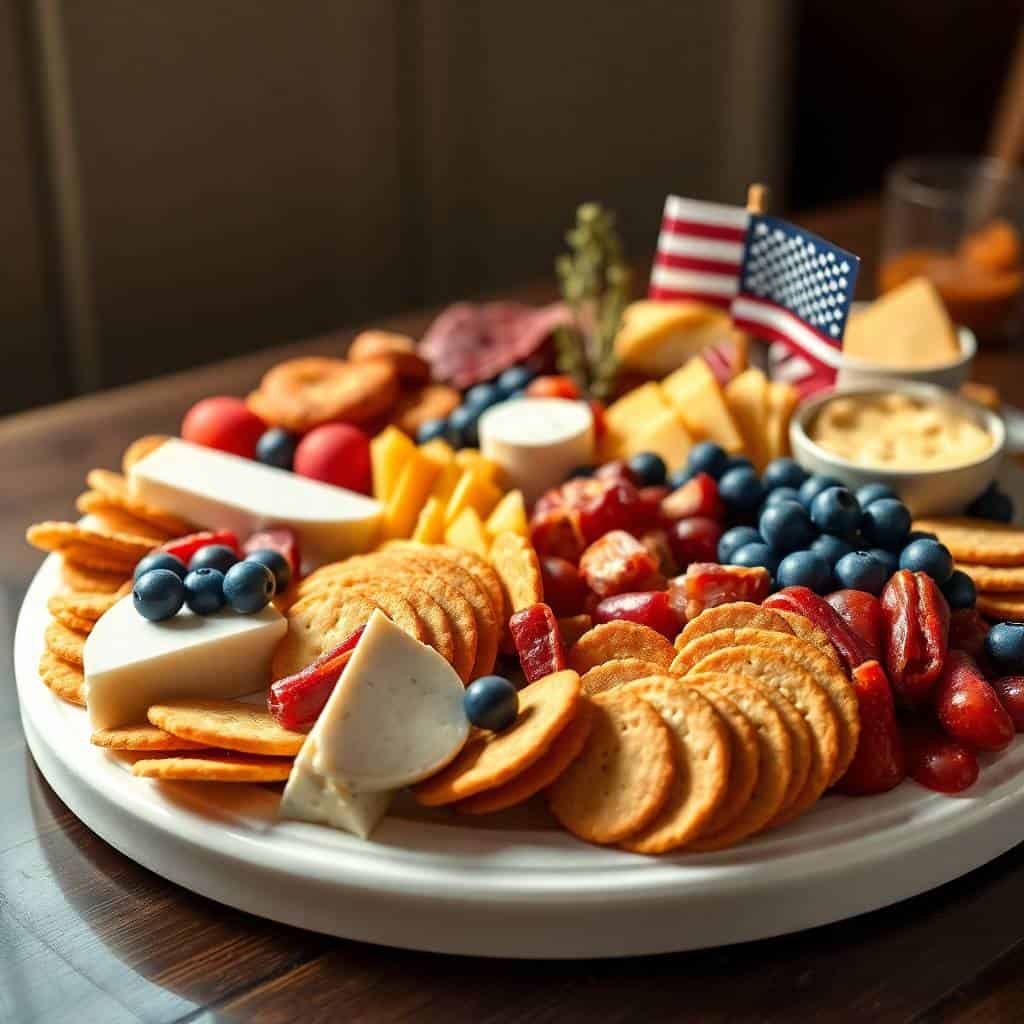
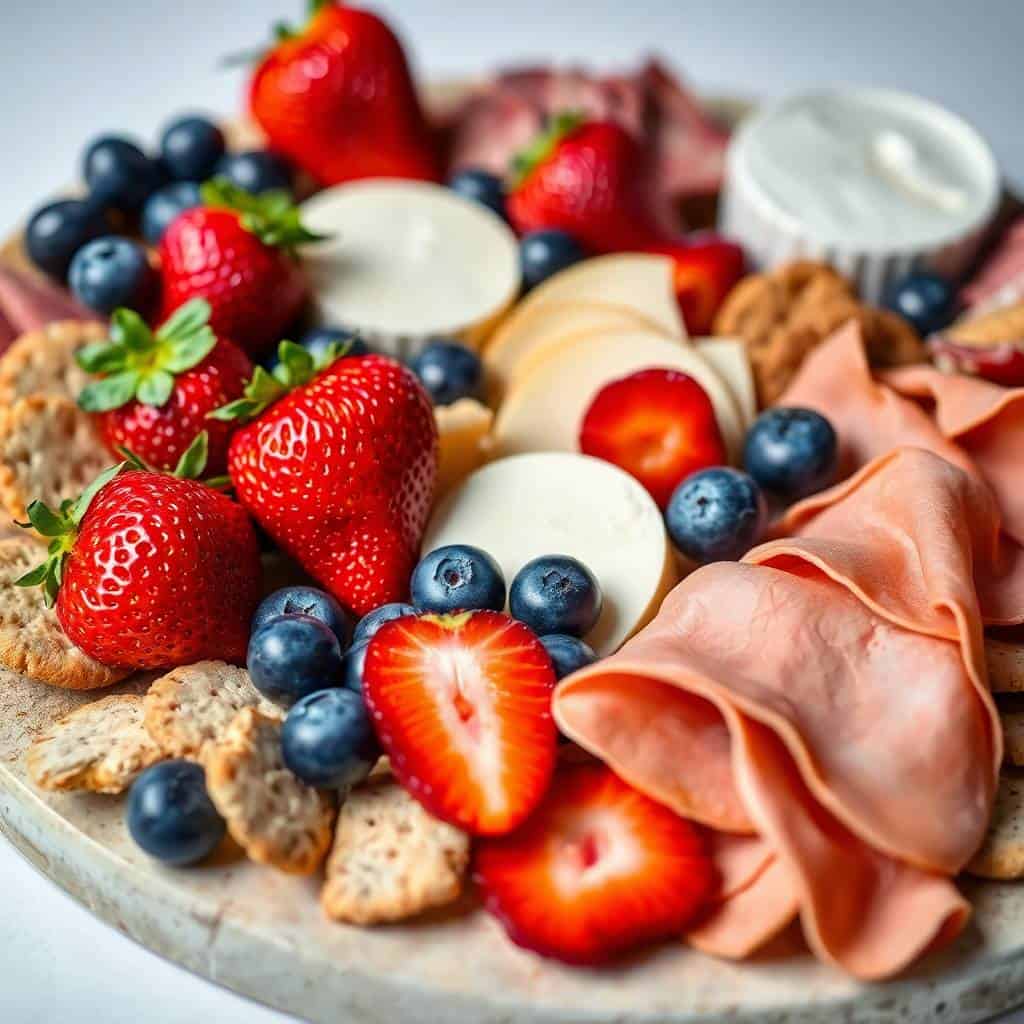
What makes a 4th of July board different from any other charcuterie spread is the intentional color story — every element is chosen specifically because it contributes a vivid red, a clean white, or a deep blue to the overall composition. Strawberries, raspberries, and salami provide the red. White cheddar, brie, cream cheese dip, and white chocolate provide the white. Blueberries, blackberries, and dried blueberry crackers provide the blue. The result is a spread that doesn't need a centerpiece or a flag decoration to read immediately as patriotic — the food itself tells the whole story.
This post walks through everything you need to build the most beautiful, most impressive 4th of July grazing board possible — the exact ingredients, the assembly technique, the tips that make the difference between a board that looks intentional and one that looks random, and variations for different dietary needs and party sizes. Whether you're hosting 8 people or 40, this board scales effortlessly and sets the tone for the entire celebration.
Let's build the most patriotic, most beautiful grazing board of the summer!
WHY YOU WILL LOVE THIS RECIPE
- Zero Cooking Required: Every element on this board is served at room temperature or cold — no oven, no stovetop, no timing coordination between multiple hot dishes. On a July 4th when the grill is already running and the kitchen is occupied with side dishes, a completely no-cook appetizer spread that looks genuinely spectacular is one of the most practical decisions a host can make.
- Serves as Both Appetizer and Decoration: A well-assembled red, white, and blue charcuterie board is both a serving platter and a centerpiece — it replaces table decoration with edible art. The visual impact of the red strawberries, white cheeses, and deep blue blueberries arranged on a wooden board creates a genuinely festive atmosphere without a single paper flag or plastic decoration required.
- Feeds Every Dietary Preference Simultaneously: A charcuterie board by nature contains options for meat eaters, vegetarians, gluten-free diet guests, nut-free guests, and children — without any modification to a single recipe. The variety of the board is what makes it work for every guest rather than requiring a separate spread for different dietary needs, which is one of the most genuinely practical qualities any party food can have.
- Assembles in 20 Minutes: The most time-intensive step in building a charcuterie board is slicing and arranging — there is no marinating time, no cooking time, no resting time, and no cooling time. With all ingredients purchased ready-to-use, a full patriotic grazing board for 12 people assembles in 20 minutes of focused arrangement, making it the fastest impressive party food available.
- Scales Effortlessly for Any Party Size: Adding 10 more guests to a charcuterie board means buying proportionally more of each element and using a larger board or adding a second board — there's no recipe scaling, no additional cooking equipment, and no timing recalculations. A board for 8 and a board for 40 use the same technique and the same ingredient proportions, just different quantities.
- The Board Tells a Complete Patriotic Story Without Any Added Decoration: When every ingredient is chosen for both flavor and color contribution, the finished board reads as unambiguously patriotic without any paper flags, toothpick decorations, or themed additions. The food itself — red raspberries, white brie, blue blueberries — creates the visual story, which is a more elegant and more sophisticated approach to holiday entertaining than decoration-heavy spreads.
INGREDIENTS
- RED Elements:
- 1 lb fresh strawberries, hulled — leave whole with stems on for the most dramatic presentation, or halve the largest ones
- 1 cup fresh raspberries — these cluster beautifully in small groupings and fill color gaps in the arrangement
- 6 oz salami or soppressata, sliced — fold each slice into quarters for the classic charcuterie "flower" fold that adds height and visual interest
- 4 oz pepperoni, thinly sliced — roll into cylinders or fold in half for varied presentation
- Sun-dried tomatoes in oil, drained — 2–3 tablespoons adds an intensely flavored deep red element with excellent contrast against the pale cheeses
- Cherry tomatoes on the vine (optional) for additional red volume
- WHITE Elements:
- 6 oz aged white cheddar, sliced into thin rectangles or broken into rough shards — both presentations work well
- 4 oz brie or camembert, left whole as a centerpiece and scored on top for easy serving
- 4 oz fresh mozzarella pearls or burrata — their soft white surface provides textural contrast against firm aged cheeses
- 4 oz goat cheese log, rolled in herbs — the soft, spreadable white cheese is a crowd favorite and provides a tangy counterpoint to the rich aged cheeses
- Assorted white and plain crackers — water crackers, almond flour crackers, or plain pita chips (approximately 4 oz per 8 guests)
- Marcona almonds or white-coated almonds — 3–4 tablespoons for filling gaps and adding buttery crunch
- White chocolate bark broken into pieces (optional) — adds a sweet element and an unexpected textural component
- BLUE Elements:
- 1.5 cups fresh blueberries — the most important blue element, used generously throughout the board in clusters and as gap-fillers
- 1 cup fresh blackberries — their deep purple-blue color and dramatic size make them one of the most visually striking board elements
- 4 oz blueberry jam or preserves in a small serving bowl — provides a blue accent, a sweet component, and a condiment for the cheeses
- Blue corn tortilla chips (optional) — their deep blue-purple color adds a dramatic visual element and provides a gluten-free cracker alternative
- Extras and Condiments:
- Honey in a small drizzle jar or small bowl with a honey dipper — pairs with every cheese and berry on the board
- Whole grain or Dijon mustard in a small bowl — pairs with the meats and aged cheddar
- Fresh rosemary sprigs and fresh mint — used as decorative greenery throughout the board to add color variation and fragrance
DIRECTIONS
- Step No.1: Choose and prepare your board
Select the largest board or serving surface available — the most common charcuterie board mistake is using a board that's too small, which forces ingredients to pile on top of each other and eliminates the ability to see and appreciate each individual element. A large rectangular wooden board, a marble slab, a large baking sheet lined with parchment, or even a clean section of butcher paper laid flat on a table all work well. For 12 people, a board of at least 18 x 24 inches produces the most beautiful, most generous presentation. Wash and completely dry all fresh berries and herbs — any surface moisture on the fruit transfers to the crackers and cheeses nearby and makes them soggy within an hour of assembly.
- Step No.2: Place anchors first — cheeses and bowls
The first step in any charcuterie assembly is placing the largest, most fixed elements that cannot be moved easily once positioned — these are the anchors that the rest of the board is built around. Place the whole brie wheel first, positioned slightly off-center on the board. Place any small bowls (for honey, jam, mustard) in the remaining spaces, distributed across the board rather than clustered together. Lay sliced white cheddar in an overlapping fan arrangement near one corner. Position the goat cheese log near the opposite corner. These five fixed elements — brie, goat cheese, sliced cheddar, honey bowl, jam bowl — define the structure of the entire board and guide everything that comes next.
- Step No.3: Add meats with folds and volume
Charcuterie presentation is about height and dimension — flat, laid-out meat slices look sparse and unimpressive while folded and arranged meat creates visual abundance even from a smaller quantity. Fold salami slices into quarters to create standing "roses" that cluster together and create significant height. Roll pepperoni into cylinders and arrange in loose groups. Drape larger soppressata slices in gentle curves rather than laying them flat. Place meat clusters adjacent to the cheese anchors so the pairing is visually obvious and practically accessible — guests should be able to reach both a meat and a cheese with one arm movement.
- Step No.4: Add fruit in color clusters
This is the step that creates the patriotic color story. Work in the color sequence — red, then white, then blue — placing each color in distinct clusters rather than scattering individual pieces randomly across the board. Arrange whole strawberries with stems pointing upward in a generous cluster along one side of the board. Cluster raspberries in two or three groups near the strawberries for additional red volume. Place blueberry clusters in the spaces between the cheese and meat anchors — blueberries are the most versatile shape for filling gaps since they nestle into irregular spaces perfectly. Arrange blackberries in dramatic groupings near the board edges where their size has maximum visual impact. The goal is visible bands of red and blue against the white cheese elements — the color contrast reads as deliberately patriotic only when the colors are grouped rather than mixed.
- Step No.5: Fill gaps, add crackers, and finish with herbs
Stand crackers vertically in groups of 5–6 rather than laying them flat — vertical crackers create height, take less board space, and are easier for guests to pick up cleanly. Fan them in small groups adjacent to each cheese anchor so the cracker-to-cheese proximity is clear. Scatter marcona almonds and any white chocolate pieces into the remaining gaps — nuts and chocolate are the most flexible gap-fillers since their irregular shapes fit into any space. Finally, tuck small sprigs of fresh rosemary and fresh mint throughout the board. The greenery serves two purposes: it creates color variation against the red-white-blue palette and it signals intentionality — a board with fresh herb garnish reads as professionally arranged even to someone who has never assembled a charcuterie board before. Stand back and assess — any area that looks sparse gets blueberries, raspberries, or nuts until the board looks genuinely abundant from edge to edge.
TIPS FOR SUCCESS
- Abundance Is the Most Important Visual Principle: A charcuterie board that looks sparse is always less impressive than one that looks generous, regardless of what's on it. The goal is for no section of the board to show bare wood or empty space — every gap should be filled with something edible. Buy slightly more of every element than you think you need and use the excess for gap-filling. Blueberries, raspberries, and nuts are the easiest, least expensive gap-fillers and should always be purchased in generous quantities specifically for this purpose.
- Group Colors — Don't Scatter Them: The patriotic color story only works when the red, white, and blue elements are in distinct clusters rather than evenly distributed across the board. A single blueberry next to a single strawberry next to a white cracker reads as random rather than intentional — a large cluster of blueberries adjacent to a large cluster of strawberries separated by a band of white cheese reads as deliberately patriotic. Work in color groups and resist the urge to distribute each ingredient evenly across the entire board.
- Vary Height Throughout the Board: The most visually compelling boards have varied height across the surface — some elements tall (standing crackers, folded salami roses, the brie wheel), some medium (stacked cheddar slices, fruit clusters), and some flat (sliced strawberries, scattered blueberries). A board where everything lies at the same height looks flat and two-dimensional in photos and in person. Use folded meats, vertical crackers, and small ramekins to create the height variation that makes the board look genuinely abundant and professionally assembled.
- Pull Cheeses from the Refrigerator One Hour Early: Cheese served straight from the refrigerator is firm, muted in flavor, and less aromatic than cheese served at room temperature. Pulling all cheeses from the refrigerator 45–60 minutes before serving allows them to reach their optimal serving temperature where flavors are more pronounced, textures are more yielding, and the overall eating experience is significantly more satisfying. This single step makes a more noticeable difference to the quality of a cheese board than almost any other preparation choice.
- Keep Crackers Off the Board Until 30 Minutes Before Serving: Crackers placed on a charcuterie board more than 30–45 minutes before serving in warm or humid conditions absorb moisture from the surrounding fruit and begin to soften and lose their crunch. Pre-arrange all cracker sections on the board but keep them covered loosely with a clean kitchen towel or in a separate bag until 30 minutes before guests arrive. This ensures every cracker maintains its full crunch through the entire serving window rather than softening progressively throughout the party.
- Provide Serving Utensils for Each Cheese: A shared cheese knife used across multiple cheeses transfers flavors — brie residue on the cheddar knife changes the flavor of the cheddar. Place a small dedicated knife or spreader beside each cheese, and a small spoon in each condiment bowl. Guests should be able to serve themselves from every element of the board without any element of awkwardness — clear serving utensils for each component make the board genuinely approachable and encourage more confident self-service.
VARIATIONS
- Vegetarian 4th of July Board: Replace all charcuterie meats with additional cheese varieties, marinated vegetables, and extra fruit. Add roasted red peppers from a jar (drained) for the red color contribution the salami would otherwise provide. Include marinated artichoke hearts, olives, and fresh vegetable crudités — radishes provide vivid red color and excellent crunch, celery sticks provide green contrast, and cucumber rounds fill space beautifully. A vegetarian board built with abundant cheese variety and generous fresh produce is genuinely more interesting and more varied than a meat-forward board and appeals to the widest possible range of guests.
- Dessert Patriotic Board: Build the entire board around sweet elements rather than savory ones — red velvet cake bites, white chocolate bark, blueberry macarons, strawberry-dipped pretzels, white peppermint bark, raspberry gummies, and a central bowl of patriotic M&Ms in red, white, and blue. Include fresh strawberries and blueberries as fresh counterpoints to the sweet packaged elements. This dessert board works beautifully as a separate sweet table element alongside the savory charcuterie board at large gatherings, or as a standalone dessert option that serves the same crowd-pleasing function as a cookie platter but with significantly more visual impact.
- Gluten-Free Patriotic Board: Replace all wheat-based crackers with gluten-free alternatives — rice crackers, almond flour crackers, blue corn tortilla chips, and sliced cucumber rounds all provide crunch and a vehicle for cheeses and meats without any gluten. Every other element on the standard board is naturally gluten-free. Label the board clearly so gluten-free guests can eat with confidence. This modification requires no additional preparation — simply selecting the right crackers produces a board that is fully accessible for gluten-free guests without any other changes.
- Kids' Mini Patriotic Boards: Set up individual small wooden boards or plates for children with simpler, more approachable elements — mild white cheddar cubes, pepperoni rounds, strawberry halves, blueberries, plain crackers, and a small cup of ranch dressing or honey for dipping. Children who have their own board are significantly more likely to eat the charcuterie and to find the grazing format genuinely fun rather than overwhelming. Mini boards also eliminate the issue of children reaching across the main board and disrupting the arrangement that the adults are photographing.
- Elevated Flag Board: Deliberately arrange the top surface of the board in the shape of an American flag — a rectangle of blueberries in the upper left corner representing the stars field, horizontal stripes of sliced strawberries alternating with stripes of sliced white mozzarella extending to the right and down. This flag arrangement requires slightly more planning and slightly more precise ingredient quantities but creates an immediately recognizable patriotic image that is extraordinarily impressive when brought to the table whole. Plan the proportions carefully before beginning assembly and use a ruler if necessary — flag-format boards are the most photographed of any charcuterie arrangement.
- Individual Cone or Cup Patriotic Boards: For outdoor parties, picnics, or gatherings where a large shared board is impractical, assemble individual paper cone appetizer cups or small clear plastic cups with each person's portion — 2–3 cheese cubes, 2–3 meat folds, a small cluster of each berry color, and 4–5 crackers per cup. Arrange all filled cups on a tray in a red-white-blue pattern. Individual portions eliminate the logistics of a shared board, travel well, and look genuinely festive arranged together on a serving tray. They're also more hygienic for outdoor summer entertaining where insects and weather may affect an open board.
SERVING AND STORAGE
Serving
For indoor parties, the board can sit at room temperature comfortably for 2 hours — after 2 hours in warm conditions, the soft cheeses begin to become overly soft and the meat quality deteriorates. For outdoor summer entertaining where temperatures are above 80°F, limit the board to 1 hour at room temperature and replenish from refrigerated reserve quantities rather than setting out the entire board at once. Set out the board 15–20 minutes before guests arrive so the cheeses have time to come to the correct serving temperature from any brief refrigeration. Bring the complete board to the table before anyone touches it so the full visual arrangement can be appreciated — photograph it immediately, as boards look their most spectacular in the first 10 minutes before guests begin serving.
Storage
Leftover board components should be stored separately — wrap cheeses individually in wax paper then plastic wrap and refrigerate for 3–5 days. Store remaining charcuterie meats in an airtight container and refrigerate for up to 5 days. Return fresh berries to a covered container in the refrigerator and use within 1–2 days. Crackers that have been on the board should be returned to their original packaging or an airtight container at room temperature. The board itself should not be stored assembled — once the board has been served, components are better stored individually for quality and food safety reasons. A partially served board that has been at room temperature for more than 2 hours should not be rewrapped and refrigerated — discard the room-temperature cheese and meat portions and store only what was kept refrigerated as reserve.
FAQ
The board can be assembled up to 2 hours before serving and kept refrigerated, covered loosely with plastic wrap, until 15–20 minutes before guests arrive. For the best result, place cheeses and condiment bowls first, then add meats and crackers no more than 1 hour before serving since crackers begin to soften in the refrigerator from the moisture of surrounding fruit. The fresh berries can be placed on the board up to 2 hours ahead as long as they are completely dry before placement. If preparing elements the night before, wash and dry all berries, slice all cheeses, fold all meats, and store each component separately in the refrigerator — then assemble the board the morning of the party for the freshest, most beautiful result.
For a charcuterie board serving 12 people as an appetizer alongside other party food, plan for approximately 2–3 oz of cheese per person (24–36 oz total across all cheese varieties), 2 oz of cured meat per person (24 oz total), 1 cup of crackers per person, and ½ cup of fresh berries per person. These quantities produce a board that looks genuinely abundant without being excessive. If the board is the primary food at the gathering rather than an appetizer, increase all quantities by approximately 50%. It's always better to have slightly more than needed — a board that runs out too quickly is significantly more disappointing than one with a small amount remaining.
The best cheese choices for a patriotic board are white or pale-colored varieties that contribute to the white color band of the red-white-blue palette — aged white cheddar, brie, camembert, fresh mozzarella, burrata, goat cheese, and manchego all work beautifully. Avoid strongly colored cheeses like orange cheddar, smoked gouda, or pepper jack since their colors compete with the deliberate red-white-blue composition. For variety, aim for three different texture levels: one firm aged cheese (white cheddar or manchego), one creamy soft-ripened cheese (brie or camembert), and one spreadable cheese (goat cheese or cream cheese). This three-texture approach ensures every type of cracker and every guest preference is accommodated.
Yes — a vegetarian patriotic board is genuinely one of the most beautiful and most varied board formats available. Replace the meat elements with additional cheese varieties, marinated vegetables, hummus in a small bowl, roasted red peppers for the red color contribution, olives for savory depth, and extra fresh produce. Radishes sliced in half provide vivid red color and satisfying crunch. Cucumber rounds and snap peas add fresh green contrast. Artichoke hearts and sun-dried tomatoes add savory complexity. A well-built vegetarian board has more variety and more color contrast than a meat-forward board and appeals to the widest possible range of guests at any gathering.
A large wooden cutting board or wooden serving board is the most classic and most visually appropriate vessel for charcuterie — the warm, natural tones of wood provide the most beautiful backdrop for the colors of the cheese, meat, and fruit. Marble slabs are the most elegant option and photograph particularly beautifully. For very large gatherings, a clean baking sheet lined with parchment paper, a section of butcher paper laid flat on a table, or even a clean cutting board tray works well. The most important quality is size — the board should be large enough that every element has its own clearly defined space. A crowded, overly full board on a small surface looks less impressive than the same quantity of food spread generously across a larger surface.
Yes — a vegetarian patriotic board is genuinely one of the most beautiful and most varied board formats available. Replace the meat elements with additional cheese varieties, marinated vegetables, hummus in a small bowl, roasted red peppers for the red color contribution, olives for savory depth, and extra fresh produce. Radishes sliced in half provide vivid red color and satisfying crunch. Cucumber rounds and snap peas add fresh green contrast. Artichoke hearts and sun-dried tomatoes add savory complexity. A well-built vegetarian board has more variety and more color contrast than a meat-forward board and appeals to the widest possible range of guests at any gathering.
Try the elevated flag board arrangement for the most dramatically patriotic presentation, or the individual cup variation for outdoor picnics and pool parties where a shared board is impractical. Pair it with our red white and blue trifle for the most complete, most beautiful patriotic dessert and appetizer spread of the summer.
Which variation are you building this 4th of July? Drop it in the comments — we love seeing your patriotic boards! For more summer entertaining ideas, browse our best finger food recipes for your next celebration. 🇺🇸🍓🫐
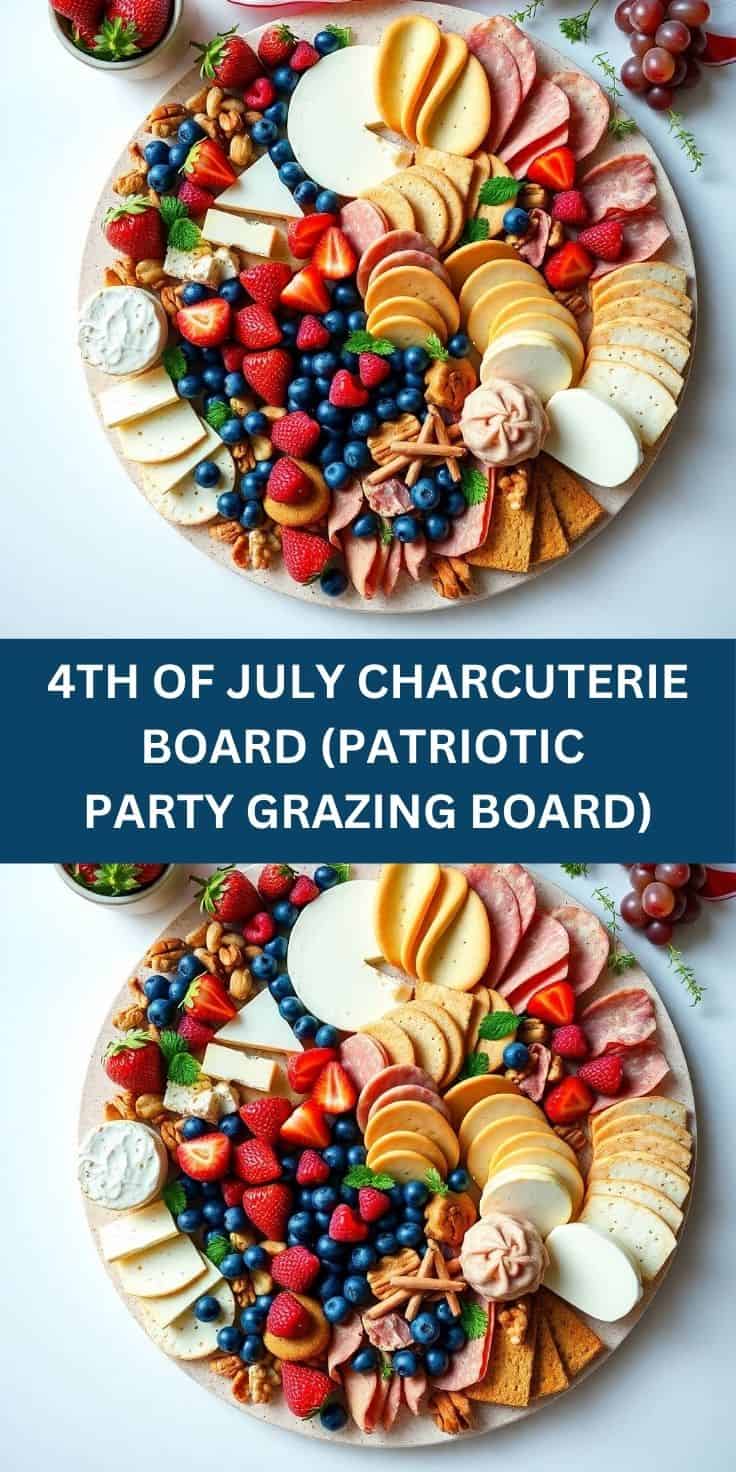
4TH OF JULY CHARCUTERIE BOARD (PATRIOTIC PARTY GRAZING BOARD)
Equipment
- Large serving board or tray
- Small bowls (for dips)
- Cheese knife
- Serving spoons
Ingredients
Red Fruits:
- 2 cups strawberries halved
- 1 cup raspberries
- 2 cups watermelon cubes
White Elements:
- 8 oz white cheddar cheese cubed
- 1 wheel brie cheese
- 2 cups crackers
- 1 cup marshmallows
Blue Elements:
- 2 cups blueberries
- 1 bag blue corn chips
Extras:
- 1 small bowl honey
- 1 small bowl jam or fruit dip
- 1 small bunch fresh mint
Instructions
Prepare Board:
- Place small bowls for dips and honey on the board first to anchor the layout.
Add Cheese:
- Arrange cheeses in different sections, mixing cubes, wedges, and slices for variety.
Add Fruits:
- Place red and blue fruits in separate clusters for a patriotic color pattern.
Fill Gaps:
- Add crackers, chips, and marshmallows to fill empty spaces on the board.
Garnish:
- Add fresh mint for color and freshness.
Serve:
- Serve immediately or chill until ready to enjoy.
Notes
- Balance colors evenly for visual impact.
- Use seasonal fruits for best flavor.
- Can be assembled up to 2 hours ahead.

Comments
No Comments