
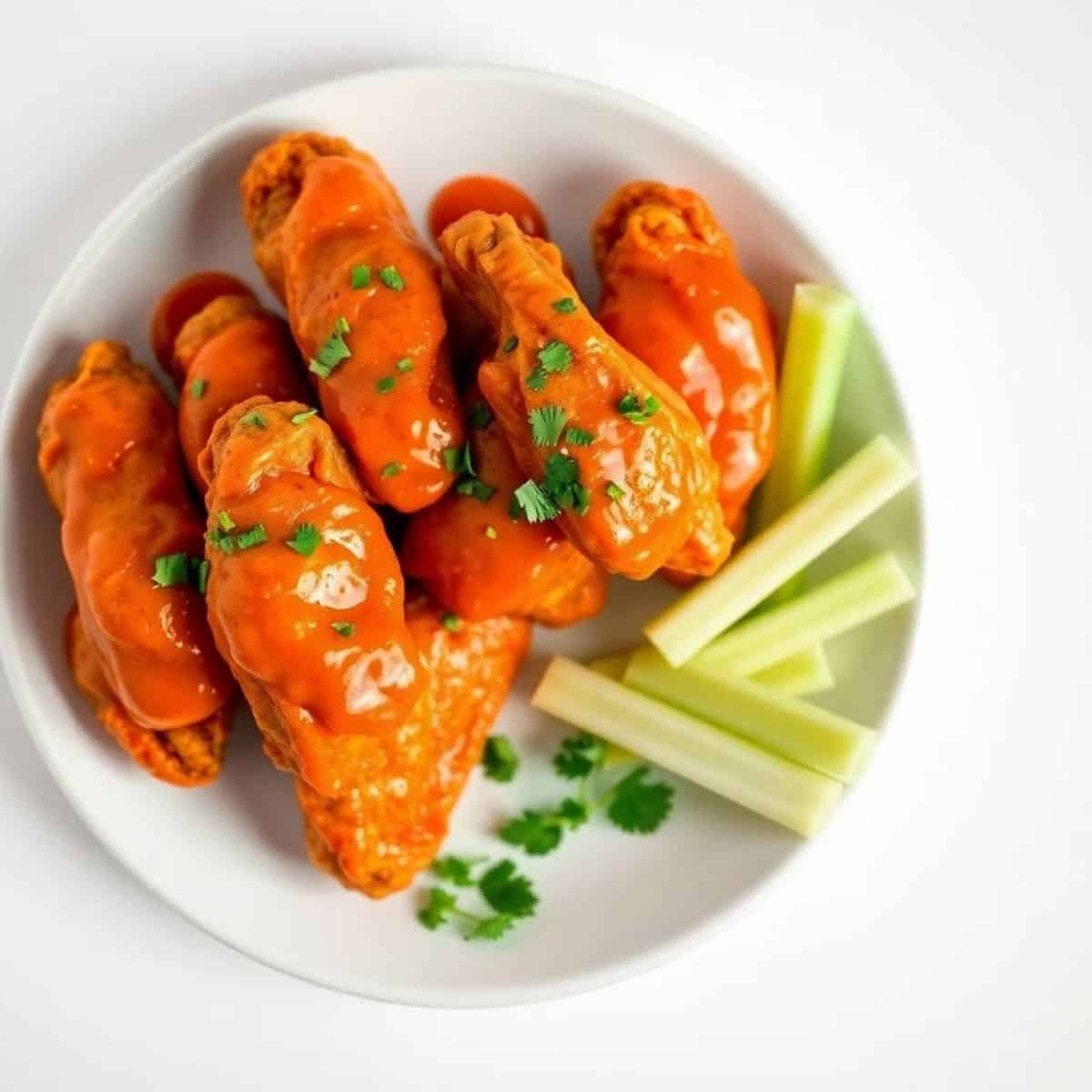
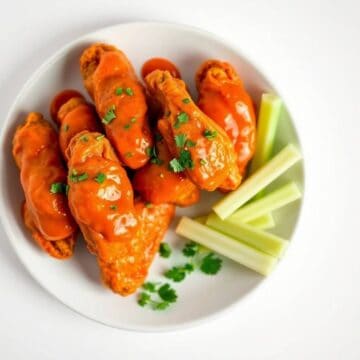
The recipe that disappears faster than anything else I put on a game day table — faster than the dips, faster than the sliders, faster than the nachos — is a platter of buffalo chicken wings: crispy, juicy wings baked until deeply golden and crackling-crisp, then immediately tossed in a glossy, tangy, buttery hot sauce that clings to every surface and delivers the perfect balance of heat, salt, tang, and richness in every single bite. They are the food that turns a gathering into a party and makes every person at the table reach for another the moment they finish the first.
What makes buffalo wings genuinely great at home rather than merely serviceable is the baking technique — patting the wings completely dry, coating them with a small amount of baking powder along with the seasoning, and baking them at high heat on a rack produces a crispiness that rivals deep-frying without a single drop of oil beyond the light coating on the skin. The baking powder raises the pH of the skin and causes it to brown and crisp in a way that plain seasoning alone cannot achieve. This is the technique that professional wing spots use and the reason properly prepared baked wings are every bit as satisfying as fried ones.
This post covers the classic buffalo chicken wing in complete detail — preparation, baking technique, buffalo sauce ratios — plus six variations including honey buffalo, garlic parmesan, extra-spicy, BBQ buffalo, lemon pepper buffalo, and an air fryer version. Every version serves four and takes under 40 minutes. Find more wing inspiration in our buffalo chicken wings original, our best buffalo chicken recipes, and our best game day recipes.
Let's make the best plate of buffalo wings your kitchen has ever produced!
WHY YOU WILL LOVE THIS RECIPE
- Baking Powder Is the Secret to Genuinely Crispy Baked Wings: The single most impactful technique in this recipe — and the detail that separates legitimately crispy baked wings from soft, disappointing ones — is the baking powder in the seasoning blend. Baking powder (not soda) raises the pH of the chicken skin, which accelerates the Maillard browning reaction and causes the skin to dry out and crisp at a dramatically faster rate than unseasoned skin. The result is a baked wing that has a genuinely crunchy, crackling exterior rather than the flabby, soft skin that most baked wing recipes produce. This technique is non-negotiable for the best possible result.
- The Buffalo Sauce Ratio Is the Entire Recipe: Classic buffalo sauce has an exact ratio — hot sauce to butter — and that ratio is the entire flavor of every buffalo wing ever made. Too much butter and the sauce is rich but mild and lacks the characteristic sharp vinegar tang of buffalo; too little butter and the sauce is harsh, thin, and unpleasantly hot. The ratio that produces the balanced, clingy, glossy buffalo sauce that everyone recognizes and loves is roughly 3:1 to 4:1 hot sauce to butter, whisked together over gentle heat until emulsified into a cohesive sauce that clings to the wing surface rather than running off. Garlic powder rounds the flavor; paprika adds color and subtle earthiness.
- Infinitely Customizable Heat Level: The sriracha-to-butter ratio and the choice of hot sauce completely control the heat level of the finished wings. Frank's RedHot produces the most classic, moderately spicy buffalo flavor that most people recognize as the standard; Tabasco produces a sharper, vinegar-forward heat; Crystal produces a milder, more tangy result. Doubling the butter reduces heat; doubling the hot sauce intensifies it. Adding honey (1–2 tablespoons) produces a sweet-spicy balance that is the most universally appealing version for mixed heat-preference crowds. I make different heat levels simultaneously by splitting the sauce batch — mild for some guests, extra-spicy for others.
- The Ultimate Party and Game Day Food: Buffalo wings have been the defining party food of American entertaining for decades for very good reason — they are handheld, they are dramatic, they generate conversation and enthusiasm, they are shareable, and the flavor is universally exciting. A platter of properly made buffalo wings arrives at a party table and everything else becomes secondary. I have never served buffalo wings to a group and had even one wing left at the end of the meal. The quantity that seems like more than enough for the number of guests is always the correct amount, and it is always not quite enough. See our best game day recipes for the complete party spread.
- Make-Ahead and Reheat-Friendly: The wings can be baked completely, cooled, and refrigerated for up to 2 days before serving. To reheat and re-crisp, place on a wire rack over a baking sheet and bake at 400°F for 10–12 minutes until hot and crispy again, then toss in freshly made sauce. Alternatively, the sauce can be made up to a week ahead and refrigerated — reheat gently and toss with freshly baked or reheated wings when ready to serve. This two-component make-ahead approach makes serving buffalo wings at a party almost entirely stress-free. See our best air fryer appetizers for more party prep ideas.
- Blue Cheese and Celery Are Not Optional — They Complete the Experience: The classic buffalo wing serving accompaniment of celery sticks and blue cheese dressing is not just a presentation choice — it is a functional component of the eating experience. The cool, creamy blue cheese cuts through the heat and richness of the buffalo sauce in a way that ranch dressing also does but with more complexity; the cold, crunchy celery provides a textural and temperature counterpoint to the hot, saucy wing that makes the combination more satisfying than either element alone. Every time I skip the celery and blue cheese I regret it. They complete the plate. See our chicken dipping sauces for more dipping options.
INGREDIENTS
- For the Wings:
- 2 lbs chicken wings, split into flats and drumettes
- 1 teaspoon salt
- ½ teaspoon black pepper
- 1 teaspoon garlic powder
- 1 teaspoon paprika
- 1 tablespoon baking powder (aluminum-free)
- 1 tablespoon vegetable oil
- For the Buffalo Sauce:
- ½ cup hot sauce (Frank's RedHot recommended)
- 2 tablespoons unsalted butter, melted
- ½ teaspoon garlic powder
- ¼ teaspoon paprika (optional, for color)
- For Serving:
- Celery sticks
- Blue cheese or ranch dressing
DIRECTIONS
- Step No.1: Prepare the wings
Preheat the oven to 400°F (200°C). Line a large rimmed baking sheet with aluminum foil (for easy cleanup) and place a wire rack on top of the foil — the rack is important because it elevates the wings so hot air circulates underneath, producing a crispy bottom as well as top. Pat every wing piece completely dry with paper towels — genuinely dry, not just wiped over — on both sides. Any residual moisture on the skin will produce steam during baking and prevent crispiness. In a large bowl, toss the dried wings with the vegetable oil, salt, pepper, garlic powder, paprika, and baking powder until every piece is evenly and thoroughly coated. The baking powder should be aluminum-free to avoid any metallic taste in the finished wings. Arrange the seasoned wings on the wire rack in a single layer with space between each piece — do not let them touch or overlap.
- Step No.2: Bake the wings
Bake at 400°F for 25 minutes, then flip every wing piece using tongs, and bake for another 20–25 minutes until the skin is deeply golden brown, crackled, and audibly crispy when you pick up a wing. The total bake time is 45–50 minutes — longer than many recipes suggest, but the extended time at high heat is what produces genuinely restaurant-quality crispy skin rather than merely baked chicken. During the last 5 minutes of baking, the skin should be visibly brown and tightened. If the wings are not yet deeply golden after 45 minutes, switch the oven to broil for 2–3 minutes watching carefully — the broiler converts good wings to great ones in the final moments.
- Step No.3: Make the buffalo sauce
While the wings bake, combine the hot sauce, melted butter, garlic powder, and paprika in a small saucepan over low heat, whisking continuously until the butter is completely emulsified into the hot sauce — about 1–2 minutes. Do not let the sauce boil, as boiling separates the butter from the hot sauce and produces a greasy, broken sauce that does not cling to the wings properly. The finished sauce should be smooth, glossy, and uniform in color — a deep orange-red with no visible butter pooling on the surface. Remove from heat and keep warm until the wings are ready.
- Step No.4: Toss the wings in sauce
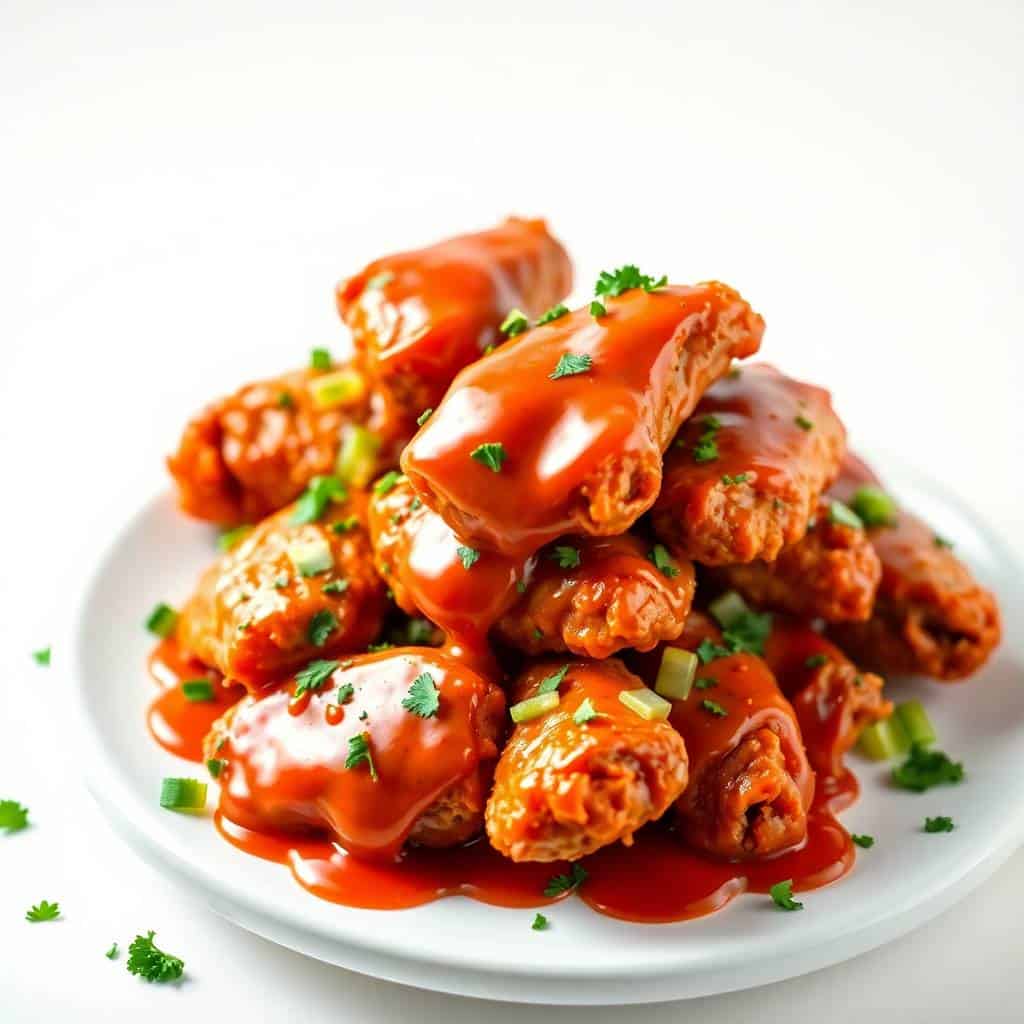
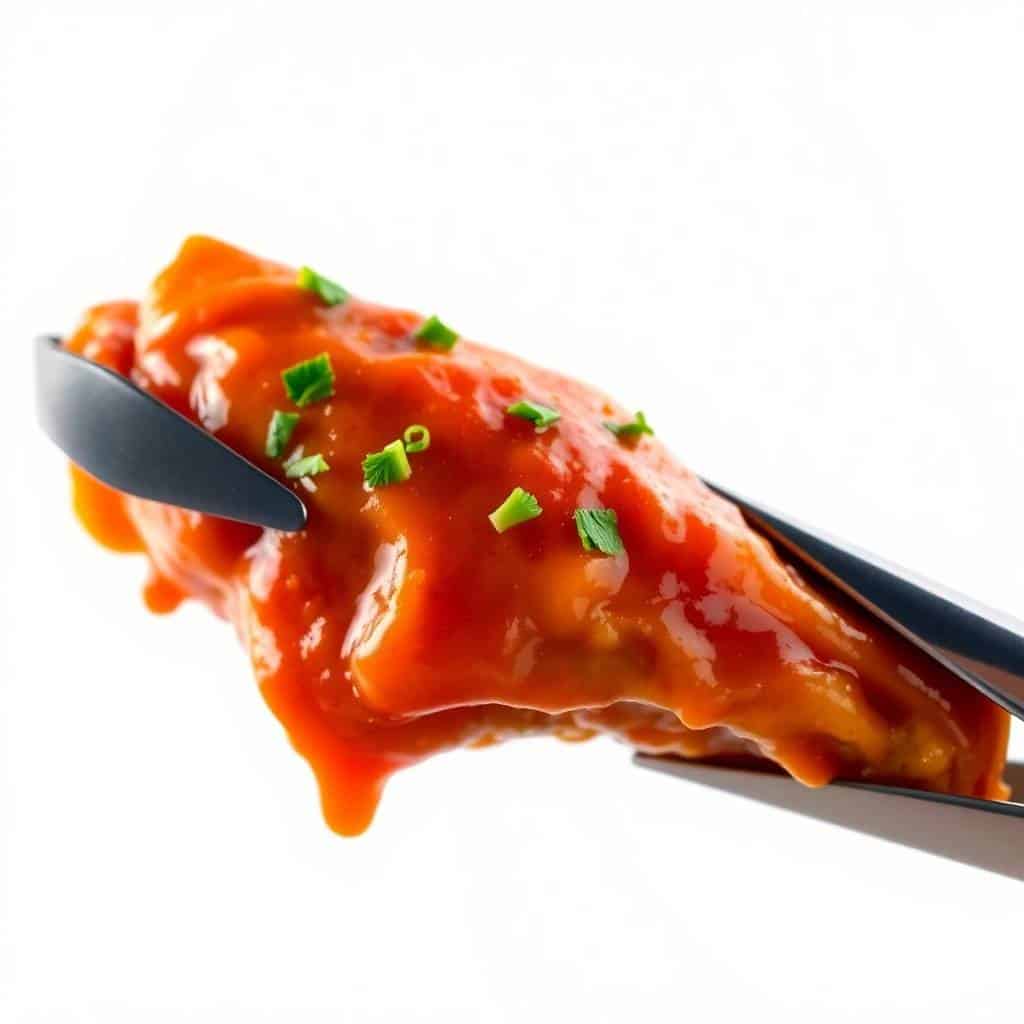
Transfer the hot, crispy wings from the rack into a large bowl immediately upon removing from the oven. Pour the buffalo sauce over the wings and toss vigorously using tongs or two large spoons until every surface of every wing is completely and evenly coated. Tossing while the wings are still hot from the oven is essential — hot wings absorb the sauce into the skin surface rather than just being wet with sauce, and the skin texture remains crispier when the sauce has a warm surface to cling to rather than a cooled one. Every toss incorporates more sauce into the wing surface; aim for thorough, generous coverage.
- Step No.5: Serve immediately
Transfer the sauced wings to a large serving platter immediately — buffalo wings are best within the first 10 minutes of saucing, while the exterior is still maximally crispy and the sauce is still warm. Arrange celery sticks and carrot sticks alongside and place a ramekin of blue cheese dressing and a ramekin of ranch dressing at each end of the platter. Serve while audibly sizzling if possible. Wings that sit for more than 15–20 minutes after saucing lose their crispiness as the sauce moisture penetrates the skin — serve them fast and watch them disappear faster.
TIPS FOR SUCCESS
- Pat the Wings Completely Dry Before Seasoning: This is the most important preparation step and the one most home cooks skip because it seems unnecessary. Any moisture remaining on the wing surface at the start of baking produces steam during the first 15–20 minutes of cooking, which prevents the skin from beginning to crisp. A completely dry surface, by contrast, begins to dehydrate and crisp from the very first moment of oven heat. Use paper towels and press firmly on every surface, including the underside where water pools after washing. Do this step and the difference in finished crispiness is immediately and dramatically apparent.
- Use Aluminum-Free Baking Powder: Baking powder containing aluminum can leave a metallic, slightly bitter aftertaste on the finished wings that is particularly noticeable in the skin. Aluminum-free baking powder (Rumford is the most widely available brand) produces all the crisping benefit without any metallic taste. Check the label before purchasing — aluminum-containing baking powder has "sodium aluminum sulfate" listed in the ingredients; aluminum-free versions list only "monocalcium phosphate" and "sodium bicarbonate."
- Never Crowd the Wings on the Pan: Wings touching each other during baking trap steam between them and produce pale, soft skin on the touching surfaces rather than the all-over golden crispiness that makes buffalo wings great. Every wing piece needs clear space around it — at least ½ inch of open space on all sides. If 2 lbs of wings will not fit on one rack without crowding, use two racks simultaneously, switching their positions halfway through the bake time to ensure even cooking. Crowding is the most common reason home baked wings disappoint.
- Toss Wings in Sauce Immediately While Still Hot: The window for optimal wing saucing is the 60-second period immediately after the wings come out of the oven. During this window the skin is at its crispiest and the surface temperature is high enough for the sauce to partially absorb rather than just coat. Wings that cool before saucing have a softer skin surface that becomes immediately flabby when sauce is applied. Set up the saucing bowl before the wings come out of the oven so the transfer and toss happen in one fluid motion with no delay.
- Adjust Sauce Heat Level to Your Preference: The 3:1 hot sauce to butter ratio in this recipe produces a moderately spicy wing that most people find very approachable and very satisfying. For milder wings, increase the butter to 3–4 tablespoons; for hotter wings, increase the hot sauce or add ¼ teaspoon of cayenne pepper. Adding 1–2 tablespoons of honey produces the most universally popular sweet-spicy version that disappears fastest at any gathering. Taste the sauce before tossing and adjust — the sauce should taste assertive when eaten alone since its flavor disperses when coating the wings.
VARIATIONS
- Honey Buffalo Wings: Add 2 tablespoons of honey to the buffalo sauce before whisking — the honey rounds the sharp edges of the hot sauce, adds a gentle sweetness that balances the heat, and produces a slightly thicker, more glossy sauce that clings to the wings dramatically. This is the most universally popular wing variation I make — the sweet-heat combination appeals to guests who find straight buffalo too sharp and to guests who love the full heat equally. It is the first variation to run out at any party. Pair with our honey garlic chicken wings for more sweet-savory wing ideas.
- Garlic Parmesan Wings: Skip the buffalo sauce entirely. Instead, toss the hot crispy wings with 4 tablespoons of melted butter, 4 cloves of minced or pressed garlic, ½ cup of finely grated Parmesan, fresh parsley, and a generous pinch of salt. The garlic parmesan wing is the alternative for guests who cannot tolerate spice — it is deeply savory, rich, and absolutely delicious in its own right and just as much of a crowd-pleaser as the buffalo version. I always make a split tray when entertaining — half buffalo, half garlic parmesan — and both sides are gone in the same amount of time. See our garlic parmesan recipe for the flavor profile reference.
- Extra Spicy Buffalo Wings: Add ¼ teaspoon of cayenne pepper and ½ teaspoon of crushed red pepper flakes to the buffalo sauce. Use a hotter base hot sauce (Tabasco, Louisiana, or a small-batch craft hot sauce with higher heat) instead of Frank's. The extra-spicy version is not for the casual spice enthusiast — this is genuinely hot in the best possible way, the kind of heat that builds with each wing and produces the satisfying endorphin rush that serious spice lovers specifically seek out. Label this variation clearly so unsuspecting guests are warned before they bite in.
- BBQ Buffalo Wings: Combine equal parts buffalo sauce and your favorite barbecue sauce — approximately ¼ cup of each — and toss the wings in the mixture. The BBQ-buffalo hybrid produces a smoky, tangy, slightly sweet sauce that is more complex than either sauce alone and deeply satisfying in a different way from classic buffalo. This is the variation that gets the most "what is in the sauce?" questions from guests and the one I recommend for anyone who wants to serve wings that feel new and different without departing entirely from familiar territory. See our Georgia mustard barbecue sauce for a unique BBQ pairing.
- Lemon Pepper Buffalo Wings: Replace the paprika in both the wing seasoning and the sauce with 1 teaspoon of lemon pepper seasoning, and add 1 tablespoon of fresh lemon zest to the sauce along with the hot sauce and butter. The lemon pepper version is bright, citrusy, and simultaneously savory and tangy — it tastes completely different from standard buffalo while using the identical baking technique. This is the most refreshing wing variation, ideal for summer entertaining when you want something that feels lighter than the classic version. See our lemon pepper chicken breast for more lemon pepper flavor inspiration.
- Air Fryer Buffalo Wings: Season the wings identically and cook in the air fryer at 380°F for 20–22 minutes, shaking the basket halfway through, then increase to 400°F for the final 5 minutes for maximum crispiness. Toss in the buffalo sauce as directed. The air fryer version is faster than the oven and produces excellent, genuinely crispy wings — slightly less uniformly crisped than the oven-and-rack method but significantly more convenient for a weeknight preparation when you want great wings quickly. See our best air fryer appetizers for more air fryer ideas.
SERVING AND STORAGE
Serving
Serve buffalo chicken wings immediately from the bowl while hot and freshly sauced. Arrange on a large platter with celery sticks, carrot sticks, and ramekins of blue cheese and ranch dressing. For a complete game day spread, pair with our cheesy taco dip, our bang bang chicken sliders, and our classic french fries. Always make more than you think you need — the calculation of "one pound per person" consistently underestimates actual buffalo wing consumption at any gathering.
Storage
Store leftover wings in an airtight container in the refrigerator for up to 3 days. To reheat and re-crisp, place on a wire rack over a baking sheet and bake at 400°F for 10–12 minutes — this method restores most of the original crispiness. The microwave reheats wings quickly but produces soft, steamed skin; the oven is always worth the extra time. Freeze cooked wings without sauce for up to 2 months — reheat from frozen at 375°F for 15–18 minutes, then toss in freshly made sauce for nearly-fresh quality.
FAQ
Yes — and baking is actually the recommended method in this recipe. The combination of a wire rack (to elevate the wings for all-around air circulation), aluminum-free baking powder in the seasoning (to accelerate skin browning and crisping), and a sufficiently high oven temperature (400°F) produces baked wings that are genuinely crispy in a way that rivals deep frying. The extended bake time (45–50 minutes total, flipping halfway) is crucial — rushed baking at lower heat produces soft skin. A final 2–3 minutes under the broiler takes good baked wings to great ones.
Increase the butter in the buffalo sauce to 3–4 tablespoons — the additional fat coats the hot sauce molecules and reduces the perceived heat on the palate. Alternatively, add 1–2 tablespoons of honey to the sauce, which balances the sharp heat with sweetness. Using a milder hot sauce (Crystal or Cholula produce noticeably less heat than Frank's RedHot with the same tangy flavor profile) also reduces the final heat level without requiring any ratio change. For very heat-sensitive guests, making a separate garlic parmesan sauce as an alternative eliminates the heat entirely.
Yes — the buffalo sauce keeps in an airtight jar in the refrigerator for up to 2 weeks. Reheat gently in a small saucepan over low heat, whisking until the butter re-emulsifies with the hot sauce and the mixture is smooth and warm before tossing with the wings. Making the sauce in advance is one of the most practical party prep steps available — one 5-minute preparation session produces sauce ready to deploy for any wing occasion over the following two weeks.
Blue cheese dressing is the traditional and most complementary choice — the cool, tangy, creamy flavor of blue cheese provides an exact counterpoint to the sharp vinegar heat of buffalo sauce. Ranch dressing is the milder, more universally accepted alternative that pairs equally well with the wing flavor. For a more elevated experience, make homemade blue cheese dressing with quality blue cheese, mayonnaise, sour cream, lemon juice, and fresh chives. Both sauces should be served very cold — the temperature contrast against the hot wing is part of the appeal.
Yes — freeze cooked wings without sauce for the best result. Cool completely, arrange in a single layer on a sheet pan and freeze until solid, then transfer to a freezer bag for up to 2 months. Reheat from frozen on a wire rack at 375°F for 15–18 minutes until crispy and hot throughout, then toss in freshly made buffalo sauce. The reheated frozen wings lose a small amount of crispiness compared to freshly baked, but are still significantly better than wings that have been sauced and then frozen — the sauce makes the skin soft and difficult to re-crisp.
Buffalo chicken wings are the food that makes any gathering feel instantly more festive and more fun — the smell of them in the oven, the sizzle when the sauce hits the hot wings, and the first bite of that tangy, spicy, buttery coating against crispy skin is one of the most satisfying food experiences in all of party cooking. Make the honey version alongside the classic and watch every single one disappear.
Try the garlic parmesan version for the non-spice crowd, the BBQ buffalo for the most complex flavor, and the lemon pepper version for summer. Pair with our buffalo chicken wings original, our best buffalo chicken recipes, our cheesy taco dip, and our best game day recipes for the ultimate party spread. 🔥🍗✨
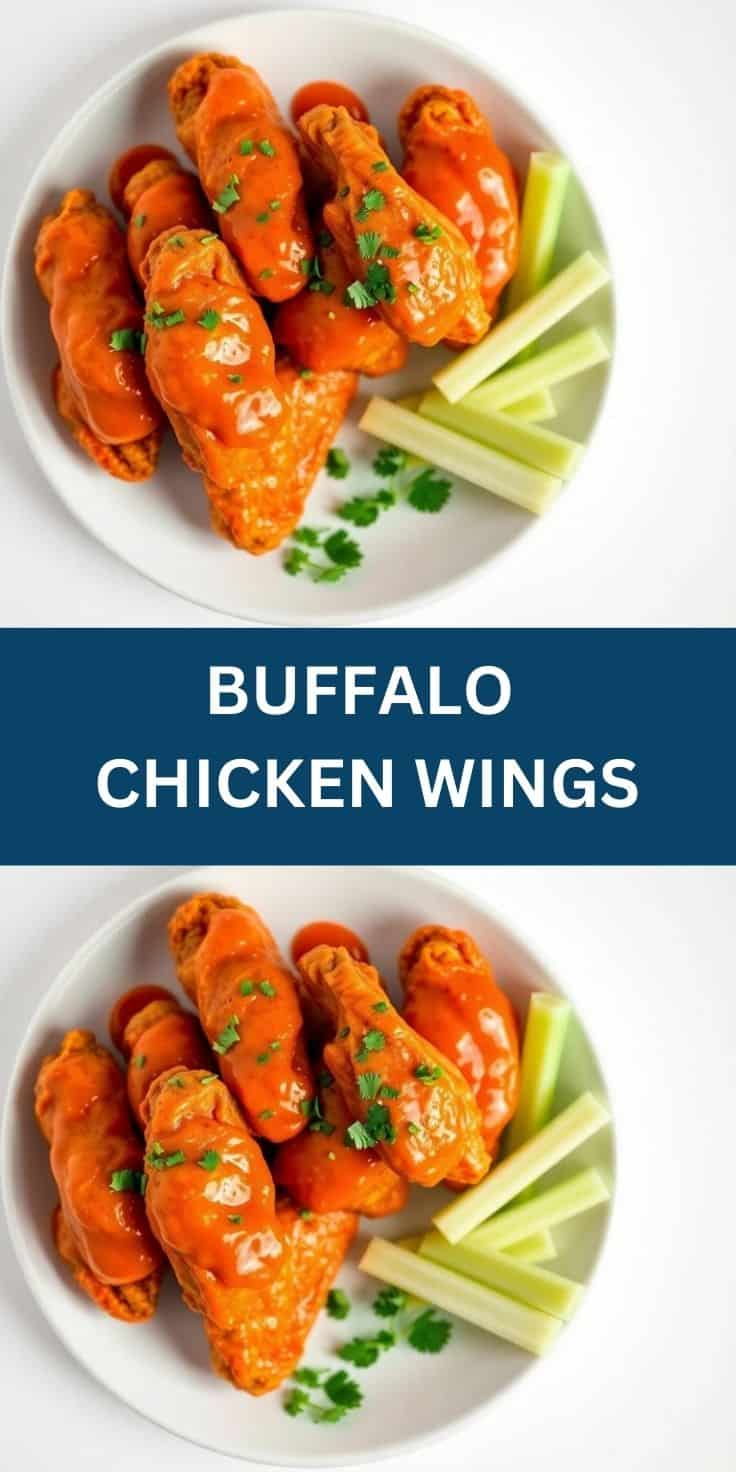
BUFFALO CHICKEN WINGS
Ingredients
For the Wings:
- 2 lbs chicken wings split into flats and drumettes
- 1 teaspoon salt
- ½ teaspoon black pepper
- 1 tablespoon vegetable oil
For the Buffalo Sauce:
- ½ cup hot sauce like Frank’s RedHot
- 2 tablespoons unsalted butter melted
- ½ teaspoon garlic powder
- ¼ teaspoon paprika optional for color
Instructions
Prepare Oven:
- Preheat oven to 400°F (200°C). Line a baking sheet with foil and lightly grease.
Season Wings:
- Toss chicken wings with salt, pepper, and vegetable oil. Arrange wings on the baking sheet in a single layer.
Bake Wings:
- Bake wings for 25 minutes, flipping halfway, until golden brown and cooked through.
Prepare Buffalo Sauce:
- While wings bake, combine hot sauce, melted butter, garlic powder, and paprika in a small bowl. Mix until smooth.
Coat and Serve:
- Once wings are done, toss them in the buffalo sauce until evenly coated. Serve immediately with celery sticks and ranch or blue cheese dressing.
Notes
- Make Ahead: Wings can be prepped a few hours before baking.
- Variations: Add cayenne pepper for extra heat or use smoked paprika for a smoky flavor.
- Serving Suggestions: Serve with celery sticks and ranch or blue cheese dressing.
- Allergy-Friendly: Ensure hot sauce is gluten-free if needed.
- Storage Tips: Store leftovers in an airtight container in the fridge for up to 2 days. Reheat before serving.



Comments
No Comments