
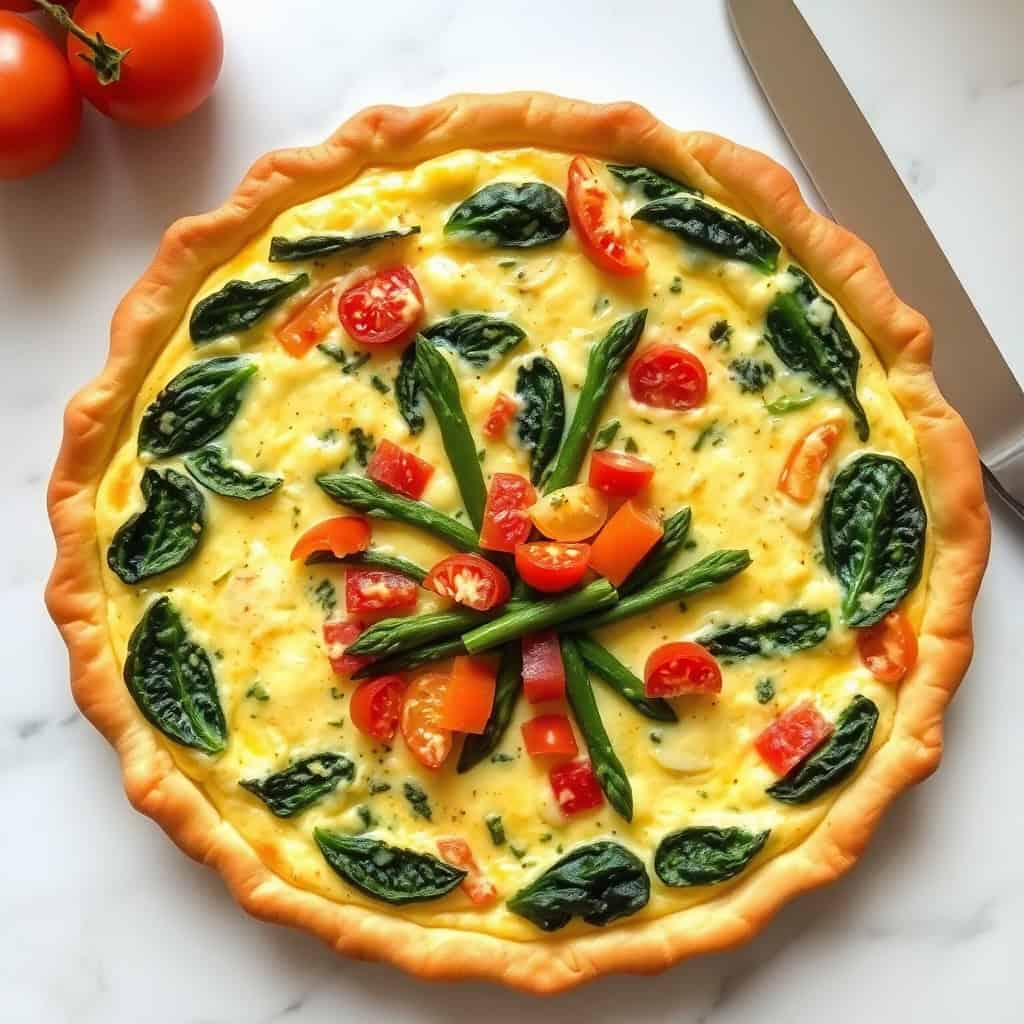
There is something genuinely extraordinary about a perfectly made quiche — that flaky, buttery crust that shatters at the touch of a fork, the silky, tender custard filling that trembles just slightly in the center when the pan is moved, and the colorful mosaic of fresh spring vegetables visible through the golden egg surface. This Spring Vegetable Quiche captures every element of a great quiche in its most vibrant, most genuinely seasonal form — loaded with asparagus, fresh spinach, cherry tomatoes, bell peppers, and green onions in a creamy egg custard seasoned with garlic, thyme, and a generous layer of melted cheese.
Quiche is one of those genuinely timeless recipes that works beautifully at every meal of the day — equally at home on a brunch table alongside fresh fruit and mimosas, served as a light lunch with a crisp green salad, or presented as a satisfying light dinner. The Spring Vegetable Quiche is particularly special because it celebrates the bright, fresh produce that becomes available in spring — asparagus, spinach, tomatoes, and bell peppers are all at their seasonal peak and taste dramatically more vibrant and more flavorful than at any other time of year. The combination of these fresh spring vegetables with a classic egg and cream custard produces a quiche that is genuinely extraordinary from first bite to last.
This Spring Vegetable Quiche can be made with a homemade buttery flaky crust for the most genuinely impressive result, or with a good-quality store-bought pie crust for maximum convenience — both versions produce a genuinely delicious quiche. The blind-baking step for the crust is essential and should never be skipped as it prevents the dreaded soggy bottom that ruins an otherwise excellent quiche. Find more brunch and spring recipe inspiration in our easy summer desserts and our vegetarian dinner recipes.
Whether you are making this for a spring brunch party, a Mother's Day celebration, a light weeknight dinner, or simply because you want to celebrate the season's most beautiful produce in the most genuinely delicious way — this Spring Vegetable Quiche will become a recipe you return to every single spring. Let's bake the most beautiful, most genuinely extraordinary quiche of the entire season!

WHY YOU WILL LOVE THIS RECIPE
- Light, Fresh, and Genuinely Flavorful: Packed with vibrant spring vegetables — asparagus, spinach, cherry tomatoes, bell peppers, and green onions — this quiche is simultaneously refreshing and satisfying. The vegetables bring color, texture, and a genuinely bright, fresh flavor that is characteristic of the best spring cooking.
- Silky, Rich, and Creamy Custard Texture: The egg custard made with whole milk, heavy cream, and four large eggs is smooth, rich, and genuinely luxurious — the combination of milk and cream produces a custard that is significantly more tender and more silky than an all-milk or all-cream version, creating the signature melt-in-your-mouth texture that defines a great quiche.
- Flaky, Buttery Crust Contrast: The crisp, golden crust adds a satisfying textural contrast against the soft, creamy filling — this contrast is what makes a well-made quiche so genuinely extraordinary as a eating experience. The blind-baked crust stays crispy underneath the filling rather than becoming soft and soggy.
- Completely Customizable and Versatile: Swap in your favorite vegetables, cheeses, or proteins for endless variations — mushrooms, zucchini, artichokes, goat cheese, feta, bacon, or smoked salmon all work beautifully in the same custard base. Quiche is genuinely one of the most adaptable recipes in all of home cooking.
- Works at Every Meal of the Day: Serve it warm from the oven at brunch, at room temperature for lunch, or cold from the refrigerator for a quick weeknight dinner. Quiche is genuinely one of the most versatile recipes available — it adapts to any meal occasion without changing anything about the recipe itself.
- Outstanding Make Ahead Friendly: This quiche stays fresh in the refrigerator for up to 4 days and reheats beautifully — making it one of the best meal prep recipes available for quick weekday breakfasts or lunches throughout the week. Make it on Sunday and enjoy genuinely excellent meals all week.
- Beautiful Presentation: The colorful spring vegetables visible through the golden egg surface create a genuinely stunning visual that makes this quiche appropriate for the most elegant brunch table — it is a dish that looks like it required significantly more skill and effort than it actually did.
INGREDIENTS
For the Crust
- 1 9-inch pie crust (homemade or store-bought) — a good quality store-bought crust works very well; for homemade, use 1¼ cups flour, ½ teaspoon salt, ½ cup cold cubed butter, and 3–4 tablespoons ice water
For the Filling
- 4 large eggs, at room temperature
- 1 cup whole milk
- ½ cup heavy cream — the combination of milk and cream produces the most silky, most luxurious custard texture
- 1 teaspoon salt + ½ teaspoon black pepper + ½ teaspoon garlic powder + ½ teaspoon dried thyme
- 1 cup shredded cheese — cheddar, Gruyère, or feta all work beautifully; Gruyère produces the most authentic French quiche flavor
- 1 tablespoon olive oil
- ½ cup asparagus, cut into 1-inch pieces
- ½ cup cherry tomatoes, halved
- ½ cup bell peppers, diced
- 1 cup fresh spinach, chopped
- ¼ cup green onions, sliced

DIRECTIONS
- Step No.1: Prepare the crust
If making homemade crust, combine flour and salt, cut in cold cubed butter until the mixture resembles coarse crumbs, then add ice water one tablespoon at a time until the dough just comes together. Form into a disc, wrap in plastic, and refrigerate for 30 minutes. For store-bought crust, follow the package instructions to thaw if needed. Preheat your oven to 375°F (190°C). Roll out the dough and press into a 9-inch pie pan, trimming any excess and crimping the edges for a neat, attractive border.
- Step No.2: Blind bake the crust
Line the unbaked crust with a sheet of parchment paper and fill completely with pie weights, dried beans, or raw rice — the weight prevents the crust from puffing and shrinking during the first bake. Bake for 10–12 minutes until the edges are set and just beginning to turn the palest golden. Remove the parchment and weights and bake for a further 5 minutes until the bottom looks dry and opaque. This blind-baking step is the single most important technique element for preventing a soggy bottom — never skip it.
- Step No.3: Prepare the egg custard
In a large bowl, whisk together the eggs, whole milk, heavy cream, salt, pepper, garlic powder, and dried thyme until completely smooth and evenly combined. Do not over-whisk — aggressive whisking incorporates too much air into the custard and produces a puffy, less silky result. Stir in ½ cup of the shredded cheese, reserving the remaining ½ cup for the top.
- Step No.4: Sauté the vegetables
Heat olive oil in a skillet over medium heat. Add the asparagus and bell peppers and sauté for 3–4 minutes until just slightly softened but still vibrantly colored — you want them tender-crisp rather than fully cooked, as they will continue cooking in the oven. Add the spinach in the final 1–2 minutes and cook just until wilted. Remove from heat and allow to cool slightly before adding to the quiche to prevent the hot vegetables from scrambling the egg custard when combined.
- Step No.5: Assemble the quiche
Spread the remaining ½ cup of shredded cheese evenly across the bottom of the blind-baked crust — this cheese layer between the crust and filling provides an additional barrier against sogginess and adds flavor to every bite. Spread the sautéed vegetables and green onions evenly over the cheese. Arrange the halved cherry tomatoes across the surface, cut-side up, for the most beautiful visual presentation. Pour the egg custard mixture slowly and evenly over everything — pour gently to avoid disturbing the vegetable arrangement. The filling should come to within ½ inch of the top of the crust edge.
- Step No.6: Bake the quiche to perfection
Place the assembled quiche in the 375°F oven and bake for 35–40 minutes until the custard is just set throughout — the center should have a very slight wobble when the pan is gently shaken but should not ripple like liquid. The top should be lightly golden. If the crust edges begin to brown too quickly before the filling is set, cover them loosely with strips of foil. Do not overbake — an overbaked quiche produces a rubbery, dry custard that lacks the characteristic silky texture that defines a great quiche.
- Step No.7: Rest and serve
Remove the quiche from the oven and allow to rest for a full 10 minutes before slicing — the custard continues to set during this resting time and produces much cleaner, more precise slices than cutting immediately. Slice into wedges and serve warm, at room temperature, or cold alongside a simple green salad or fresh fruit.

TIPS FOR SUCCESS
- Always Blind Bake the Crust: This is the single most important technique step for a great quiche. Blind baking the crust before adding the filling creates a moisture barrier between the wet custard and the pastry that prevents the dreaded soggy bottom. Never skip this step — a soggy-bottomed quiche is genuinely difficult to salvage and significantly less enjoyable to eat than one with a properly blind-baked, crispy crust.
- Use Fresh, High-Quality Seasonal Vegetables: The quality of the vegetables directly determines the quality of the finished quiche. Fresh, in-season asparagus, spinach, tomatoes, and bell peppers taste dramatically more vibrant than older, out-of-season produce. Buy vegetables as close to the baking day as possible for the most vivid color and most genuine flavor.
- Whisk the Eggs Gently: A gently whisked custard — combined just until the yolks and whites are evenly blended — produces a silky, smooth, dense custard texture. Over-whisked custard incorporates too much air and puffs up during baking before collapsing into a slightly spongy, less silky texture. Whisk just enough to combine, nothing more.
- Do Not Overfill the Crust: Leave a ½-inch gap between the top of the custard and the top of the crust edge — filling the crust completely full causes overflow during baking that sticks to the pan and burns. A slightly under-filled quiche is always preferable to one that overflows.
- Let It Rest Before Slicing: The 10-minute rest after baking is not optional — the custard needs this time to finish setting from its slightly wobbly baked state into a fully firm, precisely sliceable consistency. Cutting immediately after baking produces messy, crumbling slices that destroy the beautiful appearance of the finished quiche.
- Store Properly for Maximum Freshness: Refrigerate leftover quiche in an airtight container for up to 4 days. Reheat slices in a 325°F oven for 10–12 minutes rather than microwaving — the oven maintains the texture of the crust while warming the filling evenly. Microwaving produces a soggy crust that cannot be recovered.
VARIATIONS
- Dairy-Free Quiche: Substitute almond milk or full-fat oat milk for the dairy milk and cream, and use a dairy-free shredded cheese. The custard will be slightly less rich but genuinely delicious and suitable for those with dairy sensitivities.
- Crustless Quiche: Pour the custard and vegetables directly into a well-greased pie dish without any pastry for a low-carb, gluten-free version that is naturally lighter in calories and genuinely delicious. The crustless version bakes in slightly less time — check for doneness at the 25-minute mark.
- Spicy Spring Quiche: Add ½ teaspoon of red pepper flakes to the custard and use pepper jack cheese in place of cheddar for a version with a warming heat that makes the fresh vegetable flavors even more vivid and lively.
- Protein-Packed Version: Add ½ cup of cooked, crumbled bacon, diced ham, or shredded rotisserie chicken to the vegetable layer before pouring the custard for a more substantial, more protein-rich version suitable as a standalone meal.
- Cheese Swaps: Gruyère produces the most authentic French quiche flavor. Goat cheese adds a tangy, creamy richness. Swiss cheese produces a milder, more subtle result. Feta creates a salty, briny depth that pairs particularly well with the asparagus and tomatoes in this spring version.
- Different Vegetable Combinations: Mushrooms, zucchini, artichoke hearts, sun-dried tomatoes, roasted garlic, or caramelized onions all work beautifully in this quiche's custard base. Use any seasonal vegetable combination that appeals to you — the egg and cream custard accommodates virtually any vegetable filling.
SERVING AND STORAGE
Serving
Serve this Spring Vegetable Quiche warm, at room temperature, or cold — it is genuinely delicious at every temperature. For a complete brunch spread, pair with a simple mixed green salad dressed with lemon vinaigrette, fresh fruit, and a glass of sparkling water or white wine. For a weeknight dinner, serve alongside roasted potatoes and steamed vegetables for a balanced, satisfying meal. For a special occasion presentation, bring the quiche to the table whole and slice at the table for the most impressive, most dramatic moment.
Storage
Store leftover quiche in an airtight container in the refrigerator for up to 4 days. Reheat individual slices in a 325°F oven for 10–12 minutes to restore the crust's crispness and warm the filling evenly — avoid microwaving which softens the crust irreversibly. For longer storage, quiche can be frozen for up to 2 months — wrap tightly in plastic wrap and then foil before freezing. Thaw overnight in the refrigerator and reheat in a 325°F oven for 20 minutes until warmed through.
FAQ
Yes — quiche is genuinely one of the best make-ahead dishes available. Bake the quiche completely, allow it to cool, cover, and refrigerate for up to 2 days before serving. Reheat in a 325°F oven for 15 minutes until warmed through, or serve at room temperature. The flavors actually develop and deepen slightly overnight, making the next-day version genuinely excellent.
Two steps prevent a soggy quiche crust — blind baking the crust before adding the filling, and avoiding vegetables with excessive moisture. Always blind bake the crust for 15 minutes total before filling. If using high-moisture vegetables like tomatoes or zucchini, salt them lightly and blot with paper towels before using, or roast them briefly to reduce their water content before adding to the quiche.
Yes — but thaw them completely and drain them very thoroughly before using. Frozen vegetables contain significantly more water than fresh and if used without draining will release this water into the custard during baking, producing a watery, under-set quiche filling. Press thawed frozen vegetables firmly between paper towels to remove as much moisture as possible.
Gruyère is the most classic French quiche cheese and produces the most authentic, most deeply savory result with a beautiful nutty complexity. Cheddar is the most accessible choice with a familiar sharp flavor. Feta adds a salty, briny tang that works particularly well with Mediterranean-style vegetable combinations. Swiss produces a milder, more subtle result. Goat cheese adds a distinctive creamy richness. Any of these work beautifully — use whichever you enjoy most or have available.
Absolutely — pour the custard and vegetables directly into a well-greased 9-inch pie dish for a crustless quiche that is naturally gluten-free and lower in calories. Bake at 375°F for 25–30 minutes until just set in the center. The crustless version is just as flavorful as the crust version and is particularly popular with low-carb and gluten-free diners.
This Spring Vegetable Quiche is a fresh, vibrant, and genuinely satisfying dish that brings the very best of the spring season to your table in the most elegant possible form. With its buttery flaky crust, silky egg custard, and colorful mosaic of fresh seasonal vegetables, it is
SPRING VEGETABLE QUICHE
Ingredients
For the Crust (or use store-bought pie crust):
- 1 ¼ cups all-purpose flour
- ½ teaspoon salt
- ½ cup unsalted butter cold and cubed
- 3-4 tablespoons ice water
For the Filling:
- 1 tablespoon olive oil
- ½ cup asparagus chopped
- ½ cup cherry tomatoes halved
- ½ cup zucchini diced
- ½ cup spinach chopped
- ¼ cup green onions sliced
- 4 large eggs
- 1 cup heavy cream or milk for a lighter option
- ½ teaspoon salt
- ¼ teaspoon black pepper
- ½ teaspoon garlic powder
- ½ teaspoon dried thyme
- 1 cup shredded cheese Gruyère, Swiss, or cheddar
Instructions
Step No.1: Prepare the Crust
- In a large bowl, mix flour and salt. Cut in the cold butter until the mixture resembles coarse crumbs. Gradually add ice water, one tablespoon at a time, until the dough comes together. Form into a disc, wrap in plastic, and refrigerate for 30 minutes.
Step No.2: Pre-Bake the Crust
- Preheat the oven to 375°F (190°C). Roll out the dough and fit it into a 9-inch pie dish. Prick the bottom with a fork, line with parchment paper, and fill with baking weights. Bake for 10 minutes, remove weights, and bake for another 5 minutes.
Step No.3: Sauté the Vegetables
- Heat olive oil in a skillet over medium heat. Sauté asparagus, zucchini, and green onions for 3-4 minutes until slightly tender. Stir in spinach and cook for another 1-2 minutes. Remove from heat.
Step No.4: Make the Egg Mixture
- In a large bowl, whisk together eggs, cream, salt, pepper, garlic powder, and thyme. Stir in shredded cheese.
Step No.5: Assemble the Quiche
- Spread the sautéed vegetables evenly over the pre-baked crust. Pour the egg mixture over the top and arrange cherry tomatoes on the surface.
Step No.6: Bake the Quiche
- Bake at 375°F (190°C) for 35-40 minutes until the center is set. Let it cool for 10 minutes before slicing.
Step No.7: Serve and Enjoy
- Slice and serve warm or at room temperature. Pair with a side salad or fresh fruit for a complete meal!
Notes
- Make it Crustless: Skip the crust and pour the filling into a greased dish for a low-carb quiche.
- Dairy-Free Option: Use coconut milk or almond milk and dairy-free cheese.
- Storage: Store in an airtight container in the refrigerator for 3-4 days. Reheat in the oven at 325°F (163°C).
- Mushroom & Goat Cheese Quiche: Swap zucchini for mushrooms and use goat cheese instead of shredded cheese.
- Asparagus & Feta Quiche: Add crumbled feta and increase the asparagus for a Mediterranean twist.
- Spicy Spring Quiche: Stir in red pepper flakes and use pepper jack cheese for some heat.
- Protein-Packed Quiche: Add cooked bacon or diced ham for extra protein.



Comments
No Comments