
I made my first batch of air fryer beef jerky on a Sunday afternoon when my husband mentioned he'd spent $12 on a small bag of store-bought jerky and it was gone in twenty minutes. That felt like a challenge. I had a pound of flank steak in the fridge, a bottle of soy sauce, and a curiosity about whether my air fryer could actually pull this off — and it did, better than I expected.
What I love about this method is that you don't need a dehydrator. I know a lot of jerky recipes assume you have one, but I don't, and I'm not buying one. My air fryer runs at a low enough temperature to dry the beef slowly without cooking it, and the result is genuinely chewy, smoky strips that taste like something you'd pay way too much for at a gas station — except these are actually good. The marinade I use is soy-based with smoked paprika and Worcestershire, and it does most of the heavy lifting while the beef sits in the fridge overnight.
My husband takes this jerky to work and packs it in his bag for road trips. Saad has decided it's the best snack I've ever made, which is saying something because that kid changes his mind weekly. I usually make a full two-pound batch because a single pound disappears too fast — I've tried, it's gone in two days. If you're packing snacks for a trip, this also pairs great alongside some good picnic sandwiches for a proper spread.
One thing to set your expectations on: this takes time. Not your time — the jerky just sits in the air fryer for 2 to 4 hours while you do other things. But plan around it. I usually start the marinade the night before, then run the air fryer the next afternoon. You can't rush the drying process or you'll end up with cooked beef strips instead of jerky, which is what happened to me the first time I cranked the heat too high.

Why You'll Love This Recipe
- No dehydrator required: I know people who have been meaning to make jerky for years but keep waiting until they buy a dehydrator. You don't need one. My air fryer goes down to 160°F and that's all it takes. If yours doesn't go quite that low, just use whatever the lowest setting is and check it earlier — more on that in the tips.
- You control everything in the marinade: Store-bought jerky is either too salty, too sweet, or has ingredients I can't pronounce. When I make it at home, I know exactly what went in. I use low-sodium soy sauce because the beef soaks up a lot of it during the overnight rest, and full-sodium gets overwhelming. You can tweak the heat, the sweetness, the smokiness — it's completely yours.
- High protein, genuinely satisfying snack: This isn't a light snack. Two or three strips and I'm actually full between meals. My husband uses it as a post-workout snack. It packs well, doesn't need refrigeration for a couple of weeks, and doesn't get soggy in a bag the way other snacks do. It holds up better on trips than almost anything else I make.
- Mostly hands-off cooking: The active work here is slicing the beef and mixing the marinade — maybe 20 minutes total. After that, the fridge and the air fryer do everything. I've started batches and then gone grocery shopping, done school pickup, made dinner. As long as you check in every hour or so, it's a very low-effort project.
- Cheaper than store-bought by a real margin: A pound of flank steak from Walmart or Costco runs me around $6–8. That same amount in packaged jerky is $12–15, and the packaged stuff has half the flavor. Once you make it yourself, it's hard to justify buying it again.
Ingredients
- 1–2 pounds lean beef (flank steak, top round, or sirloin), thinly sliced against the grain
- ½ cup low-sodium soy sauce (or tamari for gluten-free)
- ¼ cup Worcestershire sauce
- 2 tablespoons brown sugar
- 1 tablespoon honey or maple syrup (optional, adds a little sweetness)
- 1 tablespoon smoked paprika
- 1 teaspoon garlic powder
- 1 teaspoon onion powder
- ½ teaspoon black pepper
- ¼ teaspoon red pepper flakes (optional, for heat)
- Other spices as desired — ginger, cumin, and chili powder all work well
Directions
- Prepare the beef: Trim any visible fat off the beef — fat doesn't dry out the same way the meat does, and it can turn rancid faster in storage. Slice the beef into strips about ⅛ to ¼ inch thick, cutting against the grain. Against-the-grain slicing is important here: it shortens the muscle fibers and gives you a chewier (not tough) strip. I partially freeze the beef for 30–45 minutes before slicing — it firms up and makes thin, even cuts much easier.
- Make the marinade: Combine the soy sauce, Worcestershire, brown sugar, honey, smoked paprika, garlic powder, onion powder, black pepper, and red pepper flakes in a large bowl or a zip-top bag. Whisk or squish it all together until the sugar dissolves. Taste it — it should be savory, slightly sweet, and a little smoky. Adjust anything you want before the beef goes in.
- Marinate the beef: Add the beef strips to the marinade and toss until every strip is coated. Seal and refrigerate for at least 4 hours, but overnight is genuinely better. The longer it marinates, the deeper the flavor goes into the meat. I've done 4 hours in a pinch and it's still good, but the overnight batches are noticeably richer.
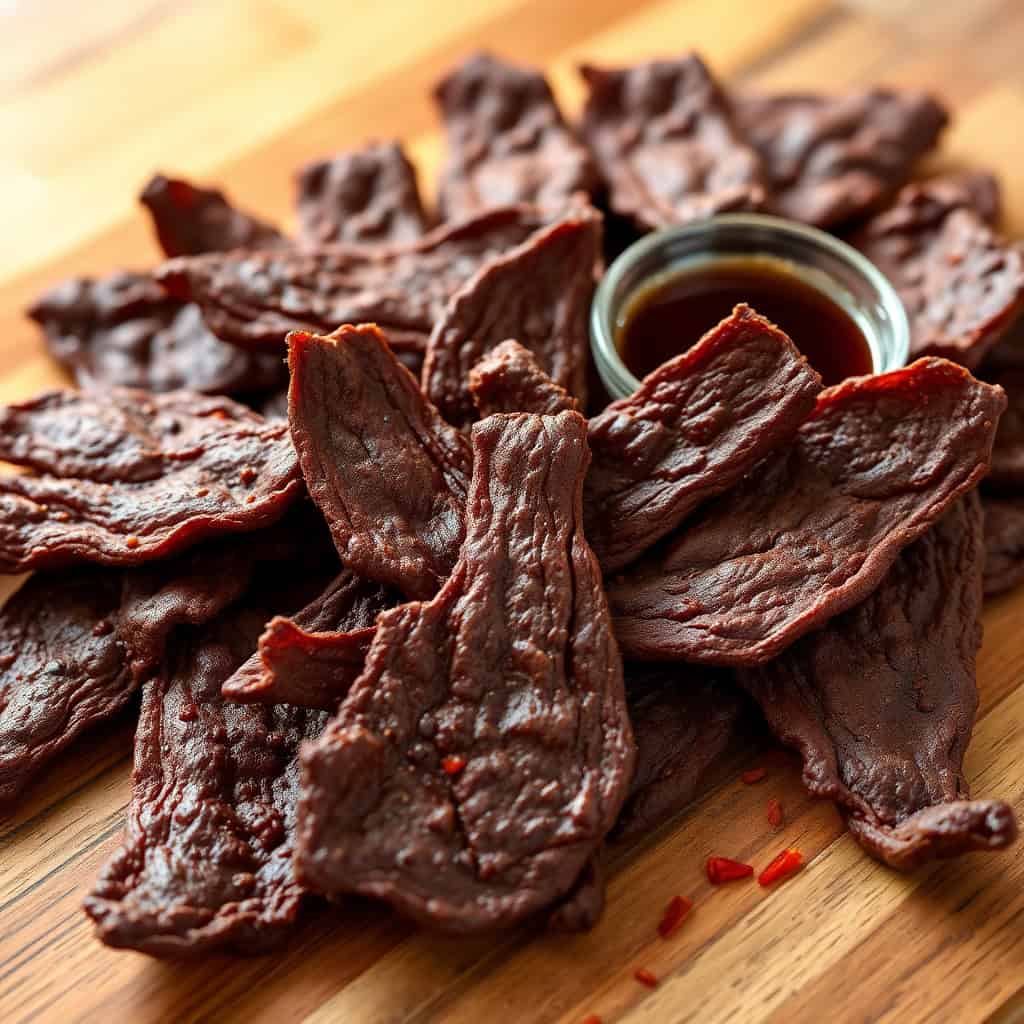
- Arrange in the air fryer: Set your air fryer to its lowest temperature — ideally 160–170°F (71–77°C). Take the beef out of the marinade and pat each strip lightly with a paper towel to remove excess liquid. Lay the strips in a single layer in the basket or on the rack, making sure none of them overlap. Overlapping strips steam each other and you end up with uneven drying. Work in batches if you need to.
- Air fry the jerky: Cook for 2 to 4 hours, checking every hour and flipping the strips halfway through. The time varies based on how thick your slices are and how your air fryer runs. You're looking for strips that are dry and leathery — they should bend without snapping, but not feel soft or moist in the center. If they're still tacky after 2 hours, keep going in 30-minute increments.
- Cool completely before storing: Pull the jerky out and let it cool on a rack or a sheet of parchment for at least 30 minutes. Don't seal it while it's warm — the steam trapped inside will make it soggy. Once it's fully cool and room temperature, store it in an airtight container or zip-top bag.
Tips for Success
- Partially freeze the beef before slicing: I figured this out after my third batch. Room-temperature flank steak is slippery and hard to cut thin consistently. If you put it in the freezer for 30–45 minutes, it firms up just enough to slice cleanly without actually freezing solid. You'll get much more even strips, which means more even drying times. A sharp chef's knife helps too — don't try this with a dull blade.
- Don't skip the pat-dry step: After the beef comes out of the marinade, I wipe each strip with a paper towel before it goes into the air fryer. It sounds fussy but it makes a real difference. Too much liquid on the surface means the outside is wet while the inside is still raw, and you can end up with uneven texture — chewy in some spots, tough in others. The goal is slow surface drying from the start.
- Check your air fryer's actual temperature: Air fryer temperatures are notoriously inconsistent. My old one ran about 15 degrees hotter than the display said. If your jerky is cooking too fast and drying out into something brittle after just 90 minutes, your fryer is probably running hot. An inexpensive oven thermometer (you can find them for under $10 at Walmart) will tell you what's actually happening in there.
- Work in batches without crowding: I know it's tempting to pile everything in at once, especially with a two-pound batch. But overlapping strips block airflow and cause uneven drying — some pieces end up over-dried while others are still soft in the middle. Two rounds in the air fryer is worth it. I use the waiting time to clean up the kitchen or start something else for dinner.
- The bend test is your best guide: You can't always tell by looking whether the jerky is done. The test I use: pick up a strip and bend it. If it cracks and snaps, it's overdone. If it flops and feels wet, it needs more time. What you want is a strip that bends and shows a slight crack in the surface but doesn't break in half. That's the sweet spot. I start checking at the 2-hour mark and go from there.
Variations
- Spicy chili jerky: Double the red pepper flakes and add ½ teaspoon of cayenne and a tablespoon of sriracha to the marinade. This is my husband's preferred version — he adds extra chili to almost everything I make. The heat hits at the back of your throat after a few chews, which is exactly what he wants. If you're sharing with kids, keep this one separate.
- Teriyaki style: Swap the Worcestershire for teriyaki sauce and increase the honey to 2 tablespoons. Add a teaspoon of fresh grated ginger if you have it. This version is sweeter and a bit glossy when it comes out of the fryer. It's the one I'd make for someone who says they don't really like jerky — the flavor is more approachable and less intensely savory.
- Pakistani-spiced jerky: This isn't traditional at all, but it works: add 1 teaspoon of cumin, ½ teaspoon of coriander, and a pinch of chaat masala to the base marinade. Skip the liquid smoke and let the smoked paprika carry the smokiness. It tastes like a fusion of something familiar to me growing up and something completely new. Saad tried it once and said it tasted like "BBQ but better," which I'll take as a win.
- Classic peppered jerky: Keep the marinade simple — soy sauce, Worcestershire, garlic powder, and a full tablespoon of coarsely cracked black pepper. No sweetener, no smoke. This is the closest to what you'd get from a traditional roadside jerky shop, and it's very straightforward to make. The pepper crust on the outside gets a little bit crispy at the edges, which I really like.
- Turkey or venison jerky: The same marinade and method work with turkey breast or venison if you have access to either. Turkey dries out a bit faster than beef because it's leaner, so start checking around 90 minutes. Venison has a slightly gamier flavor that actually pairs really well with the smoky paprika marinade. I've made both, though turkey is easier to find and usually cheaper if you catch it on sale.
Serving and Storage
Serving
Beef jerky is mostly a grab-and-go snack in my house, but I also use it as a protein addition to a packed lunch box, alongside raw vegetables and fruit. It travels well for road trips, hikes, or school bags without needing an ice pack. If you're putting together a snack board or game day spread, jerky holds its own next to something like cranberry bacon jam and crackers — the smoky beef and the sweet jam are a good combination. Serve it at room temperature; straight out of the fridge it can feel a bit stiff.
Storage
Room temperature storage works well for up to 2 weeks — keep the jerky in an airtight container or zip-top bag, somewhere cool and away from direct sunlight. Make sure the jerky is completely cooled before sealing; any residual warmth creates condensation inside the bag, and that moisture shortens the shelf life significantly. For longer storage, the refrigerator gives you up to a month, and the texture stays good. I haven't tried freezing it, but others do — freeze in a single layer first, then transfer to a bag once solid.
Frequently Asked Questions
My air fryer doesn't go as low as 160°F — will this still work?
Yes, just use the lowest setting your air fryer has. If that's 180°F or even 200°F, your jerky will still dry out, it'll just happen faster. Start checking at the 1.5-hour mark instead of waiting the full 2 hours, and use the bend test to judge doneness. The lower the temperature, the more traditional the texture — but a slightly higher temp still gets you jerky, not cooked beef, as long as you keep an eye on it.
How do I know when the jerky is actually done?
The bend test is the most reliable method. Pick up a strip and bend it — it should flex and show a slight crack on the surface but not snap in half. If it breaks cleanly, it's overdried. If it feels soft and moist in the center, it needs more time. Color alone isn't a great indicator because the marinade darkens the meat early on. I always pull one strip out and test it before declaring the whole batch done.
Can I make the marinade ahead and freeze the beef in it?
Yes, and this is actually a great meal prep move. Slice the beef, mix up the marinade, combine them in a zip-top bag, and freeze the whole thing. When you're ready to make jerky, just thaw it in the refrigerator overnight — it marinates while it thaws. I've done this when flank steak was on sale and I wanted to stock up. The texture of the finished jerky is the same as if you'd marinated fresh.
How long does homemade air fryer jerky last?
Up to 2 weeks at room temperature in an airtight container, and up to a month in the fridge. The key is making sure the jerky is fully cooled before you seal it — any trapped moisture shortens the shelf life fast. In my house, a two-pound batch rarely makes it past day five anyway, so storage hasn't been much of an issue.
What's the best cut of beef for jerky?
Flank steak is my go-to because it has a clear grain that's easy to slice against, and it's widely available at most grocery stores. Top round is also excellent and usually cheaper — Walmart and Costco both carry it regularly. Sirloin works too. The main thing is leanness: fat doesn't dehydrate properly and it can turn rancid in storage, so avoid anything well-marbled. Ask the butcher counter to slice it thin if you'd rather skip that step yourself.
AIR FRYER BEEF JERKY
Ingredients
- ½ cup low-sodium soy sauce
- ¼ cup Worcestershire sauce
- 1-2 pounds lean beef (flank steak, top round, sirloin), thinly sliced against the grain
- 2 tablespoons brown sugar
- 1 tablespoon honey or maple syrup (optional)
- 1 tablespoon smoked paprika
- 1 teaspoon garlic powder
- ½ teaspoon black pepper
- 1 teaspoon onion powder
- ¼ teaspoon red pepper flakes (optional)
- Other spices as desired (ginger, cumin, etc.)
Instructions
- Prepare Beef: Trim fat. Slice thinly (⅛ inch) against the grain.
- Marinate: Combine marinade ingredients. Marinate beef for at least 4 hours, preferably overnight.
- Air Fry: Preheat air fryer (160-180°F/71-82°C - lowest setting). Arrange beef in a single layer (don't overcrowd). Cook for 2-4 hours, flipping halfway, until dry and leathery but pliable.
- Cool & Store: Cool completely. Store in airtight container at room temperature (1 week) or refrigerator (1 month).
Notes
- Lean Beef: Use lean cuts for a less fatty jerky.
- Marinade Customization: Experiment with different flavors and spices.
- Low Temperature: Low temperature is crucial for dehydrating, not cooking, the beef.
- Don't Overcrowd: Ensure proper air circulation for even drying.
- Dryness Preference: Adjust cooking time for desired chewiness.
This has become one of those recipes I come back to every few weeks without thinking much about it. I'll notice the flank steak is on sale, throw the marinade together before bed, and run the air fryer the next afternoon. It barely feels like cooking at that point — more like something that just happens in the background of a normal day.
What I appreciate most is that it's a recipe you can actually make your own. The base marinade I've given you is where I started, but my current version has evolved — more smoked paprika, a little less sugar, and always overnight in the fridge. Yours will probably look different after your second or third batch, and that's exactly how it should go. If you want more snack and game day ideas, my cowboy cornbread casserole is always a hit alongside something like this.
I made this for the first time because I was tired of paying too much for something I figured I could make myself. Turns out I was right, and it tastes better than anything in a plastic bag at the gas station. My husband agrees, and he's the one who finished most of the last batch before I could photograph it properly. 🥩✨